

Editor’s Note: This is FlashPoint, Hello China Tech’s premium quick-strike column on one market-moving China tech event and why it matters.
Today’s column examines the sudden departure of Qwen’s technical lead Lin Junyang and the organizational restructuring that followed. The personnel change is striking. The harder question is what it reveals about Alibaba’s shift from open-source community builder to full-stack commercial machine, and whether a corporate matrix can preserve what a small team created.
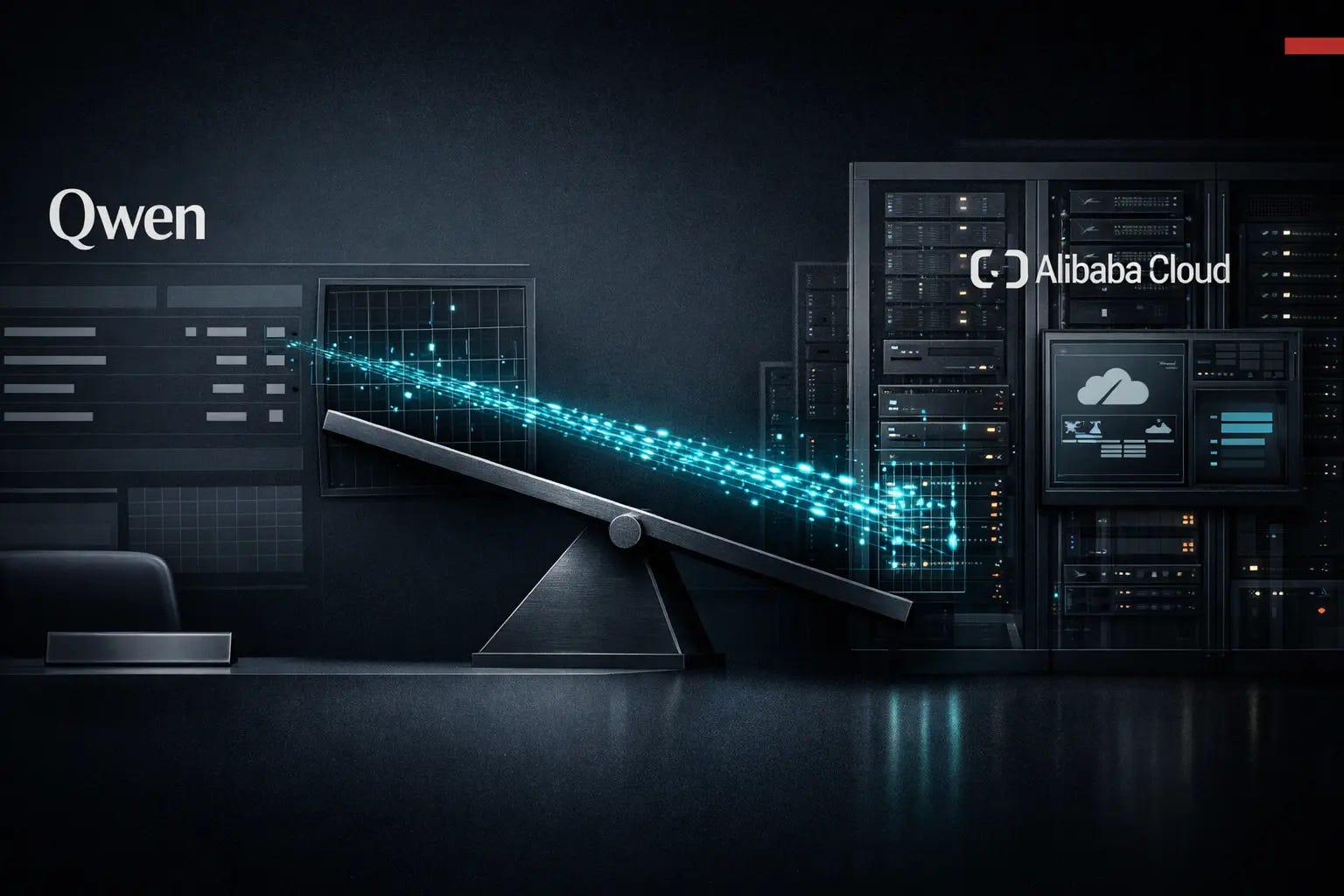
On March 4, at 1 AM Beijing time, Lin Junyang posted six words on social media: “me stepping down. bye my beloved qwen.”
Lin was not a mid-level departure. Alibaba’s youngest-ever P10, a senior technical rank that typically requires a decade of experience, he joined DAMO Academy in 2019 and was appointed technical lead of the entire Qwen model family when Alibaba formed Tongyi Lab in late 2022. He built the team. He led the open-source push. He was the face of Qwen in global developer communities. Two days before his exit, Alibaba had just unified all its model branding under the “Qwen” name, retiring the old “Tongyi Qianwen” label. Then the person most identified with Qwen walked out the door.
Within twelve hours, Tongyi Lab convened an emergency all-hands meeting. Leadership told the room that Qwen was not shrinking. This was an expansion. The base model, they said, was now the entire group’s top priority. The next morning, CEO Eddie Wu sent a company-wide email confirming Lin’s resignation, announcing a new “Foundation Model Support Group” led by himself and two senior executives, and closing with a line that read more like reassurance than strategy: “We will continue to uphold our open-source model strategy.” The sequence tells you this was not a planned transition: midnight departure, same-day emergency meeting, next-morning CEO letter. It was a shock that required stabilizing.
The restructuring that preceded Lin’s departure matters more than the departure itself. Under Lin, Qwen operated as a vertically integrated unit. Pre-training, post-training, infrastructure, multimodal: all under one leader. This structure optimized for speed: short decision chains, rapid open-source releases, fast community feedback loops. According to local media reports, that structure is now being dismantled. Alibaba is splitting the Qwen team along functional lines (pre-training, post-training, visual understanding, image generation) and merging each segment into the broader Tongyi Lab. The reorganization trades a founder-led sprint team for a corporate matrix. When a company says a project belongs to everyone, it usually means it no longer belongs to the person who built it.
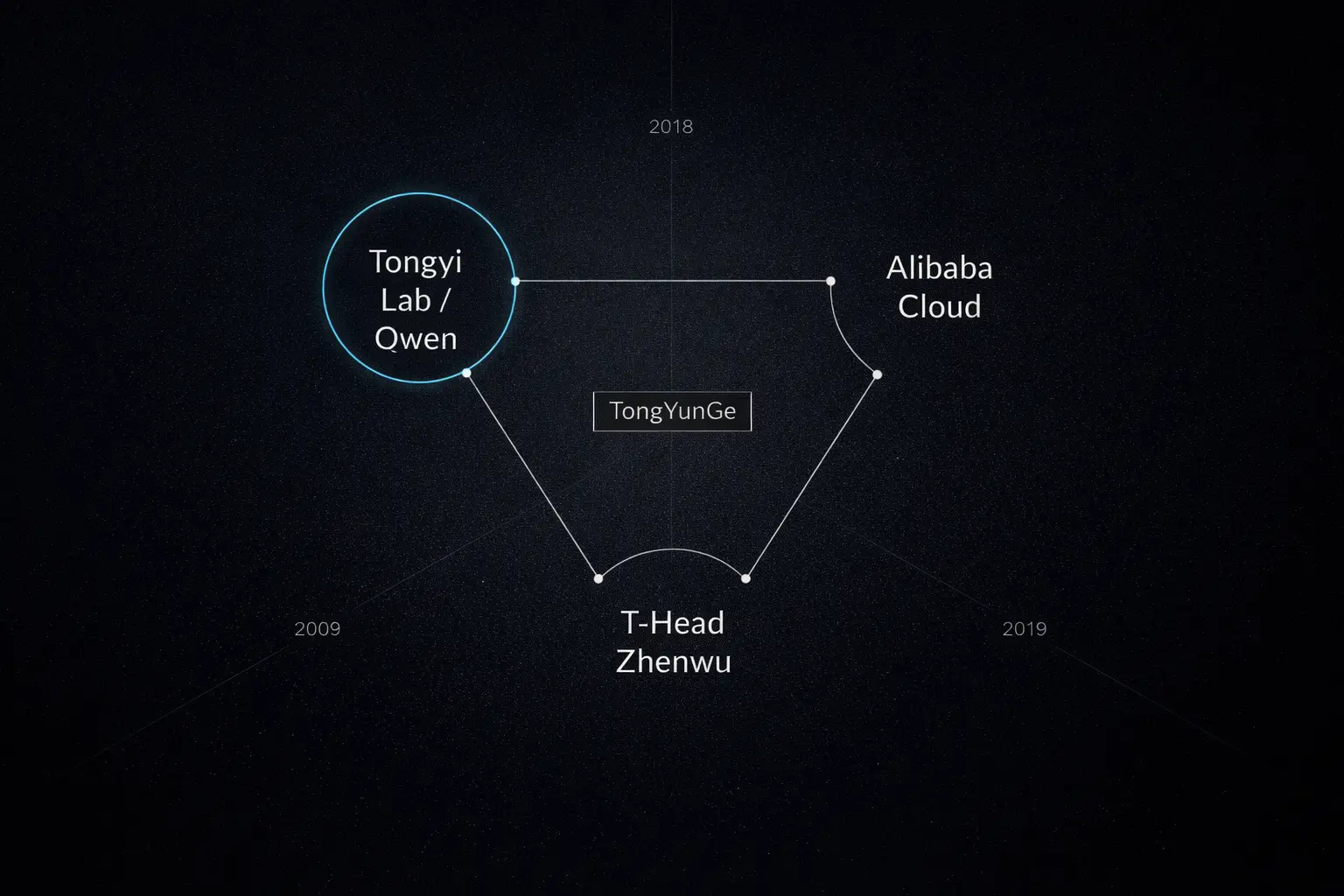
The reason is a three-character phrase: “TongYunGe(通云哥).” Ma reportedly coined the term internally in spring 2025, but it only surfaced publicly in recent weeks. A name in his trademark wuxia style for an architecture seventeen years in the making, from Alibaba Cloud’s founding in 2009 to Pingtougei’s creation in 2018 to the launch of large model research in 2019. It binds Tongyi Lab, Alibaba Cloud, and Pingtougei (Alibaba’s chip subsidiary) into the vertically integrated stack I analyzed in February: model as customer acquisition funnel, cloud as margin center, self-developed Zhenwu chips as the hardware floor. Only Google runs a comparable full-stack architecture. The reorganization serves TongYunGe, not Qwen.
Three pressures forced the timing. Alibaba committed RMB 380 billion to AI infrastructure last year and swung to a $2.6 billion quarterly free cash flow outflow. Capital at that scale demands returns in quarters, not years. The consumer AI front isn’t working either. Qwen App spent RMB 3 billion on a Spring Festival campaign and briefly topped the App Store, but by mid-February ByteDance’s Doubao had reclaimed #1. As of this week, Qwen sits at #4. The broader industry consensus is hardening: massive infrastructure bets without near-term revenue paths are unsustainable. 2026 is the year Chinese AI must commercialize or face a reckoning.
What to track from here. First, open-source release cadence. Under Lin, Qwen crossed one billion downloads and 200,000 derivatives. If the pace slows, or the most capable versions become cloud-exclusive, the organizational shift is also a strategic shift. Second, Alibaba Cloud’s AI-related revenue in the next two earnings cycles. The TongYunGe thesis predicts that Qwen drives cloud consumption. If the restructuring works, it shows up there.
The cloud funnel logic from February remains intact. Alibaba’s incentive to keep Qwen open and cheap hasn’t disappeared. But the person who built the funnel’s top layer is gone, and the organization is being rebuilt around the bottom layer. The strategy hasn’t changed. The center of gravity has.
Great points. I don't know if this is analagous to what's happening in the US, but cloud storage ain't so cheap anymore. Could we be heading to a point where consumers start choosing their AI universe based on integrated services? Why do I keep paying for three different cloud storage plans from Apple, Microsoft, and Google? Thanks to Gemini, I am really tempted to switch to a Gmail+Docs+Sheets+Gemini exclusive, all on Google Cloud. I am even thinking about finally dropping my iPhone and Macbook for a Pixel+Chromebook hardware setup because I can talk to Gemini more easily that way. What do you think is more likely in China?
Great writeup! Thanks, Poe. Such interesting times. I wonder what he does / where he goes next...