

From Principle to Price War
In late May, Fuli Luo, who leads Xiaomi’s MiMo large language model team, posted a technical explanation for why MiMo’s API prices had just dropped by up to 99 percent. A hierarchical KV cache optimization had increased cached token capacity by 5 times, she wrote, cutting caching costs by roughly 80 percent; the 99 percent headline reduction applied specifically to cache-hit input tokens, with broader input and output prices dropping 60 to 80 percent. The optimization lowered unit costs enough for MiMo to price its new API rates at near break-even, Luo argued.
In April, Luo had publicly argued that the AI industry’s rush to slash token prices was structurally unsustainable. Xiaomi’s own Token Plan, launched in April, was built on the opposite premise: a credit-based system that billed developers for tokens consumed rather than offering unlimited access at a flat rate.
Between those two positions, MiMo distributed 100 trillion free tokens to developers worldwide and briefly topped OpenRouter’s Hermes agent model rankings. By late May, MiMo-V2-Pro had fallen to 16th on the same ranking. Then came the permanent price cut, aligning MiMo’s rates with those of DeepSeek, the Chinese AI lab whose open-source models have set the industry’s pricing floor. The shift from structural pricing critique to competitive price-matching happened within the same reporting season.
Xiaomi’s Q1 2026 earnings, released the same week, supply the financial context. Revenue fell 10.9 percent year-on-year to RMB 99.1 billion. Adjusted net profit dropped 43.1 percent to RMB 6.1 billion. After reporting RMB 0.9 billion in operating income for full-year 2025, the segment housing both electric vehicles and AI posted a RMB 3.1 billion operating loss in Q1 2026.
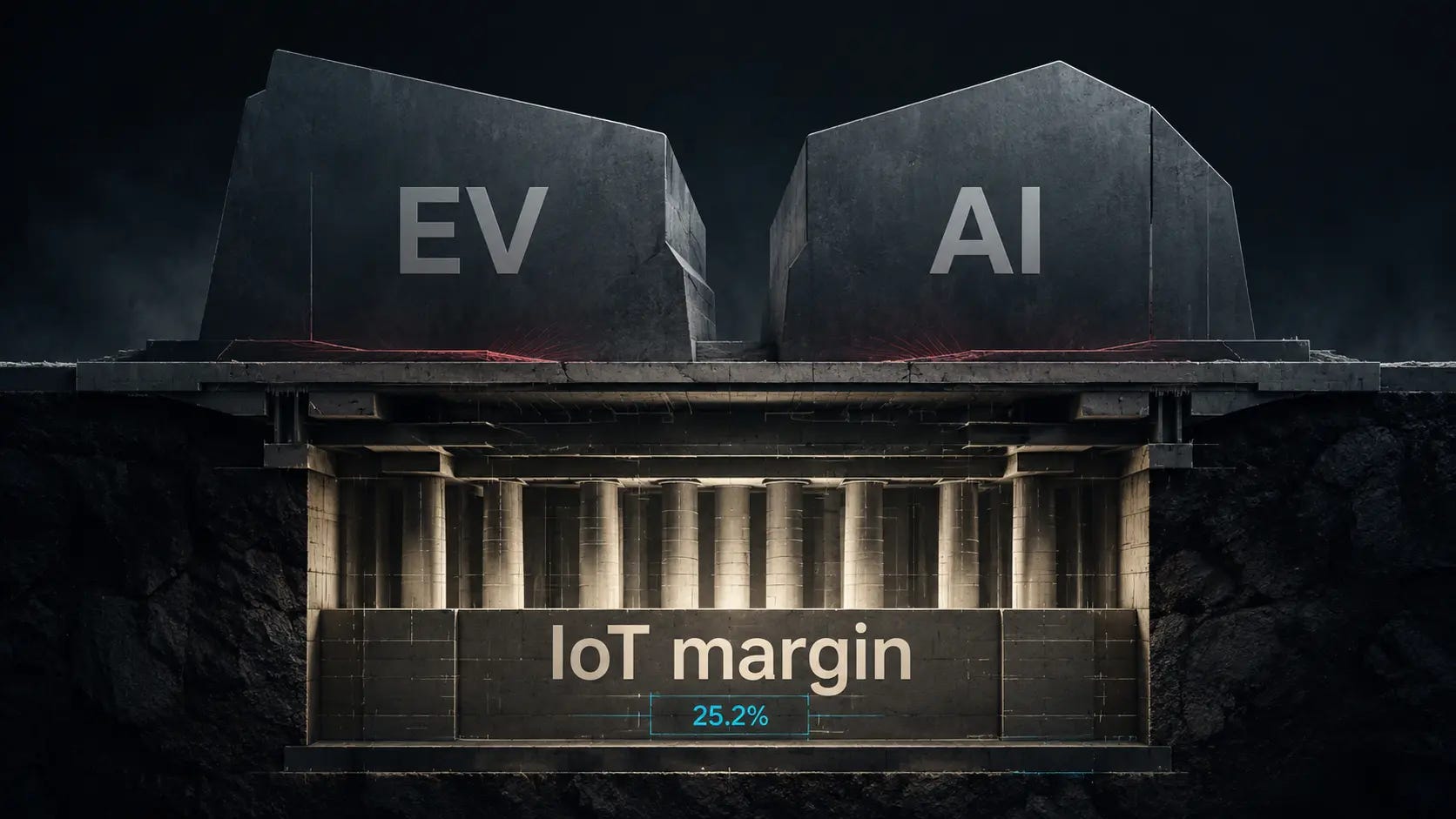
MiMo adds one more cost-sensitive front to a company already trying to protect margin across phones, cars, and IoT. The surface reads as broad-based weakness. The composition points to a more selective set of trade-offs. Xiaomi’s Q1 numbers read more clearly as four different businesses carrying four different burdens: smartphones preserve the user base, IoT supplies the margin buffer, EVs sustain the growth narrative, and AI absorbs the capital and R&D spending. Q1 reveals which of the four is bearing the most weight, and it is not the one that usually dominates the market narrative.
Shrinking on Purpose
A significant part of the revenue decline reflected deliberate trade-offs, though not every segment fits that pattern.
Smartphone shipments fell 19.2 percent year-on-year to 33.8 million units. Management described this as proactive control of mid-to-low-end inventory, a response to the memory cost supercycle that has been driving up component prices since mid-2025. Average selling price rose 8.2 percent to a record RMB 1,310, with premium models reaching 23.5 percent of mainland China sales. Xiaomi halted first-generation SU7 sales for two months to prepare the new-generation launch in March. Q1 EV deliveries of 80,856 units reflected the transition gap, not demand failure: the new SU7 accumulated over 80,000 configuration-locked orderswithin 48 days.
IoT was different. Its revenue fell 23.7 percent year-on-year to RMB 24.7 billion, pulled down by a subsidy-inflated prior-year quarter in China, though overseas IoT revenue hit a record high. The common thread across segments was not that every decline was chosen, but that Xiaomi kept prioritizing margin structure over headline revenue. Whether that margin structure could absorb the costs piling up elsewhere depended on the least visible of Xiaomi’s major hardware businesses.

The Q1 numbers reveal a company making controlled trade-offs across four business lines. The division carrying the most financial weight is the one that tends to receive the least attention. What follows starts with a margin comparison that reframes the entire story and asks how long the current structure can hold.
