

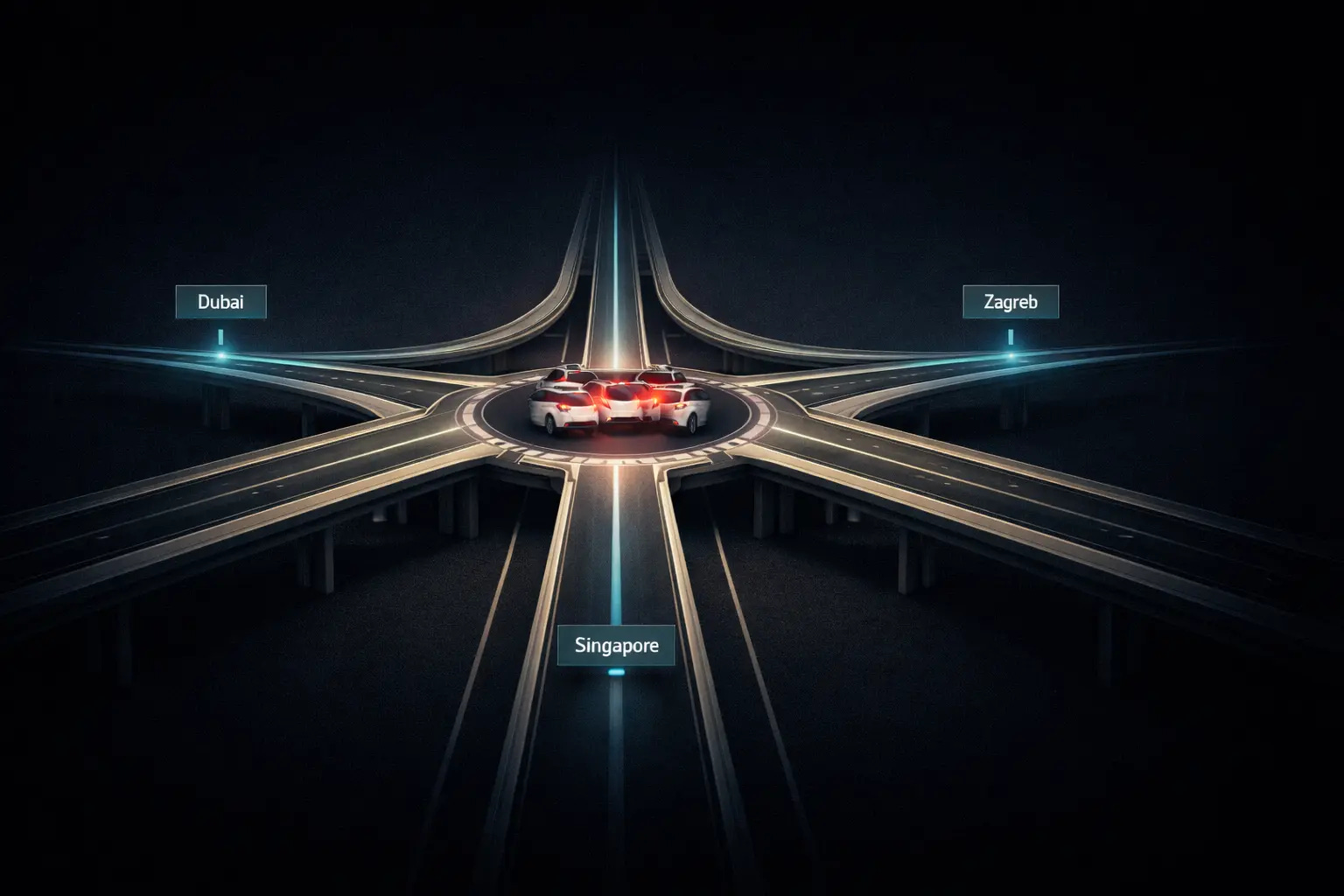
On March 30, Baidu’s Apollo Go began commercial driverless service in Dubai. Apollo Go is China’s largest robotaxi fleet, with over 20 million cumulative rides across 26 cities. The company signed an exclusive partnership with Dubai Taxi Company, the emirate’s largest state-owned taxi operator, and became the first platform in Dubai to offer fully autonomous rides through its own app. For Baidu, the internet search giant that has poured more than a decade of investment into autonomous driving, the Dubai launch extended a global footprint that already covers Hong Kong and Abu Dhabi.
The next evening, nearly a hundred Apollo Go vehicles stopped simultaneously on elevated highways across Wuhan, a central Chinese city of 13 million. Passengers found themselves trapped in stationary cars on busy motorways. SOS buttons did not respond. One rider reported waiting thirty minutes before reaching customer service by phone. Others were trapped for up to ninety minutes. Some passengers forced doors open and walked along highway shoulders to find their way out. Police reported the mass shutdown compressed three traffic lanes into one across the city’s Second and Third Ring Roads. No injuries were recorded. The fleet resumed operations the following day.
Apollo Go was not alone in making global moves that quarter. WeRide, a Guangzhou-based autonomous driving company that received a $100 million strategic investment from Uber in 2025, launched fully driverless commercial operations in Dubai. Grab, Southeast Asia’s dominant ride-hailing platform, began offering WeRide-powered robotaxis in Singapore as the region’s first autonomous ride service. Pony.ai, a Nasdaq-listed Chinese autonomous driving company, partnered with Uber and a startup called Verne to bring what they called Europe’s first commercial robotaxi service to Zagreb.
Three companies. Three regions. One quarter.
The expansion reflects a clear competitive calculation. Waymo, Alphabet’s autonomous driving subsidiary, now provides about 500,000 paid rides a week across 10 U.S. cities and says it is on track to reach one million a week by the end of 2026. Waymo has stayed within the United States. Chinese competitors see a window to secure partnerships and regulatory footholds in markets where autonomous driving policy is still being drafted.
The ambition behind the global push is understandable. The Wuhan incident complicates it. China’s robotaxi industry has entered a phase where the speed of its international expansion has outpaced the maturity of its operations. The vehicles can navigate foreign roads. The cloud infrastructure, remote monitoring systems, and emergency response chains that support those vehicles remain fragile under real-world stress. The financial models meant to underpin everything still depend on a handful of showcase cities and earnings that dissolve under scrutiny.
The pace of the global rollout is the strategy. Whether that pace is also the vulnerability is the question this industry has yet to answer.
