

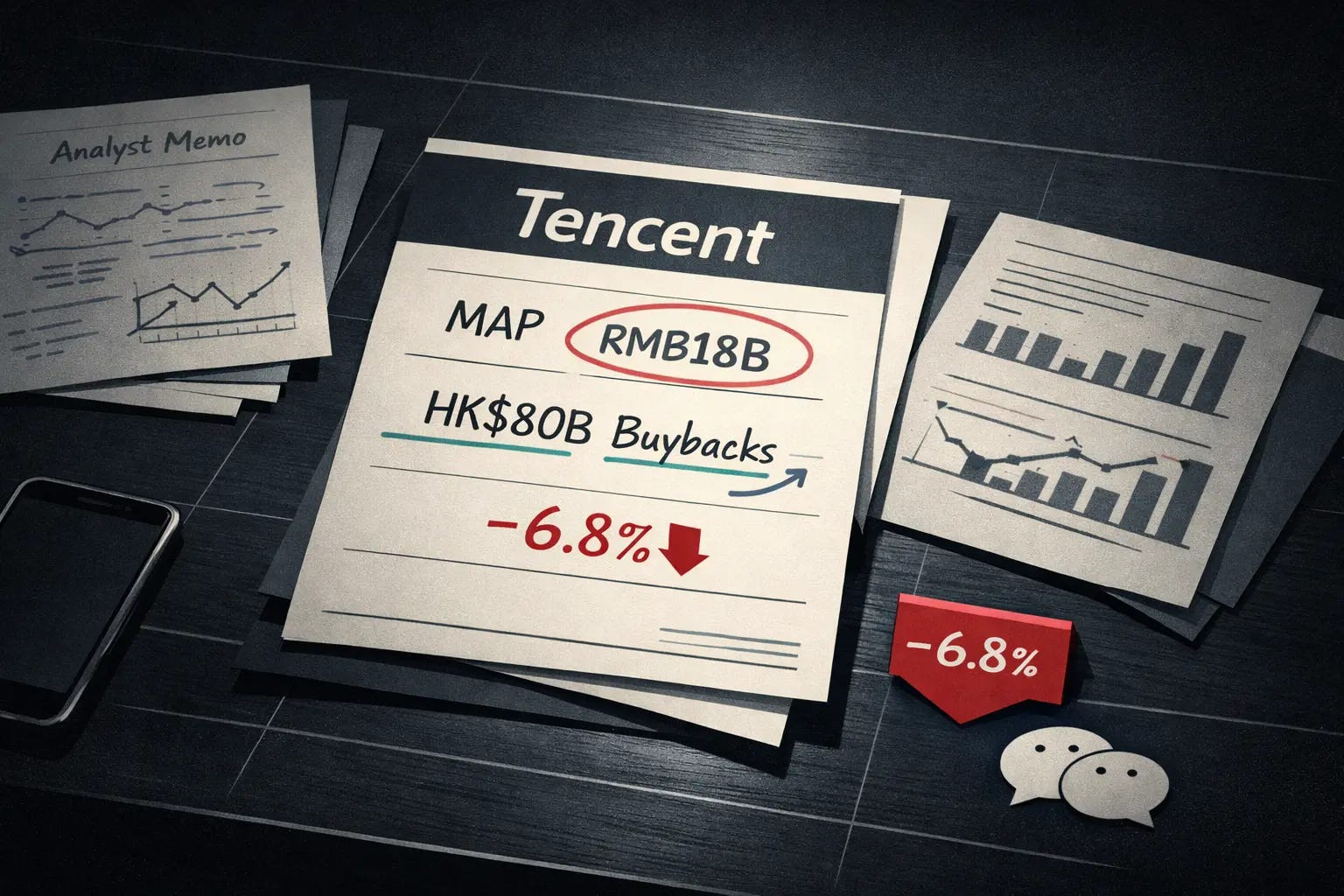
On March 19, the morning after Tencent reported its strongest annual results in years, the stock fell 6.8%. Roughly HK$340 billion in market value disappeared before lunch.
The financials themselves were hard to fault. Full-year revenue reached Rmb751.8 billion, up 14%. Non-IFRS net profit rose 17% to Rmb259.6 billion. Games revenue grew 22%, triple the rate of the global industry. Marketing services expanded 19%, outpacing China’s ad market by 5 percentage points. Tencent Cloud posted its first full-year profit at scale after more than a decade of losses. International games surpassed $10 billion in annual revenue for the first time.
Investors sold anyway, because of what came next.
During the earnings call, President Martin Lau disclosed that Tencent had spent Rmb18 billion on new AI products in 2025, with Rmb7 billion concentrated in Q4 alone. He said spending would “more than double” in 2026. To fund the increase, Tencent would reduce share buybacks, the single most important pillar of its capital return story over the past 3 years. Then Lau asked the market to do something unusual: view this AI spending not as an operating cost dragging on margins, but as a strategic investment comparable to capital expenditure or an equity stake in an affiliate. He wanted investors to assess its impact separately from the profits of the core business.
This is the earnings report in which Tencent asked the market to see two businesses inside one set of financials. One is a cash machine with expanding margins, dominant franchises, and resilient demand. The other is a loss-making AI venture that the cash machine is bankrolling. Management wants each judged on its own terms.
Every major platform company faces some version of this question: how to finance an AI transition from existing cash flows without the market treating the investment phase as permanent margin compression. Meta has navigated it through Reality Labs disclosures. Alphabet has done it through Google Cloud. Tencent’s answer, disclosing AI spending as a distinct line item and explicitly trading buybacks for AI investment, may be the most direct articulation yet.
Tencent’s financial disclosures this week go deeper than headline numbers. The company laid out a valuation framework for sustaining years of AI investment, explained why it believes the model race matters less than the interface race, and drew a specific historical analogy to justify the spending timeline. Below, we examine each layer of the bet and where the logic holds.
