


The Mirror Filing
In March, I dissected Unitree Robotics’ prospectus and found a number that reframed the entire humanoid robot sector: industrial applications accounted for just 9% of humanoid revenue. The world’s largest humanoid shipper by volume was, at its core, a research hardware company selling to labs, developers, and AI startups.
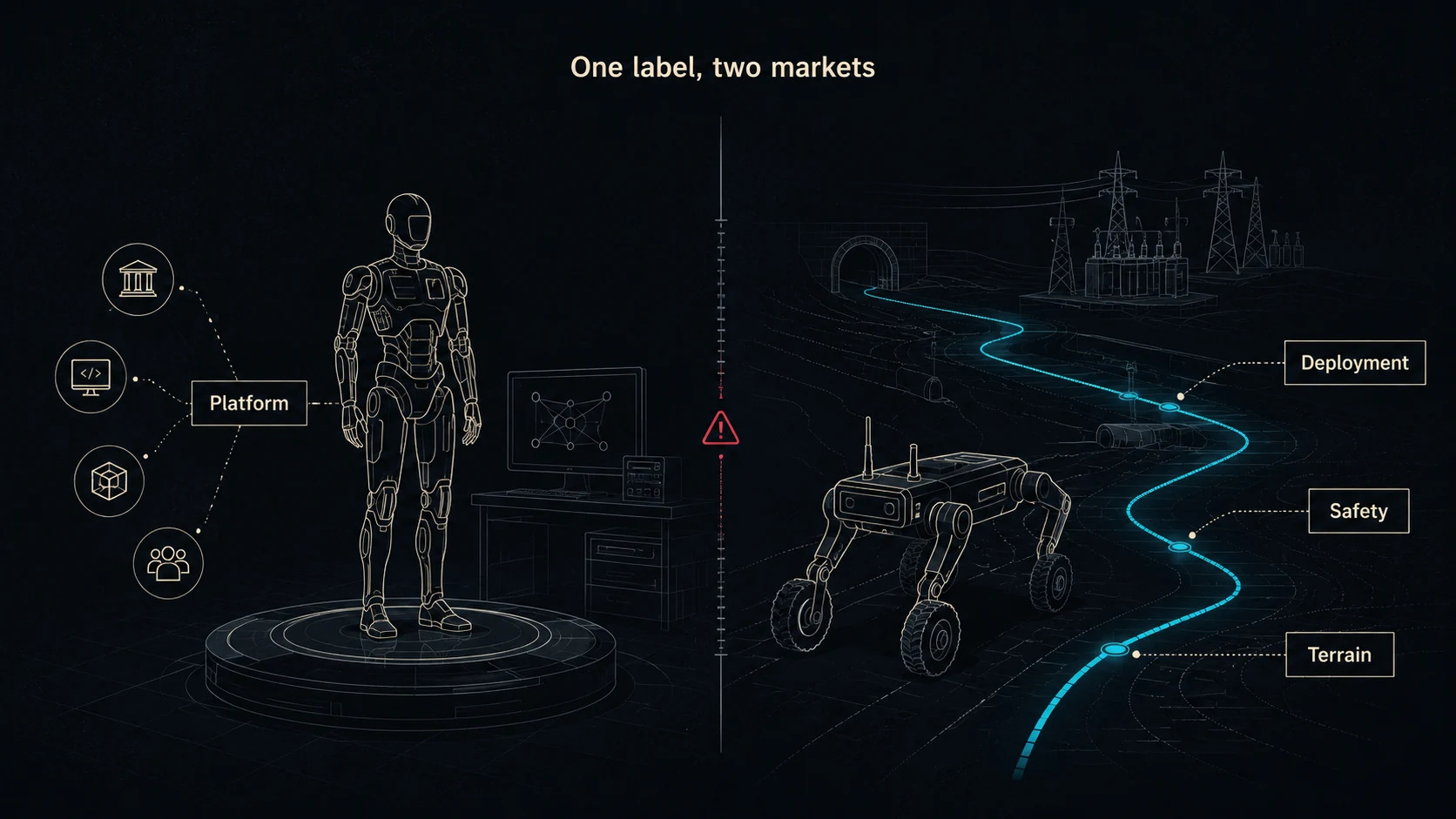
On May 18, the Shanghai Stock Exchange accepted a second IPO application from a Hangzhou robotics company in the “embodied intelligence” sector, the Chinese industry term for AI systems housed in physical robots. DEEP Robotics (云深处) filed to raise RMB 2.5 billion ($345 million) on the STAR board. Its prospectus tells the mirror story. Industry applications generated 79.33% of main business revenue in 2025. Power grids, fire departments, police and security operators, industrial facilities, infrastructure managers, and logistics companies purchased its robots for scheduled deployment. Same city. Same exchange. Same “embodied intelligence” label. A completely different business underneath.
According to Sullivan data cited in the filing, DEEP Robotics ranked first globally in industrial quadruped application revenue in 2025, second in overall quadruped revenue, and fourth in embodied-AI robot revenue.
The contrast between these two filings gives investors a clearer map of China’s embodied-AI industry than product demos or fundraising announcements provide. The sector operates as multiple parallel markets, differentiated by form factor and by who pays and why.
DEEP Robotics’ filing reveals what the robot business looks like when machines perform actual work in defined field environments, where terrain, safety, and reliability matter more than general-purpose intelligence. The economics differ from the research-hardware model in several important dimensions: smaller revenue base, slower growth curve, heavier deployment burden, longer sales cycles, and a value proposition that does not depend on a technological breakthrough that has not yet arrived.
A Different Growth Curve
DEEP Robotics’ financial trajectory looks like a hardtech company crossing from R&D into field revenue after years of investment.
Revenue grew from RMB 50.1 million in 2023 to RMB 337.5 million in 2025, a compound annual growth rate of 159.51%. The company turned profitable for the first time in 2025, reporting net income of RMB 28.68 million after losses of RMB 25.85 million and RMB 13.29 million in the preceding two years. Operating cash flow turned positive at RMB 63.75 million. Gross margins climbed from 33.48% to 52.83% over the same period.
These numbers describe a credible technology commercialization arc. They are not the explosive growth profile that Unitree’s filing revealed: RMB 1.71 billion in 2025 revenue, 60% gross margins, RMB 672 million in operating cash flow. DEEP Robotics generated roughly one-fifth the revenue and one-tenth the operating cash flow of its crosstown competitor.
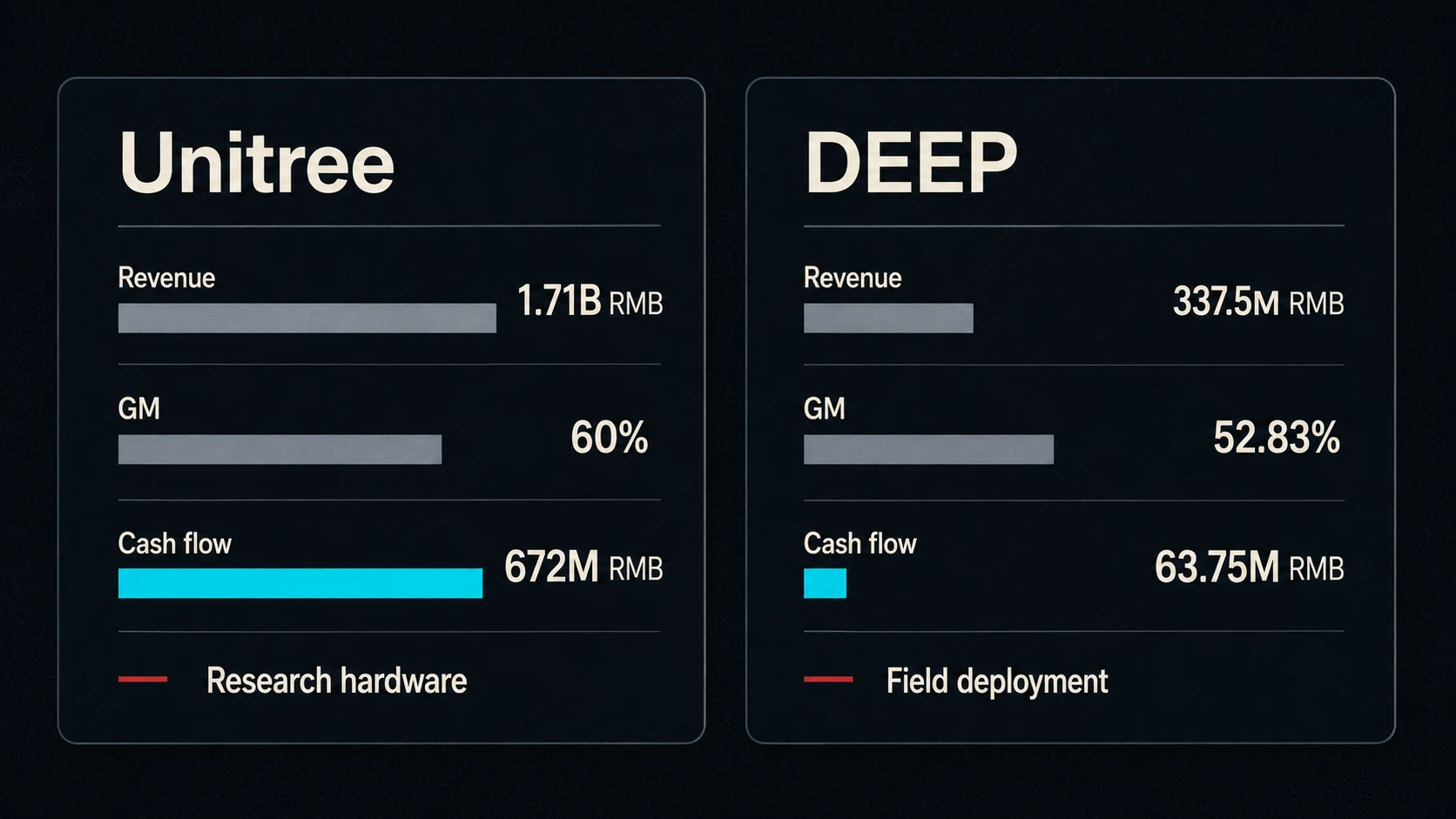
The margin expansion reflects manufacturing scale: unit production costs for the Jueying X series fell from RMB 230,300 in 2023 to RMB 131,200 in 2025 as procurement volumes grew, while revenue mix shifted toward higher-value models.
The scale gap points toward a structural difference in customer economics, not a difference in execution quality. Research hardware serves a broad, fragmented buyer base purchasing standardized platforms at accessible price points. Unitree sold over 3,500 humanoid units in the first nine months of 2025 at an average price of RMB 167,600. DEEP Robotics sold 681 Jueying X-series industrial quadrupeds at an average price of RMB 287,500 each. Higher prices, fewer buyers, longer sales cycles. The revenue per unit is larger. The path to scale is narrower.
The Safety Premium
The most consequential disclosure in DEEP Robotics’ filing is the breakdown of revenue by downstream application.
In 2025, RMB 267.3 million of main business revenue came from industry applications: power-grid inspection, emergency firefighting, police and security operations, industrial monitoring, infrastructure patrol, and logistics. The company has cumulatively sold more than 300 robots in power inspection, more than 300 in police and security, more than 150 in fire rescue, and approximately 300 in industrial settings. These are production deployments with cumulative volumes that suggest ongoing procurement cycles. The classification is based on the company’s disclosed understanding of customer use cases rather than independently audited end-use tracking.
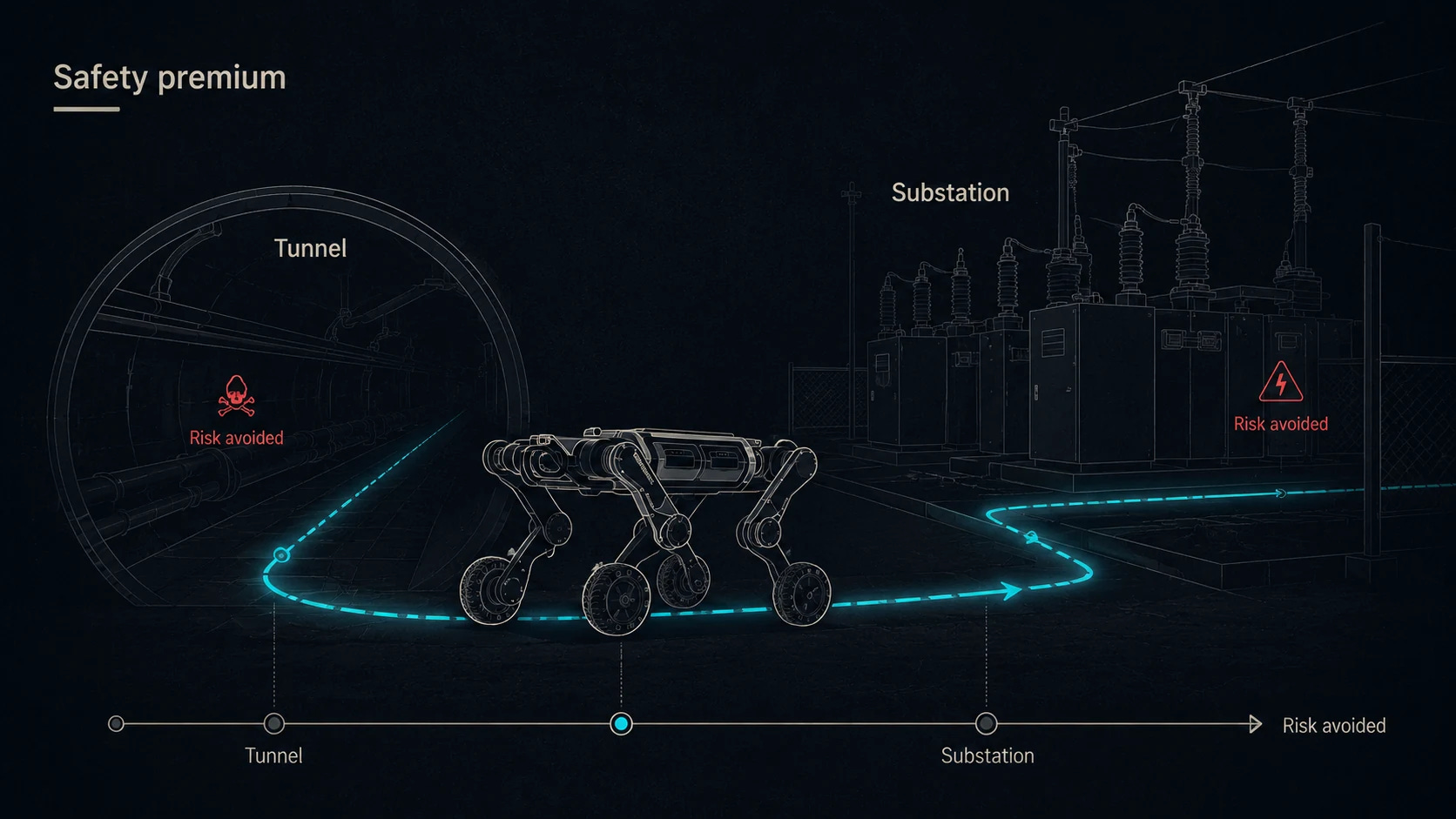
The value proposition bypasses what I have previously described as the binding constraint on industrial robot economics: the payback arithmetic of displacing low-cost labor. DEEP Robotics’ customers are not calculating whether a robot is more efficient than a human inspector. They are calculating whether a robot can enter environments where human presence carries unacceptable risk.
Utility tunnels with toxic gas accumulation where human entry requires evacuation protocols. Substation bays where high-voltage contact is lethal. These are environments defined not by labor cost but by the price of a single incident. A substation failure or a firefighter casualty creates losses that dwarf the RMB 287,500 average selling price of a Jueying X-series industrial quadruped.
This distinction matters for understanding the sector’s trajectory. DEEP Robotics’ 2025 numbers suggest that safety substitution can already support a profitable robot business within defined industrial domains. The machines do not need general-purpose cognition to walk a predetermined patrol route through a cable tunnel and report thermal anomalies. They need reliable locomotion, environmental hardening, and sensor integration. Its flagship industrial quadrupeds carry IP67 protection ratings and operate across temperature ranges of -20 to 55 degrees Celsius. These are industrial reliability specifications, not research prototype benchmarks.
This analysis continues below for Hello China Tech Premium subscribers. The free section above establishes what DEEP Robotics sells and who buys it. The paid section examines the more important question: why the company’s quadruped, wheeled-legged, and humanoid product lines appear to sit on three different commercialization timelines, and what that says about the future of China’s embodied-AI industry.
