

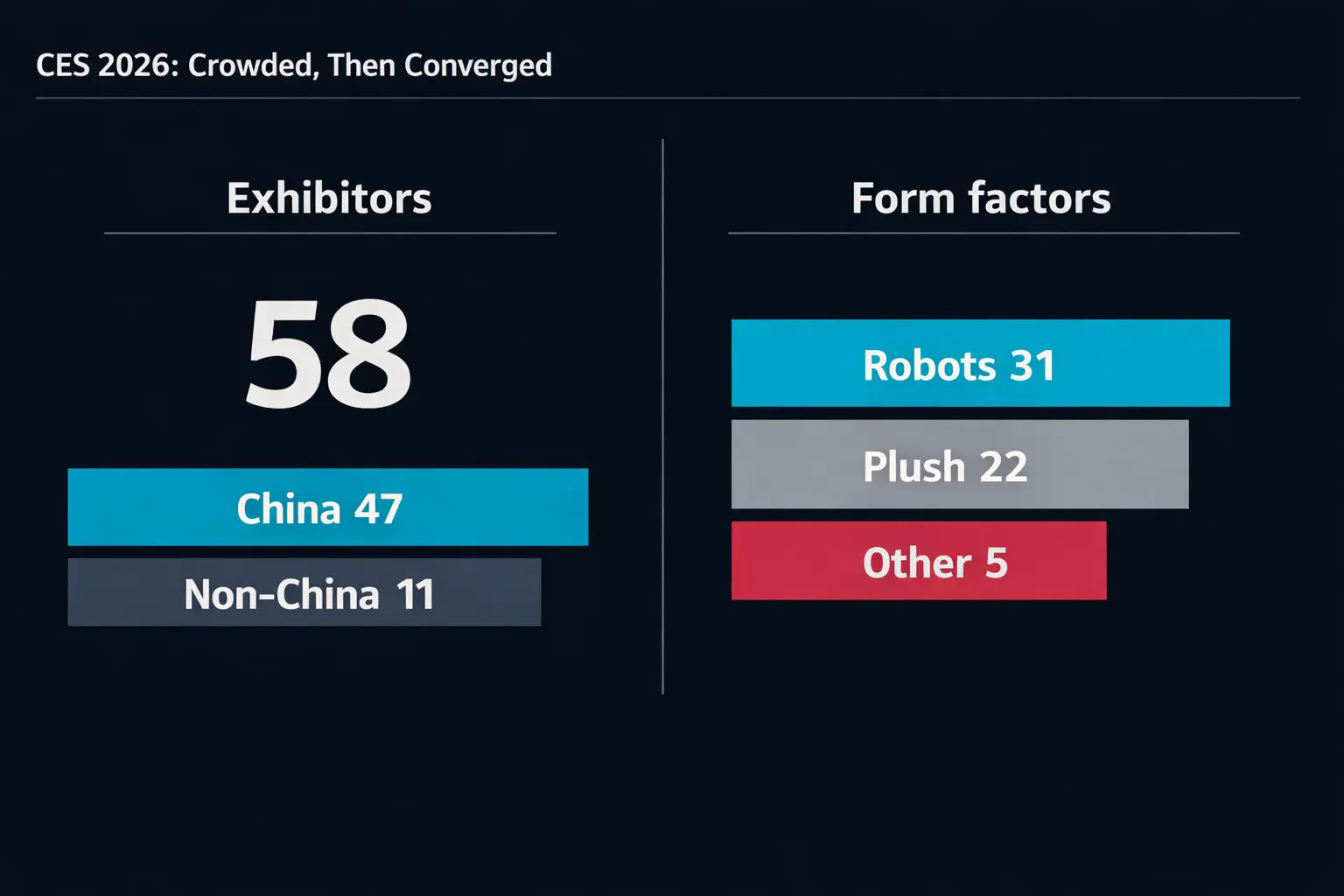
At CES 2026 in Las Vegas this January, the AI toy section told a story in two acts. In the first, nearly 50 Chinese companies unveiled conversational stuffed animals, desktop robot pets, and AI-powered figurines. They outnumbered non-Chinese exhibitors in the category by four to one. In the second, quieter act, visitors walking the booths noticed something else. Most of the products were hard to tell apart. Of the 58 AI toy and companion-robot companies on display, 31 were robot variants and 22 were plush variants. The form factors had converged. The underlying technology had converged, too.
Last October, I wrote about China’s AI toy explosion: a $3.5 billion market built on cheap large language models, the world’s most integrated supply chain, and a generation of children whose after-school tutoring vanished overnight under Beijing’s Double Reduction policy. My conclusion then was that an experiment was underway. China was shipping AI companions by the millions while the West was still debating whether it should.
Four months later, the experiment has early results, and they are sobering. The forces that made China the fastest mover in this space, cheap open-source models, efficient supply chains, and IP licensing, are the same forces now driving the product homogenization that undercuts user retention. China proved it can ship AI companions at scale. It has not yet proven that users will keep them turned on.
The Numbers That Impress
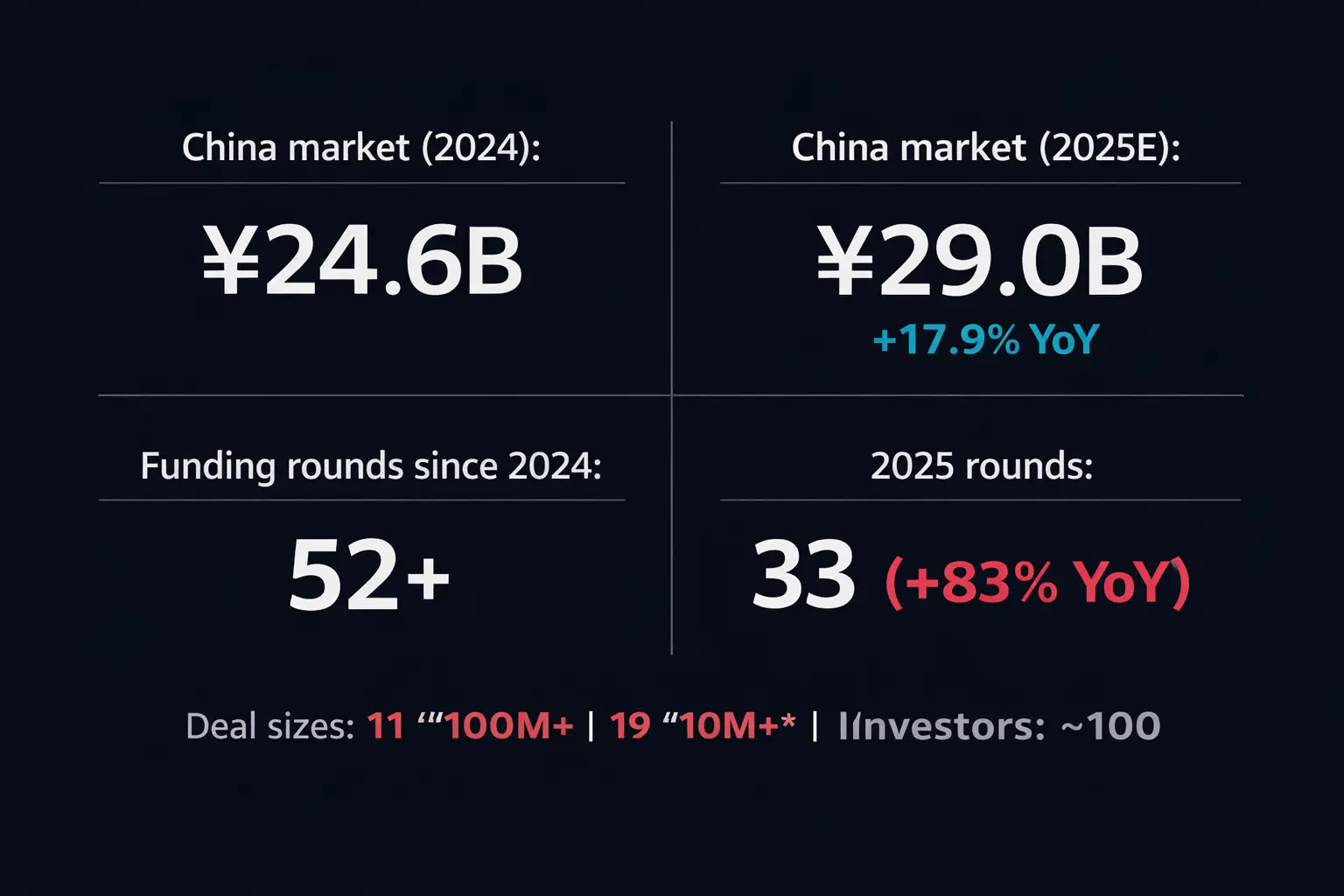
China’s Ministry of Industry and Information Technology disclosed that the domestic AI toy market reached 24.6 billion yuan ($3.4 billion) in 2024 and projected 29 billion yuan ($4 billion) for 2025, a 17.9% year-on-year increase. Multiple research firms estimate the global market will reach $36 billion to $60 billion by 2030, with China accounting for roughly 40%.
Capital has followed conviction. Since 2024, at least 52 funding rounds have closed in China’s AI toy sector, with 33 in 2025 alone, an 83% increase over the prior year. Nearly 100 investment institutions have entered the space. Sequoia China backed multiple companies in the same category within weeks. Zhu Xiaohu of GSR Ventures, one of China’s most pragmatic early-stage investors, called AI toys his “boldest bet of the year” and invested in one startup twice in three months.
Big tech has arrived. Huawei co-developed an AI plush toy that sold out its presale within days of its unveiling at a smartphone event, moving over 6,000 units on JD.comin 12 hours. ByteDance released an AI toy development kit through its cloud division. JD.com, China’s equivalent of Amazon, launched a full-stack AI toy platform called JoyInside that has connected over 40 hardware brands. Baidu and Ubtech, the robotics company, have both entered. By every growth metric, the industry appears to be reaching escape velocity.
The retention data tells a different story.
The Numbers That Don’t
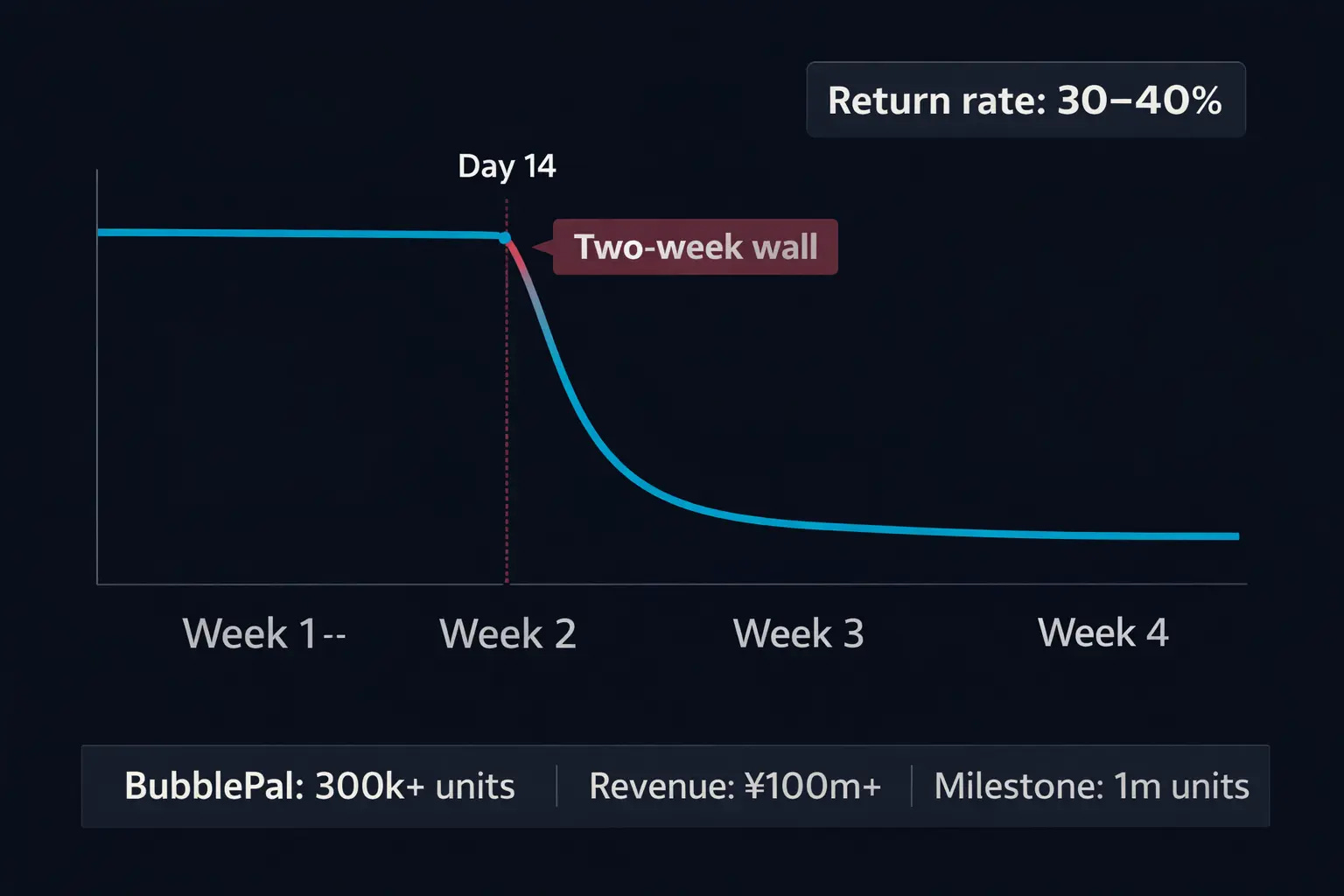
Return rates for AI plush toys on Chinese e-commerce platforms run between 30 and 40 percent. The market leader, BubblePal, has sold roughly 300,000 units since mid-2024, the highest figure for any AI toy globally. Its maker, Haivivi, has acknowledged that early return rates exceeded 30%, with the current combined rate still above 20%.
High returns are the visible symptom. The underlying condition is an engagement collapse that follows a consistent arc.
During the first two weeks, children use the toys eagerly, sometimes for hours a day. The novelty is genuine. Then the experience starts to degrade. Responses arrive after a perceptible delay, the product of a three-stage pipeline that converts speech to text, runs it through a language model, and converts the output back to audio.
For a four-year-old, even a brief pause is an invitation to walk away. When the child does speak, the toy frequently misunderstands. Children’s fragmented sentences and imprecise pronunciation overwhelm the speech recognition layer, producing answers that bear no relation to the question. Parents describe the tone as robotic, the dialogue as scripted. And even when a conversation works, it loops. Without long-term memory or sustained content refreshment, the repertoire exhausts itself within days. By the third week, an industry insider told Caixin, one of China’s most respected financial publications, many users stop turning the device on entirely.
No AI toy company currently dares to release its daily active user or monthly active user figures. In an industry built on the promise of daily companionship, that silence is itself a disclosure.