

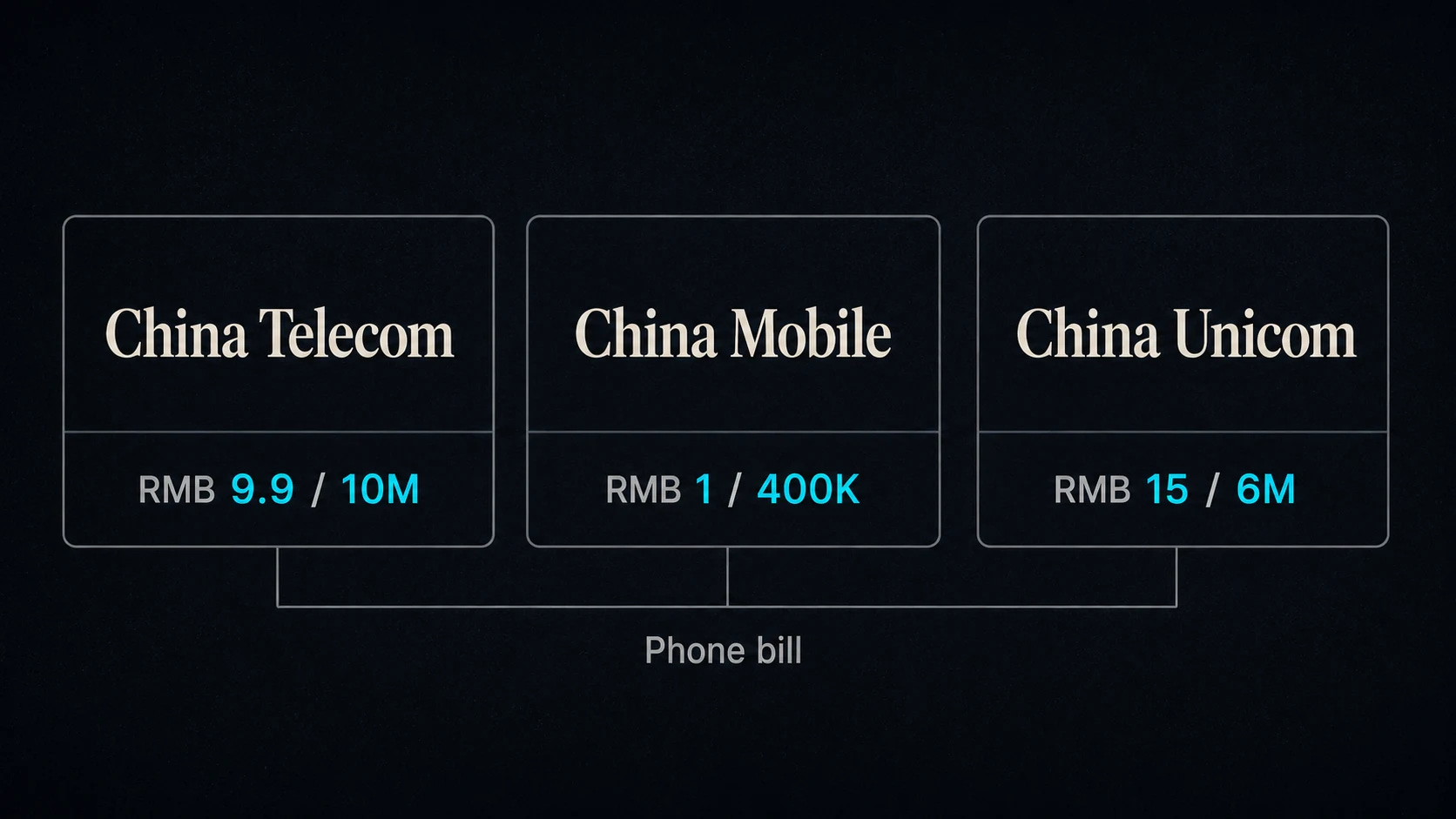
In May 2026, China’s three state-owned telecom carriers launched AI token subscription packages within days of each other. China Telecom, the country’s second-largest carrier by mobile subscribers, introduced consumer plans starting at RMB 9.9 per month for 10 million tokens. China Mobile, the largest carrier by revenue, began rolling out plans through provincial branches, with Shanghai pricing at RMB 1 per 400,000 tokens. China Unicom, the smallest of the three, offered packages from RMB 15 per month for 6 million tokens. Several of these plans support payment through existing phone bills. Users pay for AI inference the way they pay for mobile data.
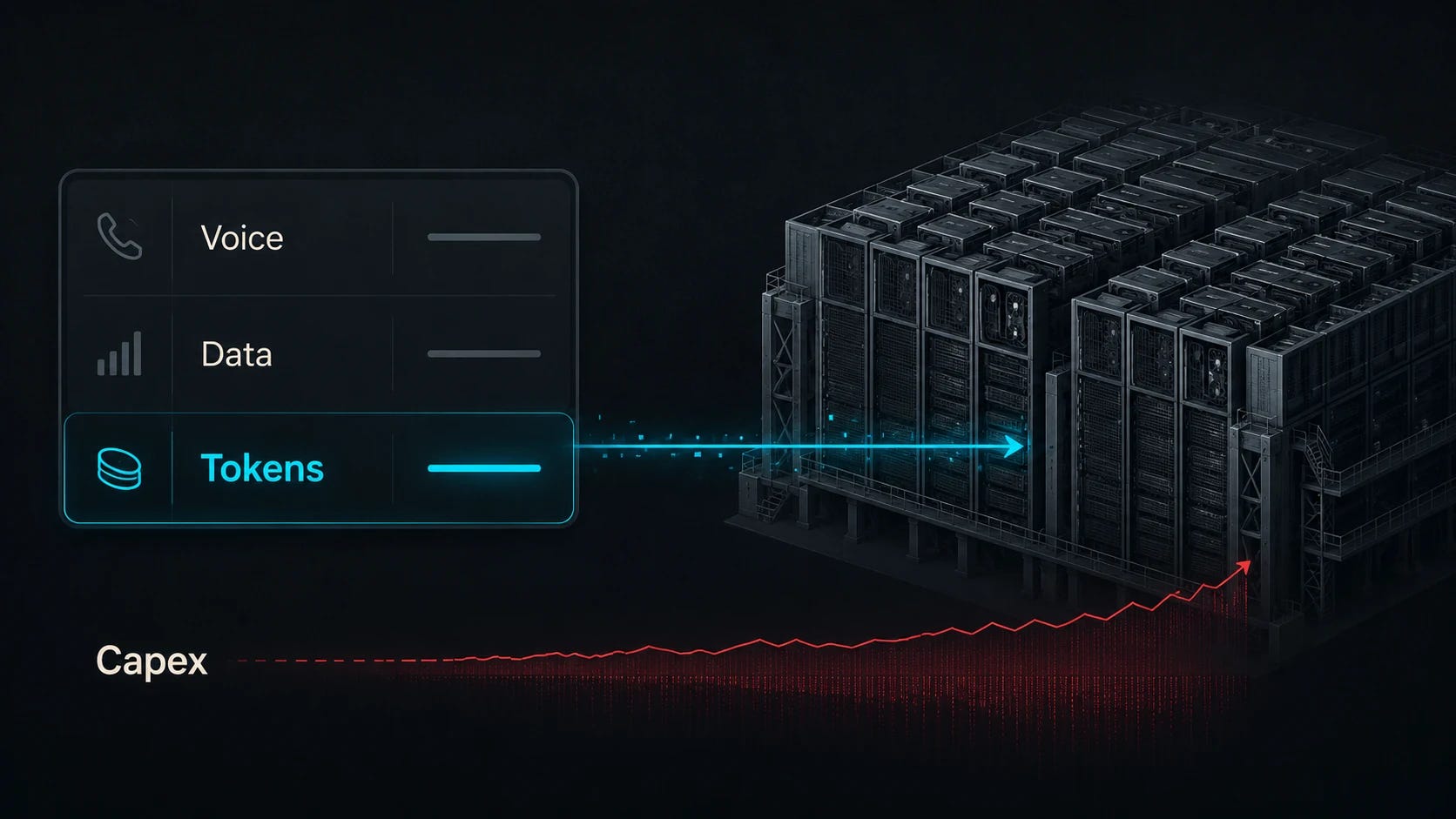
The unit has changed. The billing mechanism has not. That structural parallel is the carriers’ core bet. Over two decades, Chinese carriers sold two commodities: voice minutes and data gigabytes. Each followed the same lifecycle. Meter usage. Bill customers. Distribute through a national network. Serve hundreds of millions of subscribers. Token economics maps onto the same template. The carriers already own the metering systems, billing infrastructure, customer accounts, and last-mile networks to distribute a new commodity at scale.
The timing reflects necessity as much as ambition. In 2025, revenue growth at all three carriers fell below 1% for the first time in six years. China Mobile reported RMB 1.05 trillion in total revenue, up 0.9%. China Telecom grew 0.07%. China Unicom grew 0.68%. China Mobile’s ARPU, the average revenue per user, fell 3.5% to RMB 46.8. Its subscriber base reached 1.005 billion, with net additions of roughly 1 million for the full year. The growth model that powered two decades of expansion, more users consuming more data, is stalling.
The carriers have responded by redirecting capital toward AI compute. In May, China’s State Council placed computing networks in the same infrastructure-planning frame as water networks, new-type power grids, next-generation communication networks, urban underground pipeline networks, and logistics networks. China Telecom invested RMB 20.2 billion in compute infrastructure in 2025. For 2026, all three carriers plan to accelerate, with combined compute budgets approaching RMB 81 billion. China Mobile’s compute services revenue reached RMB 89.8 billion in 2025, up 11.1%. Compute and intelligent services together accounted for 20.2% of core service revenue. Spending on infrastructure and earning returns from it, however, are different problems.
Daily token consumption in China rose from roughly 100 billion in early 2024 to 140 trillion by March 2026. The OpenClaw wave in early 2026, when open-source AI agents began moving from developer circles into cloud-PC and one-click deployment scenarios, gave carriers a proximate trigger for packaging inference as a billable product. The question is whether the infrastructure advantages that made them dominant in voice and data can transfer to a market where model quality, application design, and trusted delivery all shape user value. As of late May 2026, no major Western carrier has launched a comparable consumer-facing token package. And the financial risks echo a precedent the carriers know well.
Three state carriers are betting that token distribution is the next iteration of their core business. What follows examines whether the economics support that bet, why Western carriers are taking a different AI route, and why the 5G investment cycle casts a long shadow over the entire effort.
