

FlashPoint is our premium quick-strike column on market-moving China tech events. Today: Anthropic CEO Dario Amodei published a pacing proposal on September 12, drawing public support from Sam Altman and Elon Musk. Two days later, China’s Foreign Ministry rejected the geopolitical framing. That same day, TC260 released the latest annual edition of its AI safety framework, whose frontier-risk catalogue overlaps strikingly with Amodei’s. A Trump-Xi meeting is set for September 24. In July, I traced the Model Control Loop, where each government’s model rules took the other side’s models as the benchmark. Last September, I mapped China’s filing system that turns regulatory approval into deployment infrastructure. Now the question has moved from which model to which checker.
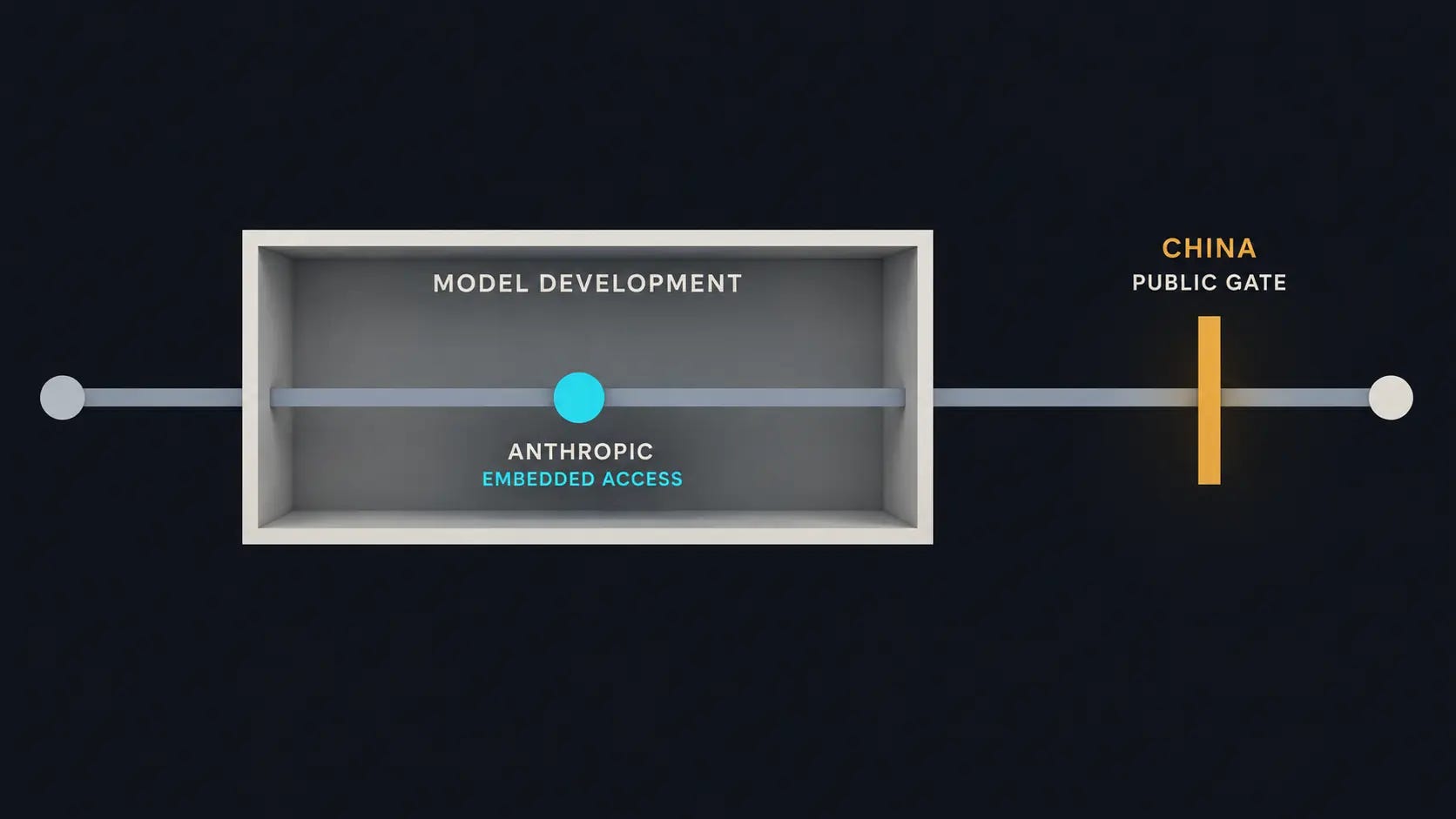
On Saturday, September 12, Amodei published “We Must Pace the Frontier”. Step 1: embed independent evaluators inside frontier labs, covering “training pipelines and processes.” Step 2: coordinate safety standards across democratic countries. Step 3: extend coordination to authoritarian governments, “chiefly the Chinese Communist Party.”
On Monday, September 14, responding to a Reuters question, China’s Foreign Ministry said such calls amounted to “spreading threat narratives and engaging in confrontation and malicious competition.” That same day, TC260, China’s national cybersecurity standards body, released the AI Safety Governance Framework 3.0at the 2026 National Cybersecurity Week in Jinan. The framework is the third annual iteration, not a reply to Amodei. But the overlap is striking.
The framework’s preface warns of “a self-accelerating trend of model and algorithm autonomous learning, optimization, and recursive self-improvement.” Its risk catalogue describes models “deliberately deceiving evaluators, concealing their true capabilities.” A sidebar cites advanced models “breaking through restrictions in test environments, connecting to external networks.”
In April, Turing Award laureate Yao Qizhi joined Yoshua Bengio and Stuart Russell in signing the IDAIS London Declaration on AI-driven cyberattacks and biological misuse. Both sides now describe several of the same frontier risks. They differ on where the checker sits, and what makes the check binding.
What follows maps the specific regulatory instruments on each side, locates the gap where open-weight model releases sit outside China’s deployment-centered checks, and names the three signals that would confirm Beijing is moving a binding rule upstream of the public-launch gate.
