


Three Signals Behind One Metric
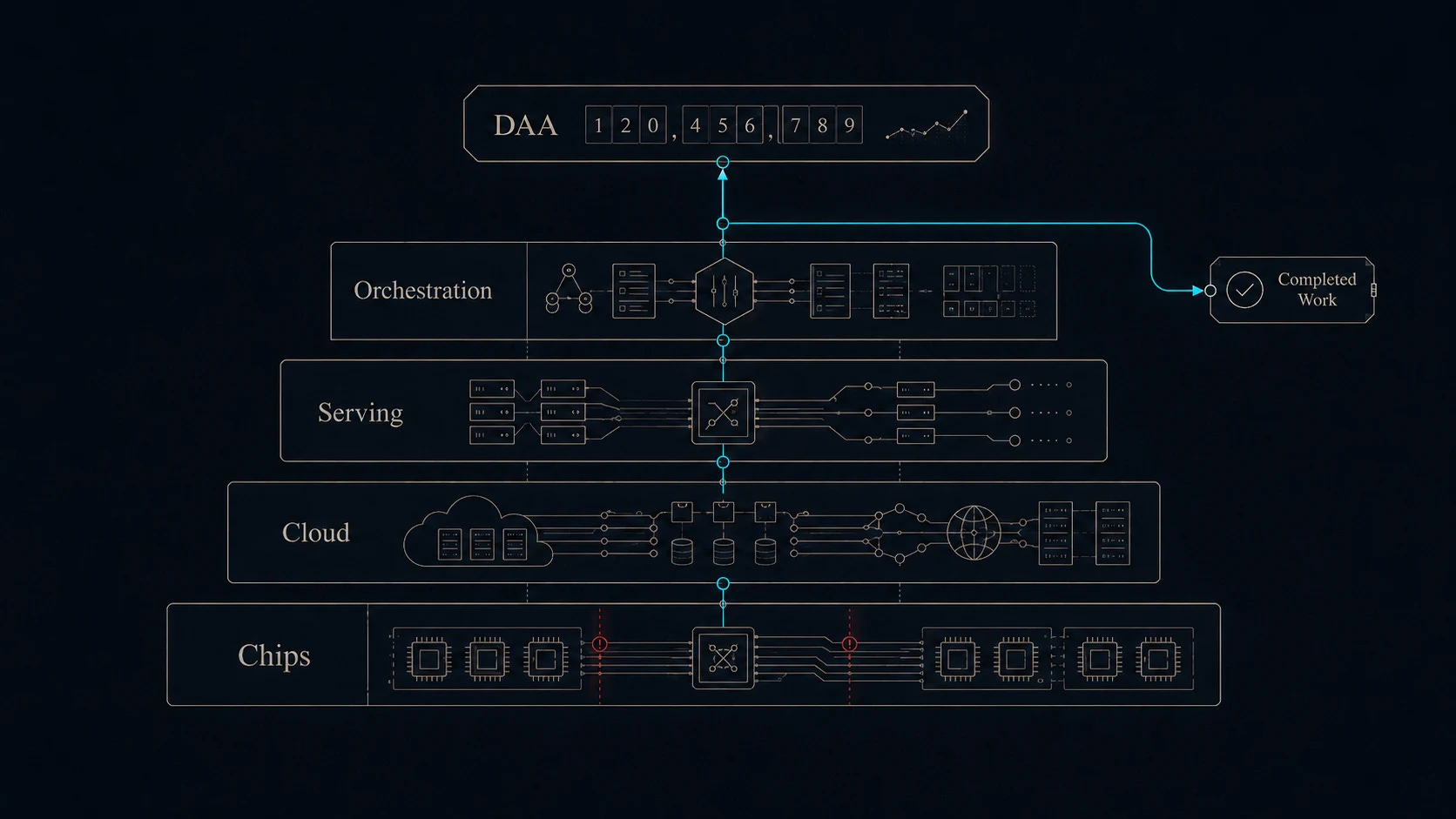
On May 13, Robin Li took the stage at Baidu’s annual developer conference and proposed a new unit of measurement for the AI era. He called it DAA: Daily Active Agents. The number of AI agents completing work and delivering results each day.
The framing was deliberate. Token consumption, Li argued, measures input. DAA measures output: how many agents are completing work and delivering results. Li predicted global DAA could eventually exceed 10 billion.
A new metric from a conference keynote would normally register as marketing. Three structural moves underneath it suggest otherwise.

First, Baidu changed how it reports revenue. Starting in late 2025, the company stopped splitting its business into “advertising” and “non-advertising.” The new structure breaks out Baidu Core AI-powered Business, which includes AI cloud infrastructure, AI applications, and AI-native marketing services. That category generated Rmb 40 billion ($5.7 billion) in 2025, growing 48% year over year. This is a company telling investors: judge us as an AI infrastructure firm, not a search advertising firm.
Second, Baidu has repositioned ERNIE from a standalone consumer story toward an infrastructure engine for the agent layer. Wenxin Assistant remains sizable: Baidu reported 202 million monthly active users for ERNIE Assistant in its Q4 2025 earnings. But the company’s strategic narrative at Create 2026 was increasingly centered on agents, cloud, and full-stack AI infrastructure. ERNIE’s role is increasingly to power the agent layer above it, rather than to win a pure consumer-attention battle against ByteDance’s Doubao, Alibaba’s Qwen, or Tencent’s Yuanbao.
Third, the product announcements at Create 2026 filled in what the new game looks like. DuMate (百度搭子), a general-purpose work agent. A code-generation platform (秒哒) that, according to Baidu, has produced over 1 million applications for more than 10 million users. A decision-optimization agent (伐谋) deployed in logistics routing, manufacturing scheduling, and financial risk management. A multi-agent digital human platform (百度一镜) for e-commerce and content production. These are not primarily chat interfaces. They are execution-oriented products, and their workloads can consume far more tokens than ordinary conversational AI.
These three signals encode the same structural judgment: in a market approaching billions of agents, the race to build agents matters less than the race to build what agents run on. Baidu has oriented its entire stack toward that objective: chips (Kunlun P800, with 256-card super-node systems that Baidu says will become available in June), cloud (a redesigned AI cloud optimized for agent workloads), model serving (KV Cache pooling, P/D separation, global inference scheduling), and agent orchestration (sandboxes, long-context management, sub-agent coordination, skill libraries).
The judgment is partly earned, partly forced. Baidu holds assets that compound in an infrastructure game: proprietary chips, a mature cloud business, two decades of search-scale data engineering. It lacks the content ecosystem or transaction network that would give a consumer agent natural distribution. But the same thesis is visible in companies that face no such constraint, which suggests something broader is at work.
Payment Rails, Device OS, National Standards
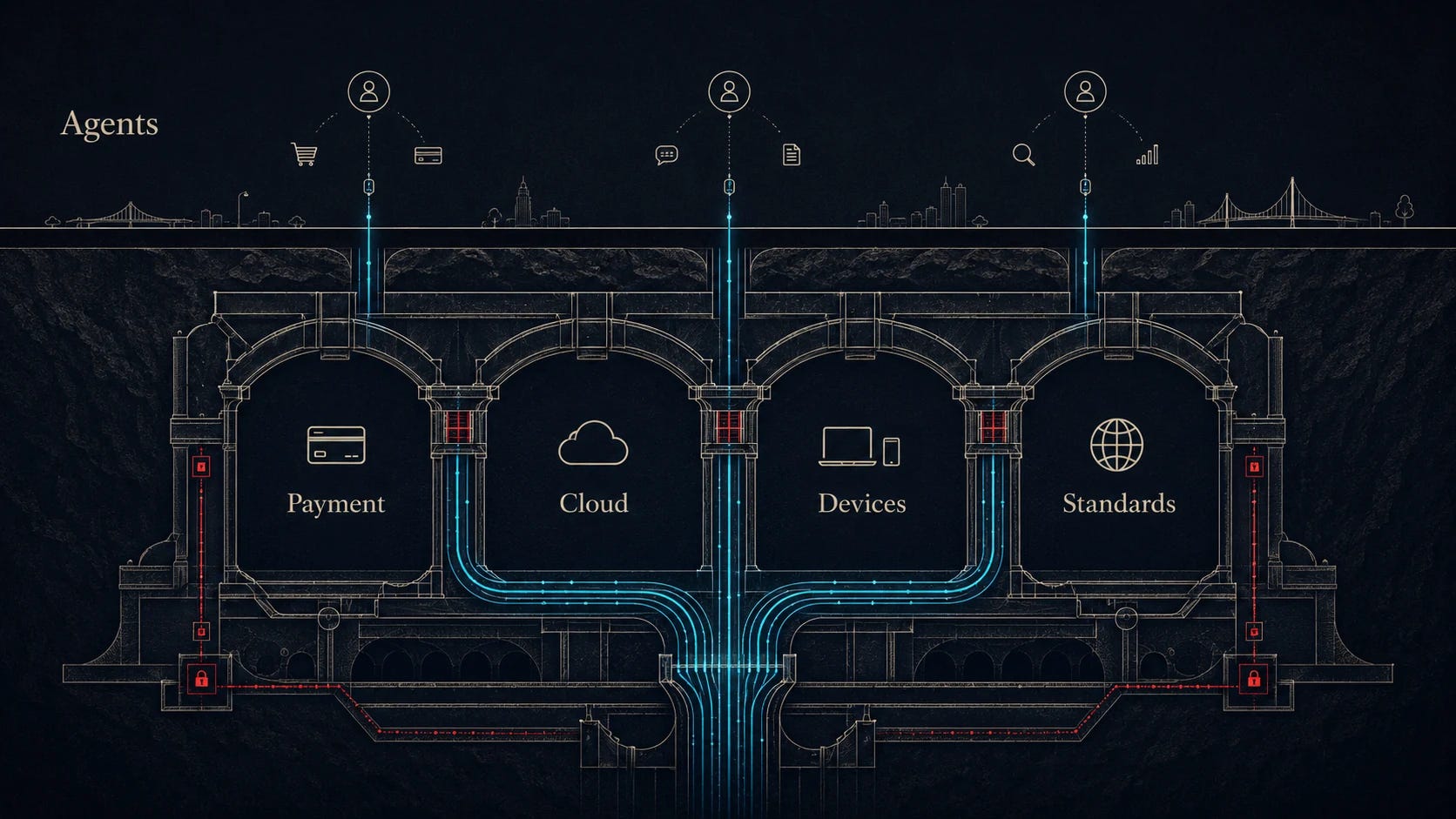
Baidu’s positioning becomes legible alongside what other Chinese companies are building. Each occupies a different layer of the same stack.
Ant Group, Alibaba’s fintech affiliate, is building the payment rails. Alipay AI Pay surpassed 100 million usersin February 2026 and processed over 120 million transactions in a single week. More structurally, Ant launched AI Collect (支付宝 AI 收) in April, enabling agents built on frameworks like OpenClaw to charge users per-task through Alipay. Ant researchers frame AI payments in three evolutionary levels: Level 1, where AI triggers payment but the user confirms; Level 2, where AI pays autonomously within preset limits; Level 3, full autonomous payment, which remains in standard-setting discussions. Ant’s security teams are also framing the problem around KYA (Know Your Agent): agent identity verification, transaction intent validation, permission boundaries, and audit trails. This is a governance framework under development, not a single shipped product.
This matters because execution without settlement remains a demonstration, not a product. An agent that books a hotel but cannot pay for it has not completed a task. Ant is solving the last step: how agents transact, who authorizes them, and who bears liability when they err. The contrast with the US is not that America lacks payments. It is that China’s most visible agent-commerce experiments are already tying payment to authorization levels, agent identity, and transaction audit trails, making agent payment a new trust layer rather than a new checkout flow.
Xiaomi is building the device-level embedding. Its MiMo-V2-Pro model, with over 1 trillion total parameters and 1-million-token context, powers miclaw, a system-level AI agent integrated into Xiaomi’s HyperOS. Xiaomi began a limited closed beta for miclaw on March 6, with a broader agent ecosystem platform moving into public testing in April. CEO Lei Jun committed at least Rmb 60 billion ($8.7 billion) to AI over 3 years. Xiaomi ships phones, cars, and more than 800 million connected IoT devices, based on prior company disclosures. If system-level agents are eventually embedded across that fleet, they gain native access to device context that app-layer agents cannot obtain. Xiaomi controls the hardware and OS surface where such deployment can happen without permission from any super-app.
As I examined in my analysis of how OpenClaw conquered China, system-embedded agents from device makers may matter more than open-protocol frameworks over the long term. They occupy a position that tools requiring manual deployment structurally cannot reach.
The Chinese government completed the picture on May 8 by issuing two documents simultaneously. Three ministries published implementation guidelines defining agents as “intelligent systems with autonomous perception, memory, decision-making, interaction, and execution capabilities,” identifying 19 application scenarios, and establishing a tiered governance framework. The same day, a separate multi-ministry group released a national standard (GB/Z 177–2026)creating a grading framework for AI terminal intelligence across categories such as phones, PCs, TVs, glasses, vehicle cockpits, speakers, and earbuds.
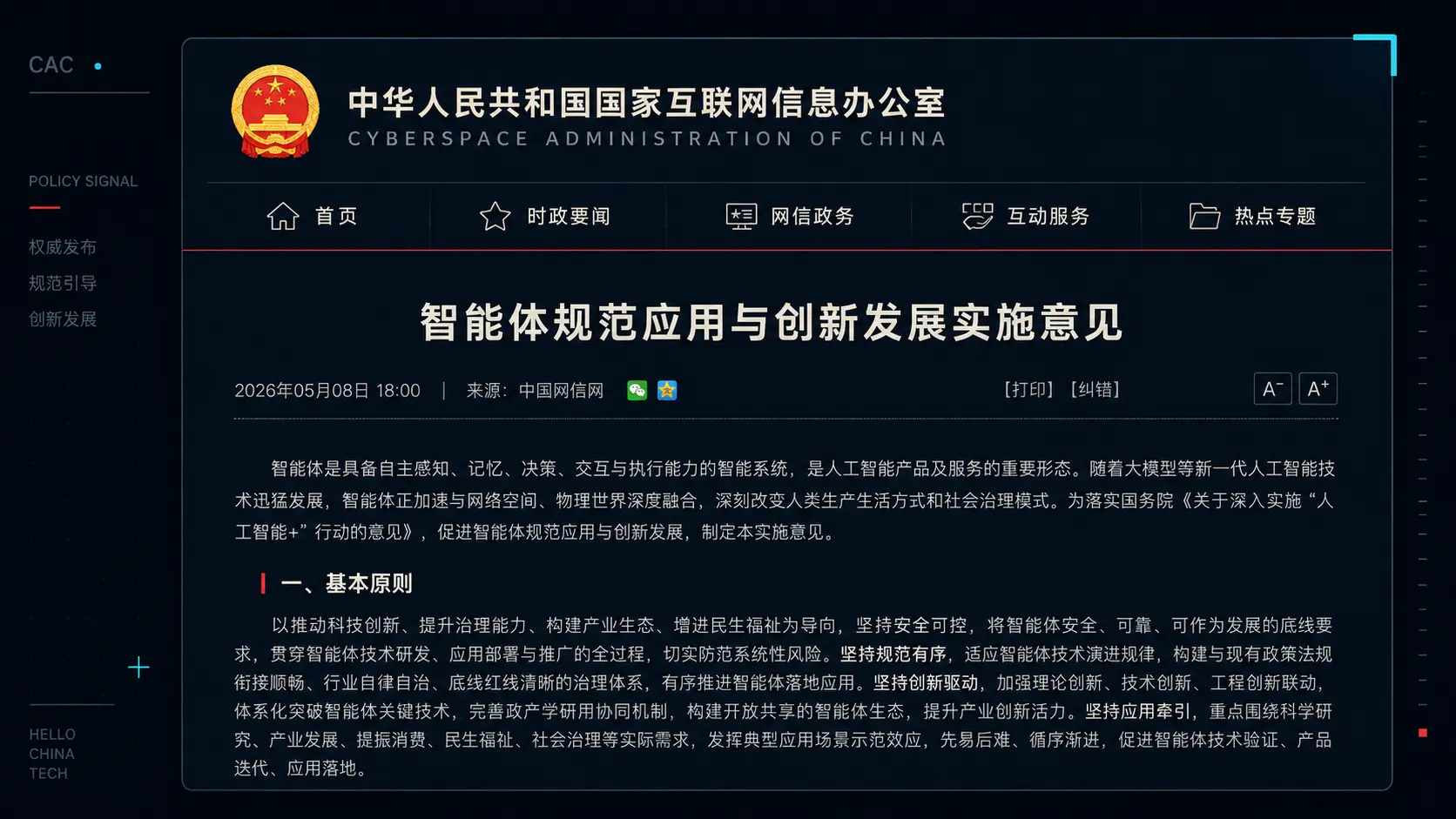
Few major economies have attempted to standardize both the software entity and its hardware carrier simultaneously at the national level. The US leaves these definitions to market competition. The EU regulates by risk category without defining product form. China chose to build the coordinate system itself, defining what an agent is and grading what it runs on in a single policy gesture.
The pattern across Baidu, Ant, Xiaomi, and the regulatory apparatus answers a “what” question: China is constructing the infrastructure layer for an agent economy. The harder questions follow. Why does China’s approach diverge from America’s? What does “Harness Engineering” mean for competitive positioning? And if China’s agent economy does not monetize through SaaS subscriptions, what does its business model look like?
