

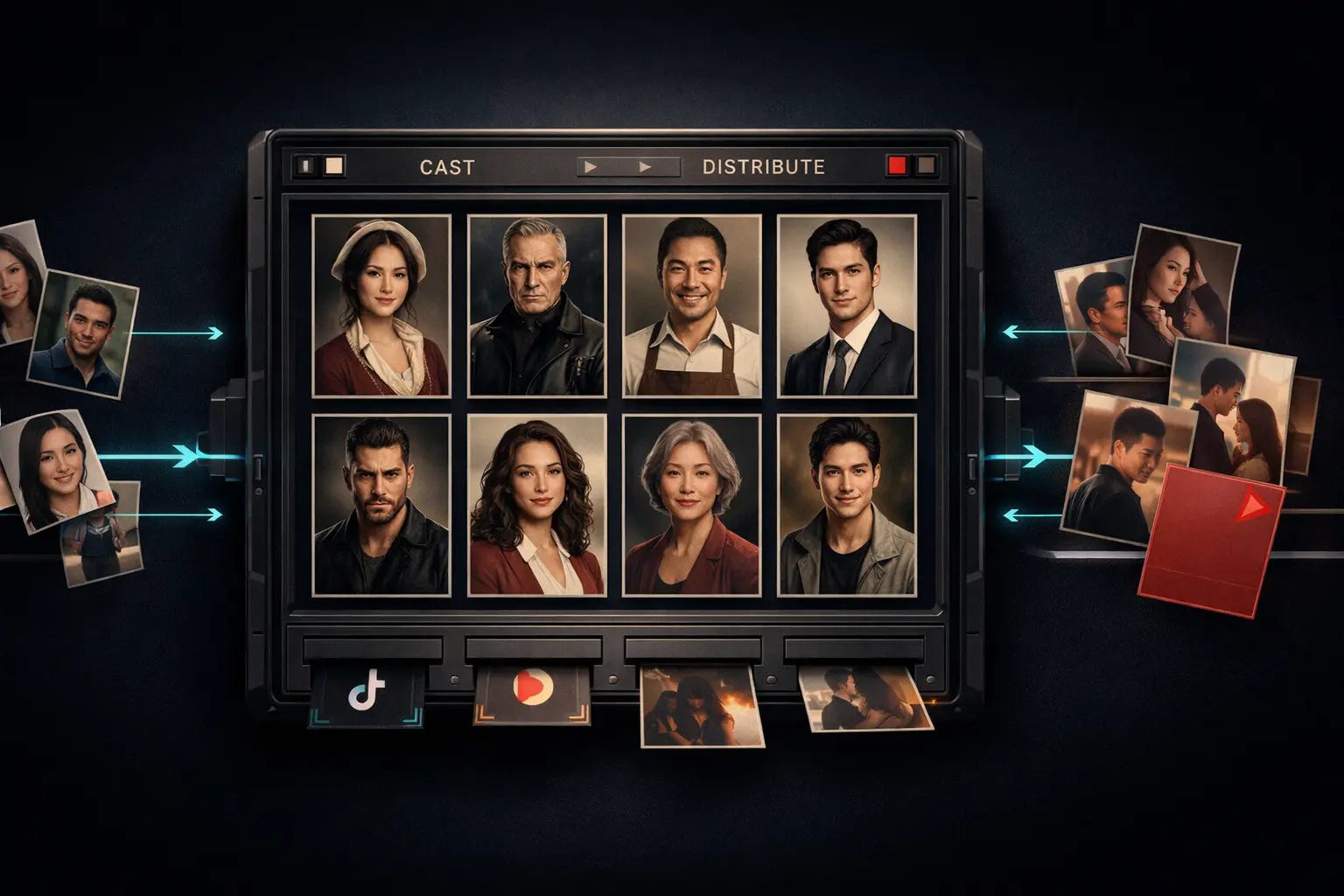
In January 2026, Chinese platforms launched more than 14,600 AI-generated short dramas. That works out to roughly 470 new titles each day. By February, 127,800 were in active circulation across the country’s streaming and social media ecosystem.
These figures require a moment of calibration for readers who have not encountered the format. Short dramas are serialised, mobile-first shows with episodes of two to five minutes, distributed through algorithm-driven platforms and monetised through advertising and micropayments. Think of them as soap operas rebuilt for smartphone attention spans: melodramatic, formulaic, and staggeringly popular. The audience for AI short dramas alone is projected to reach 280 million in 2026, up from 120 million the year before.
Before AI entered the picture, this market was already producing content at a volume no other national entertainment industry could match. Generative video models compressed the production cycle further and collapsed costs so sharply that the industry’s economics, its labour structure, and its relationship with the real human faces on screen have all been remade in under 18 months.
What followed is worth examining closely. The forces at work, collapsing production costs, displacement of human performers, industrial-scale identity appropriation, and belated regulatory response, are not unique to China.
Everyone Is a Studio Now
The production economics of AI short dramas have changed so fast that the industry’s own vocabulary has struggled to keep pace.
A live-action short drama that cost upward of RMB 1 million ($137,000) to produce in 2024 can now be generated for RMB 50,000 to 100,000 ($7,000 to $14,000) using AI tools. At the cheapest tier, outsourced workshops quote RMB 30,000 to 40,000 per complete series. Per-minute costs have fallen from RMB 3,000 to 5,000 in early 2024 to a typical range of RMB 500 to 1,000 today, with some outsourced teams quoting as little as RMB 200 ($27).
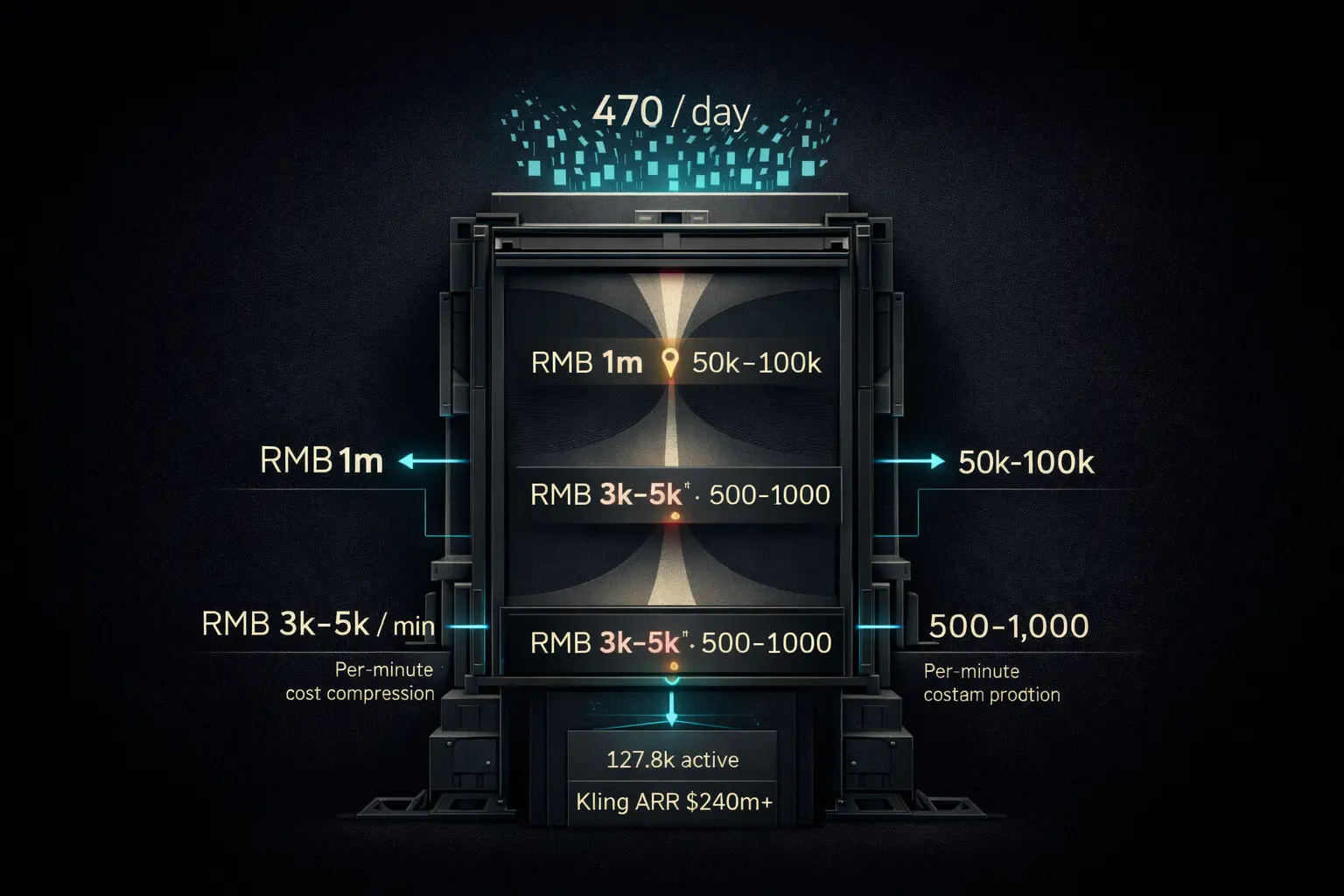
The collapse in cost has created production enterprises that would have been difficult to imagine two years ago. Jiangyou Culture, a Hangzhou-based company backed by China Literature (the Tencent-affiliated publishing group), has grown to roughly 1,000 employees and generates annual revenue of approximately RMB 1 billion ($137 million) with net profit of RMB 200 to 300 million. A separate production house, Judian, has scaled to a comparable size and produces roughly 100 AI photorealistic dramas per month alongside 1,000 to 2,000 AI voiceover dramas. Yet another company scaled from zero to 200 employees in under a year, with a ten-person team completing a 30-episode series in 20 days.
At the individual level, the figures are equally striking. At an AI entertainment forum earlier this year, a startup founder demonstrated that a single operator working with ByteDance’s latest video generation tools could produce 40 minutes of distribution-ready content per day at a profit margin of 45 per cent. The operators who run these tools, known colloquially as “card-pulling technicians” for the lottery-like process of generating and selecting usable clips, earn between RMB 2,000 and 3,000 ($275 to $410) per month. That is barely above China’s urban minimum wage.
The underlying technology has improved at a pace that caught even its creators off guard. In January 2025, fully AI-generated titles accounted for just four of Douyin’s top 5,000 short dramas. By November, the number had reached 217. When ByteDance released Seedance 2.0 in early 2026, the founder of Game Science, the studio behind the global hit Black Myth: Wukong, said he was “deeply shocked” by the model’s capabilities. Complex physical actions, multi-character scenes, sustained character consistency across shots: problems that had constrained AI video for years appeared to have been meaningfully resolved.
The commercial trajectories of the leading models have diverged. Kling AI, the video generation platform built by Kuaishou (TikTok rival Kwai’s parent company), had crossed a meaningful commercial threshold by early 2026. Official disclosures showed an annualised revenue run rate of approximately $240 million as of December 2025; market reporting indicated the figure had exceeded $300 million by January 2026. Kuaishou has disclosed adoption across professional creative sectors including film, television, short dramas, marketing and e-commerce, but has not published a revenue breakdown by category. OpenAI shut down Sora on 24 March as it redirected compute and talent toward coding tools, enterprise products and its broader AGI ambitions. Reporting also suggests the product’s compute demands had become a meaningful internal constraint. I examined what drove those two trajectories apart, and what they reveal about where AI revenue actually accumulates, in a separate analysis.
Six Days of Work in March
The industry’s expansion has come with a human cost that is visible, immediate, and concentrated among the people who least expected it.
Li Wenhao, a short drama actor based in Chongqing, was busy enough after entering the industry in 2023 to shoot for 50 consecutive days. In March 2026, he worked six. Casting calls that once arrived at a rate of more than 20 per day now come once every two or three days. Of roughly ten short drama companies he knew in his city, only two or three still hire human performers.
His trajectory reflects an industry-wide contraction. Actors who had ridden the short drama boom to unusual earnings, with daily rates reaching RMB 50,000 to 60,000 ($7,000 to $8,200) for breakout performers, report that available scripts have roughly halved. One leading actor who previously fielded more than 30 offers per month now receives seven or eight.
Some companies have made the transition with startling directness. Chengdu Zhongdu, a mid-sized studio, announced a complete exit from live-action in March, converting all staff to AI workflows. Yaoke Media, a company behind several well-known Chinese television dramas, signed two AI-generated performers to formal contracts. Public reaction was sharply negative, partly because the digital performers resembled real celebrities, and partly because of the symbolism: a major production house officially filling roles with software.
Hao Lei, one of China’s most respected dramatic actresses, delivered an assessment on a nationally broadcast variety show that travelled widely: AI will replace 90 per cent of actors. She added that in certain roles, AI already outperforms its human equivalent. The remark landed hard because of its source. Hao Lei has decades of experience on screen. She was describing what she sees in her own industry, not promoting a product.
The speed of displacement has few parallels in entertainment history. Sound took years to replace silent film. CGI eliminated specific crafts while creating others over two decades. In China’s short drama market, where productions carried no union protections and cycles were already measured in weeks, AI compressed the adjustment into months. Actors who were fielding 30 script offers a month at the start of winter found themselves with seven by spring.
Whose Face Is That?
The displacement of professional actors was, in retrospect, predictable. A less anticipated category of harm emerged alongside it: the mass, unauthorised appropriation of real people’s faces.
In early 2026, a 72-episode AI period drama appeared on Hongguo, ByteDance’s dedicated short drama app, and accumulated a popularity score exceeding 40 millionbefore anyone noticed the faces. A fashion blogger who creates content about traditional Chinese clothing discovered that one of the drama’s characters bore her likeness. The character had been written as greedy and promiscuous. A second blogger found her face used for an antagonist depicted as violent and cruel. Neither woman had been contacted, compensated, or informed.
The technique has become a common method in AI drama production. Producers download photographs from social media and feed them into AI models as reference material, a process the industry calls “reference imaging” (垫图). The output is adjusted enough to appear distinct while retaining the structural features of the original face. Producers claim independent creation. Anyone who knows the source can see the resemblance. The financial logic is straightforward: building a cast from scraped photographs eliminates the single largest variable cost in short drama production.
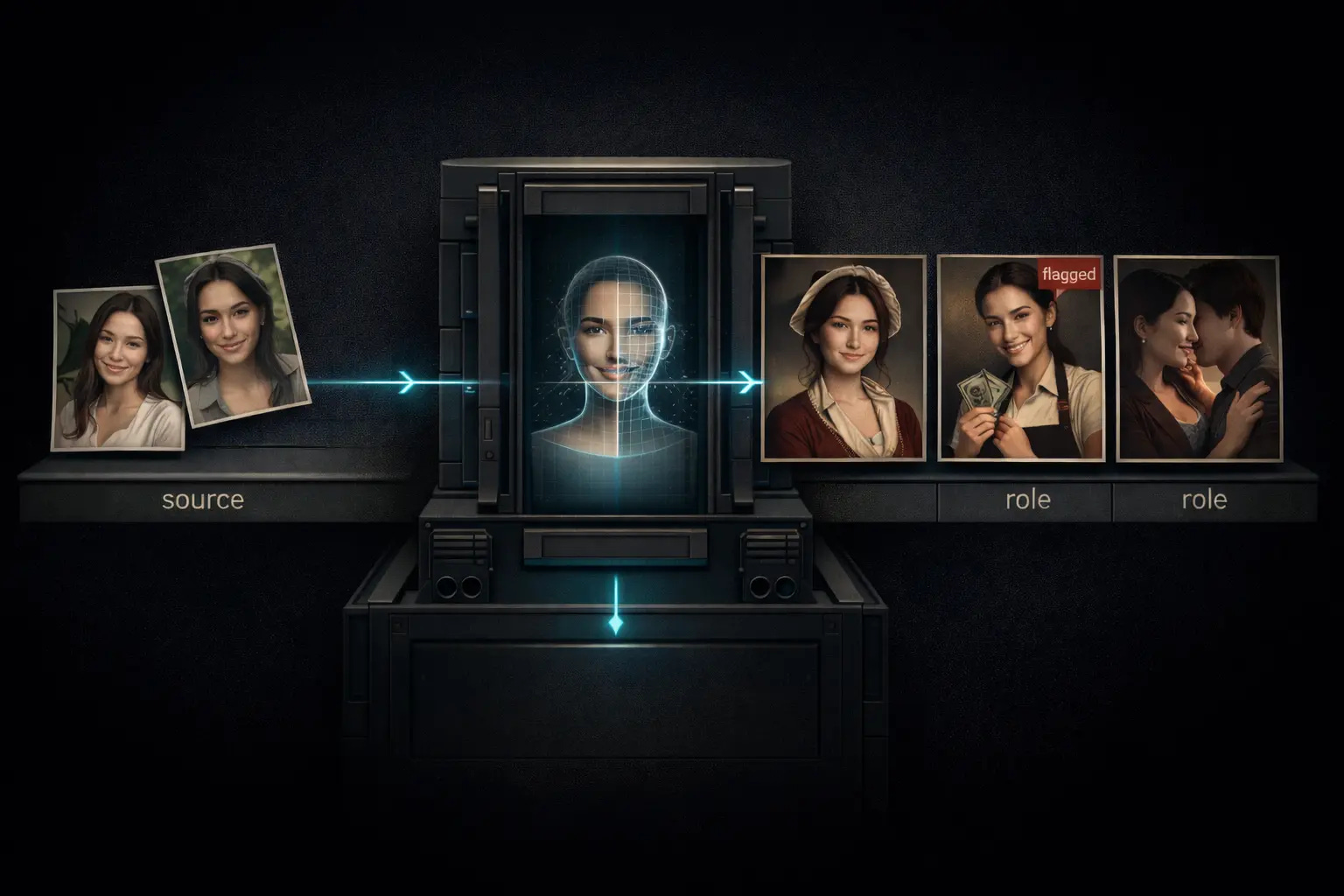
The practice reached high-profile targets quickly. Multiple AI dramas featured characters whose faces closely matched those of Yi Yangqianxi (known internationally as Jackson Yee), one of China’s most prominent young actors. Two such titles had accumulated combined popularity scores exceeding 100 million before being flagged and removed. His management commissioned lawyers and issued a formal statement. Other major Chinese entertainers, including Xiao Zhan, Yang Zi, and Dilraba Dilmurat, had been targeted through similar methods.
The celebrity cases drew headlines. The cases involving ordinary people may carry larger implications. A well-known performer who is misused commands legal resources and public sympathy. A social media user whose face appears, without her knowledge, in a production she never consented to, playing a character designed to be despised, has almost none. She may never discover the appropriation. The producer may operate through layered outsourcing that obscures accountability.
This is not a concern confined to Chinese regulatory debates. The necessary ingredients, publicly available photographs, generative models capable of photorealistic output, and financial incentives to skip licensing, exist in every market where people post images of themselves online. Any jurisdiction where AI video production reaches industrial scale is likely to face a version of the same collision between generative capability and the right to control one’s own face. China surfaced the problem first because it produces at a speed that compresses years of gradual erosion into months of visible crisis.
Seven Days in April
China’s regulatory system responded with a velocity that surprised even seasoned observers of Beijing’s technology governance.
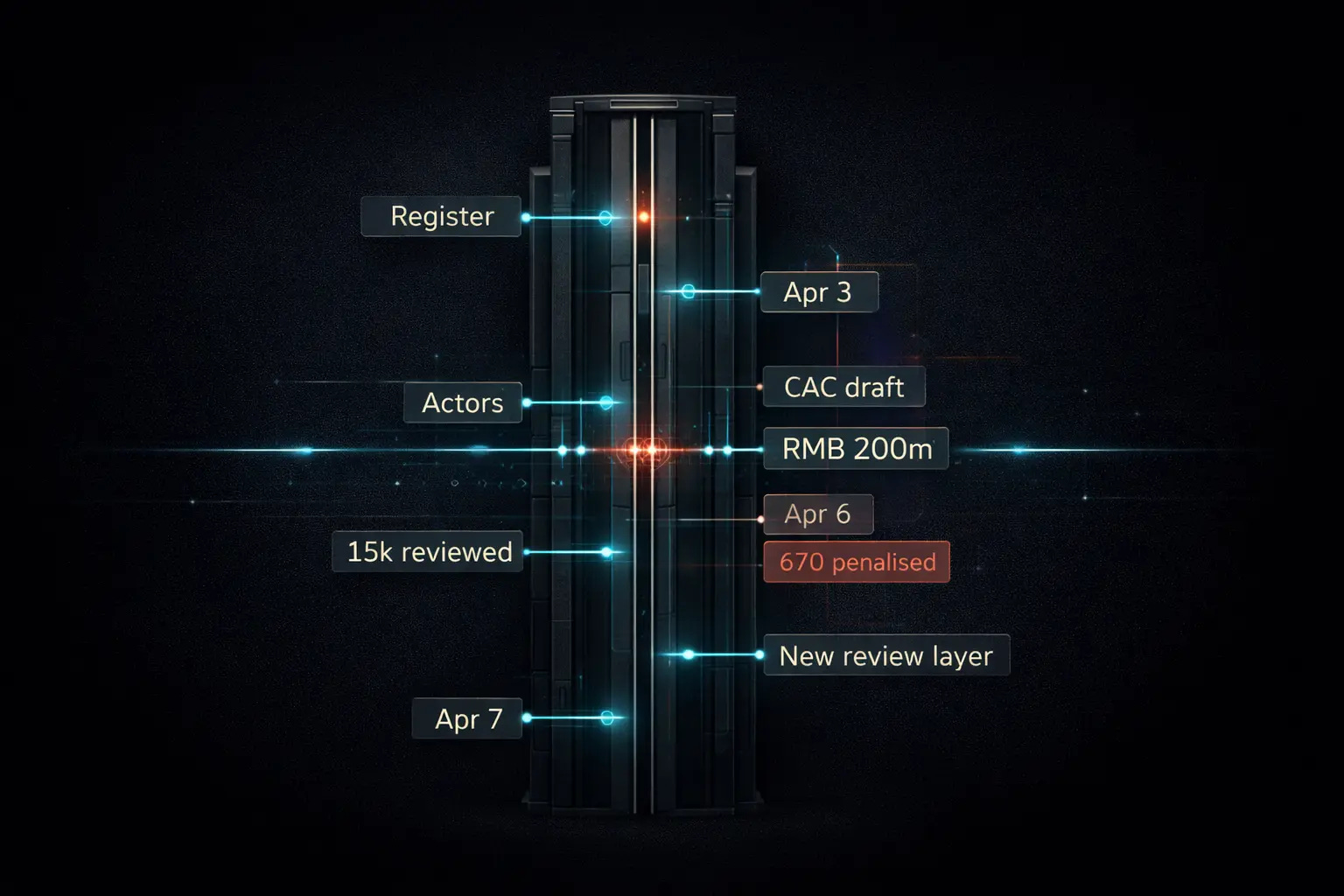
On 1 April 2026, AI dramas formally entered the national content registration system, requiring producers to register titles and undergo classification review before distribution. On 2 April, the actors’ committee of the China Broadcasting Association prohibited the unauthorised use of performers’ likenesses and voice prints, explicitly noting that labels such as “non-commercial” or “public interest sharing” do not constitute legal justification.
On 3 April, two actions landed simultaneously. The Cyberspace Administration of China published draft rules titled “Digital Virtual Person Information Service Management Measures,” governing the creation and commercial use of AI-generated human characters, with a public comment period running through 6 May. The same day, Douyin Group, ByteDance’s domestic entity, announced a RMB 200 million ($27.5 million) fund to support live-action short drama production, widely read as an acknowledgement that the AI transition had overshot.
By 6 April, Hongguo disclosed the results of a comprehensive audit: 15,000 works reviewed, 670 penalised for violations including unauthorised use of real performers’ likenesses, trademarked character designs, and copyrighted brand imagery. Penalties ranged from content removal to permanent account termination and legal referral. Updated platform-level content review standards, including a new layer of “thematic orientation review,” took effect on 7 April.
The pace reflects a recurring pattern in Chinese technology governance that Western analysts frequently underestimate. Beijing tolerates rapid commercial experimentation with minimal pre-emptive constraint. When the social costs become visible to ordinary citizens, the response comes as a dense cluster of platform actions, industry association statements, and draft national rules within days. Not all of these carry the same legal force: the CAC’s virtual-person regulation entered public consultation, while the platform review standards took effect immediately. But no comparably concentrated response has yet emerged across major Western jurisdictions.
The contrast with other governments is instructive. In March 2026, the United States Supreme Court declined to hear a case involving AI-generated visual art. The ruling leaves in place a clearer standard for fully AI-generated works lacking human authorship, which cannot receive copyright under existing law. Broader questions around AI-assisted creation remain contested. In the United Kingdom, the government abandoned a proposal allowing AI companies to train on copyrighted works under an opt-out model, retreating under pressure from artists including Sir Elton John and Dua Lipa, yet implementing no alternative framework.
This regulatory asymmetry matters beyond the specifics of short dramas. Jurisdictions with slower governance cycles face longer windows in which harmful practices can scale without formal constraint. China’s experience offers an uncomfortable data point: the costs of waiting for consensus are borne by the people whose faces and livelihoods remain unprotected while the deliberation proceeds.
Plenty of Content, Nothing to Watch
The production explosion carries a paradox the industry has begun to confront openly.
Of the 127,800 AI dramas in circulation by February 2026, the proportion that crossed the 100-million-view threshold stood at 0.117 per cent. In 2025, Douyin’s ecosystem launched 60,000 AI dramas. Ninety-six reached the benchmark. That breakout rate of 0.16 per cent has been declining as production volume climbs.
The performance ceiling tells a parallel story. The highest-viewed AI drama in circulation has reached approximately 1 billion views. The most successful live-action short drama, by comparison, accumulated 4.4 billion. AI content accounted for roughly 30 per cent of total short drama viewership during the 2026 Spring Festival holiday. The share is growing, but on the strength of sheer volume rather than audience loyalty. No AI drama has entered the cultural conversation the way live-action hits routinely do, generating fan communities, launching performer careers, spawning merchandise.
Audience surveys in early 2026 found that photorealistic AI dramas registered the lowest willingness to pay of any AI content format. Viewers detect the synthetic quality. The uncanny valley, where visual fidelity approaches realism without quite arriving, appears to suppress the emotional engagement that converts sampling into spending.
The industry has responded by leaning into distribution economics. AI drama production increasingly runs on what Chinese producers call traffic arbitrage: manufacture content cheaply, spend aggressively on platform ads to generate views, and profit from the margin. In March 2026, daily ad spend on AI dramas across Douyin broke RMB 70 million ($9.6 million), surpassing live-action short dramas for the first time. Survival depends on media buying efficiency, not storytelling.
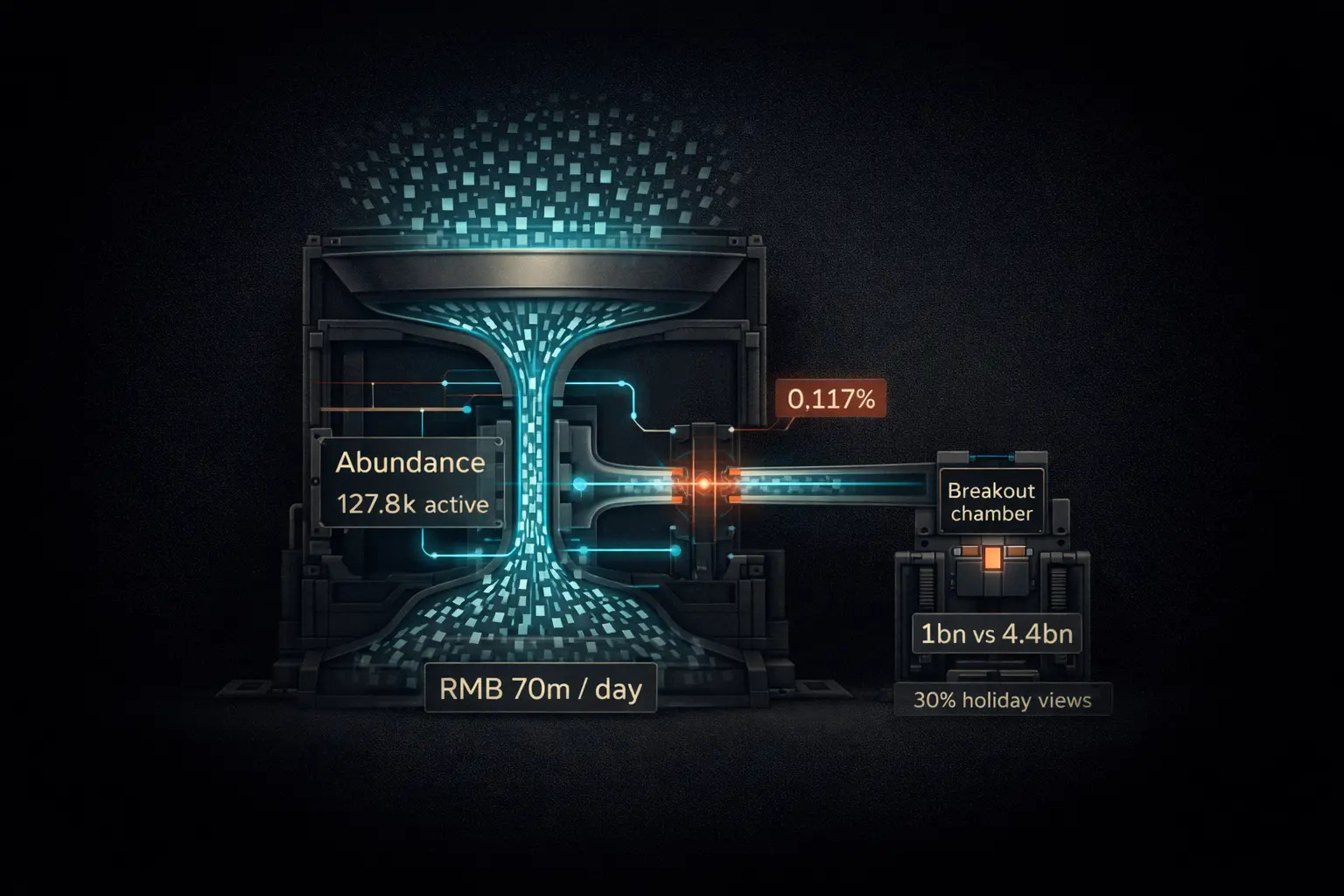
One AI entertainment executive characterised the resulting structure with unusual candour: “model companies sell compute, platforms sell traffic, capital sells stories.” Each participant in the chain profits from the system’s activity regardless of whether the output finds a real audience. The closed loop can sustain itself financially without producing a single work that resonates culturally. Whether that constitutes an entertainment industry or merely a revenue mechanism wearing the costume of one is a question the market has not yet been forced to answer.
From Bollywood to Hollywood
China’s experience would command less attention if it appeared to be unique. The evidence from other markets suggests the pattern is broader.
India’s film industry, the most prolific by output in the world, has begun adopting AI production tools along a trajectory that broadly tracks China’s. A leading Bollywood talent agency has built an AI studio in Bengaluru to engineer digital actors inspired by Hindu mythology. AI-assisted production costs have reportedly fallen to one fifth of traditional budgets, with timelines compressed to one quarter. One Indian media company re-released a 2013 Bollywood hit with an AI-altered happy ending. The modified version sold 35 per cent of tickets during its release month, 12 percentage points above the cinema chain’s 2025 average. The company is now reviewing its back catalogue of 3,000 titles for additional AI adaptation opportunities.
India faces far fewer formal labour constraints than Hollywood, even as audience acceptance remains uneven. The country’s entertainment industry operates without equivalents to SAG-AFTRA or the Directors Guild of America, and studios have moved quickly to exploit this flexibility. Yet India’s quality challenge mirrors China’s with striking precision: an AI-generated mythological television series aired on a major Indian streaming platform to 26.5 million views and a 1.4 out of 10 audience score. The willingness to sample AI entertainment and the reluctance to invest emotional commitment in it appear consistent across cultures.
In Hollywood, the friction takes a different form. Union agreements negotiated after the 2023 strikes require consent and compensation for digital replicas and maintain minimum creative staffing. These constraints have slowed visible AI adoption at the production level. Below that level, AI use percolates through junior staff informally, without institutional guidance.
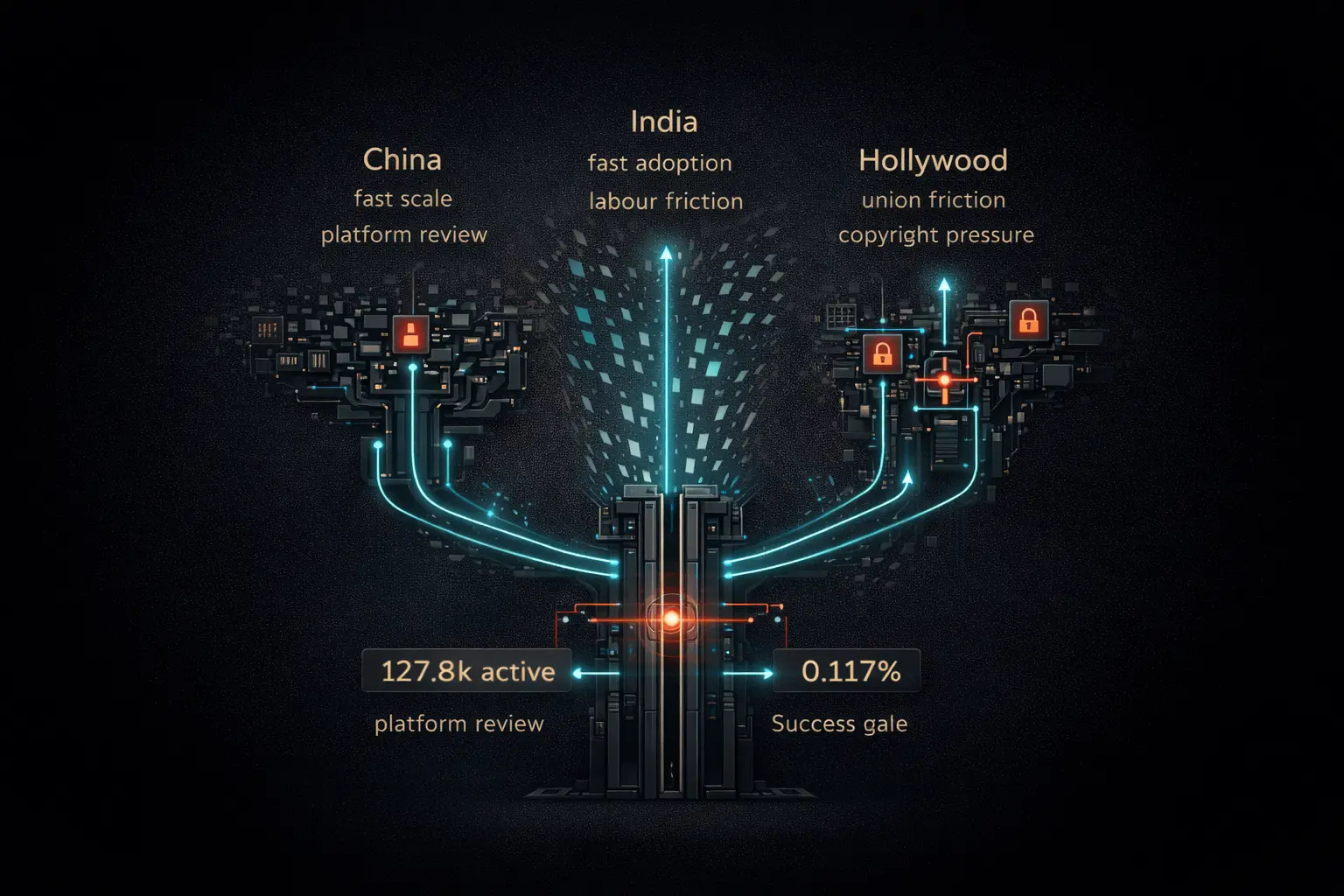
On the copyright front, the MPA and major studios including Disney, Warner Bros. Discovery, Paramount, Netflix, and Sony sent cease-and-desist letters to ByteDance over Seedance 2.0 in February. Separate lawsuits and complaints against other AI companies over image generation, character rights and training data are proliferating. The legal architecture governing AI-generated entertainment remains unsettled in every major jurisdiction. The commercial incentive to produce it has not paused to wait for resolution.
Market coverage citing Goldman Sachs projects the global AI video market at approximately $29 billion by 2030, up from $3 billion in 2025. China’s experience suggests the supply side of that projection is already plausible.
What 470 a Day Tells Us
China’s AI drama market has produced the world’s most detailed case study of what happens when the cost of creating entertainment content collapses toward zero.
Quantity arrives first, in overwhelming abundance. Production enterprises scale from nothing to a thousand employees within months. Anyone with access to a generative model and a platform account can operate as a studio. The barriers that once shaped the entertainment industry, specialised equipment, trained performers, physical production infrastructure, compress toward irrelevance.
The consequences follow, and they arrive faster than the institutions designed to manage them. Actors who were fielding 30 script offers a month find themselves with seven. Ordinary people find their likenesses embedded in productions they never authorised. Audiences sample the output in vast numbers, but willingness to pay remains weak. Regulators, confronted with a market moving at machine speed, sprint to impose structure on terrain that was open land the month before.
Every element of this sequence is portable. The short drama format, optimised for mobile distribution and algorithmic amplification, is not unique to China. TikTok, YouTube Shorts, and Instagram Reels have built equivalent distribution infrastructure worldwide. India’s entertainment industry is already travelling the same path without the friction of union protections. Hollywood’s contractual defences are real, and they are also the product of specific historical negotiations that most other countries’ creative industries have never replicated.
China has settled the first question for every entertainment market: AI production can reach industrial scale. The question that remains is who absorbs the cost when it does. The performers whose livelihoods dissolve. The individuals whose faces are harvested. The audiences asked to watch content that nobody invested enough to make compelling. Or the institutions that arrive to govern a transformation already well under way.
This article examined what happens on the ground when AI entertainment reaches industrial scale. A companion analysis looks at the other side of the equation: who is making money, and why. It covers the commercial divergence between Sora, Seedance, and Kling in detail, Meitu’s $530 million application-layer export model, and what the Manus acquisition tells us about how Chinese AI companies can and cannot go global.
"China has settled the first question for every entertainment market: AI production can reach industrial scale. The question that remains is who absorbs the cost when it does. The performers whose livelihoods dissolve. The individuals whose faces are harvested. The audiences asked to watch content that nobody invested enough to make compelling. Or the institutions that arrive to govern a transformation already well under way." IHistory repeats.
This is an insightful article. I am consistently impressed by the speed of China’s legislative processes. In an era of rapid technological disruption, the ability to be both robust and agile is a decisive strategic advantage. While no system is without flaws, Chinese institutions demonstrate a remarkable capacity for rapid, decisive action that reflects a strong connection to the societal needs they serve. History shows that those who define the rules set the standards, control the narrative, and ultimately lead the race. Conversely, entities resistant to change risk obsolescence. China’s less rigid historical framework regarding IP and its developing film industry have inadvertently provided leverage, allowing the country to adapt quickly and establish international standards in AI before competitors can react.