

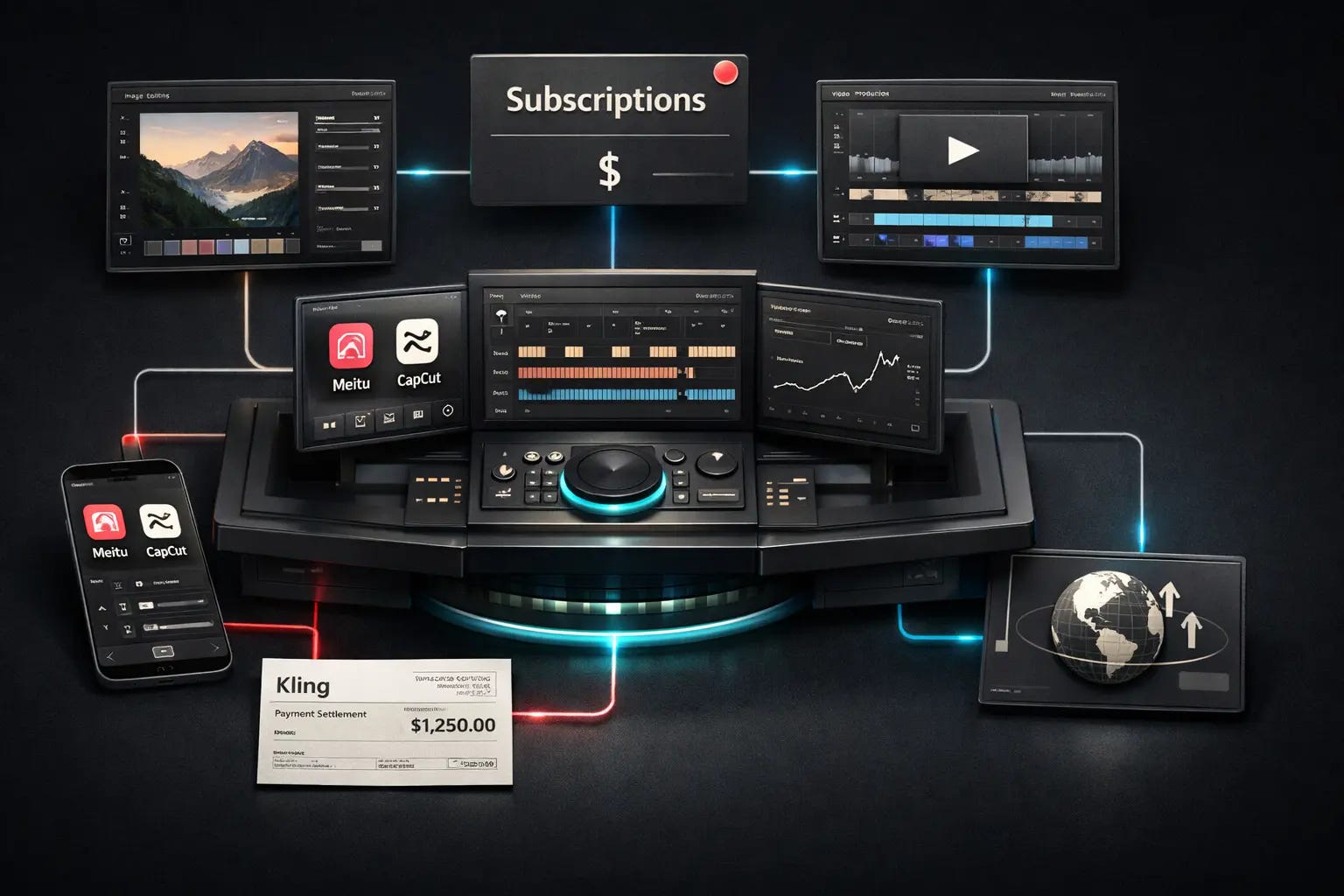
On 25 March, OpenAI shut down Sora, the text-to-video model that had captivated the AI world since its debut two years earlier. The reasons were familiar: the product appears to have consumed more in compute than it could justify commercially, and never found a sustainable business model.
The same day, Kuaishou Technology, the Chinese short-video platform behind TikTok rival Kwai, published its annual earnings. Tucked inside the results was a striking figure. Kling AI, the company’s video generation platform, had reached an annualised revenue run rate of $300 million as of January 2026. Fourth-quarter revenue came in at RMB 340 million ($47 million). Management projected that Kling’s 2026 revenue would more than double.
One product collapsed under the weight of its own compute bill. The other crossed a commercial threshold rare among standalone AI video tools worldwide. The contrast frames a question that extends well beyond video generation: in the emerging AI industry, where does the revenue actually accumulate?
Western discourse about Chinese AI tends to cluster around two narratives. The first centres on model-layer breakthroughs: DeepSeek’s ascent, its open-source challenge to OpenAI. The second follows founder migration: Manus relocating to Singapore, HeyGen moving to Los Angeles, a generation of Chinese AI engineers voting with their feet. Both stories are real. Neither captures the most commercially significant development in Chinese AI today.
That development sits in the application layer. A cohort of Chinese companies that build AI-powered products for specific use cases, from image editing to video production to e-commerce design, are generating measurable, recurring global revenue. They treat foundation models as inputs rather than outputs. They solve problems granular enough that general-purpose AI cannot easily replicate the solutions. This application-layer advantage may prove more durable than model superiority or talent arbitrage. The evidence is accumulating faster than most Western observers appreciate.
The Scoreboard Everybody Misreads
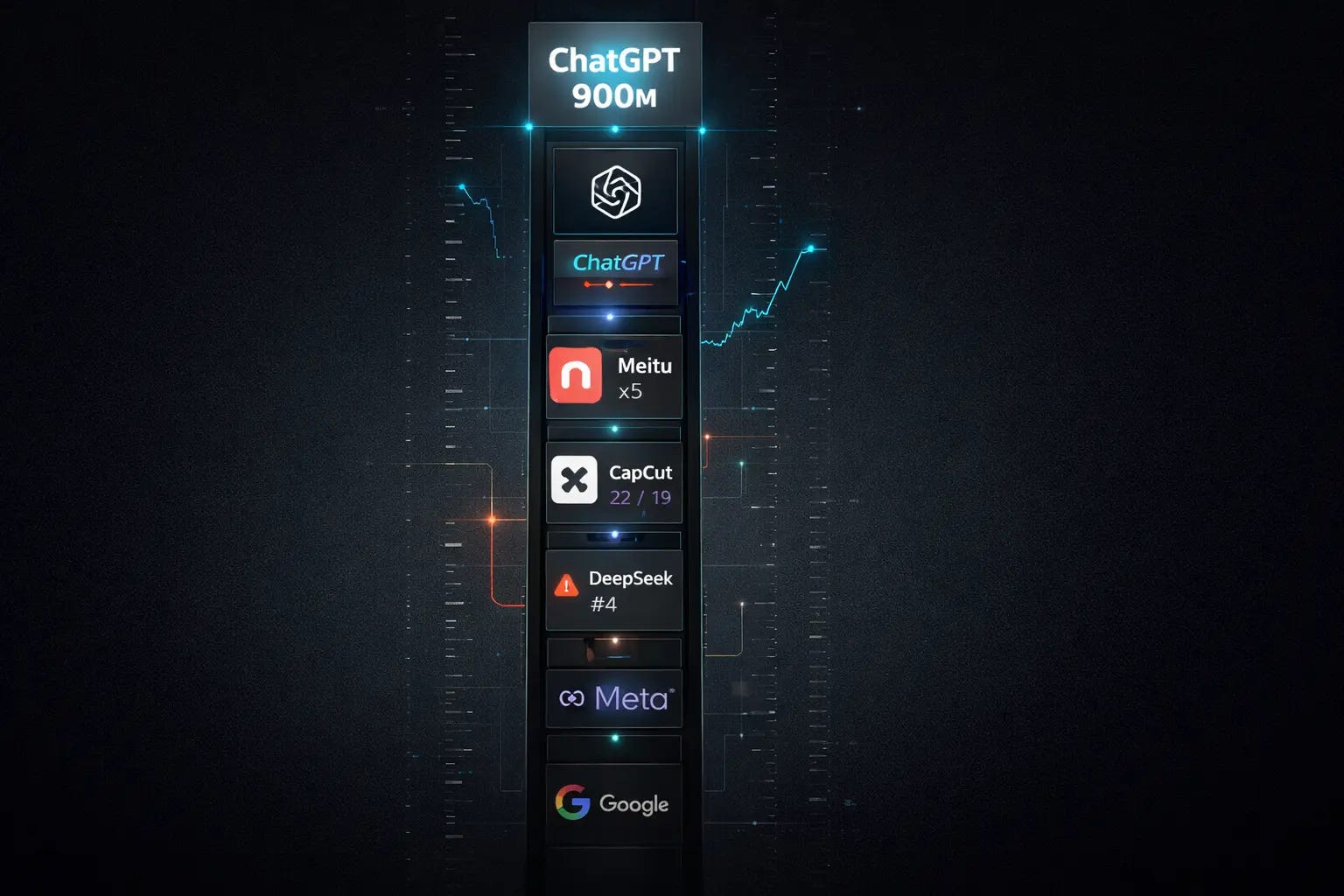
Andreessen Horowitz published the sixth edition of its Top 100 generative AI consumer applications ranking in March 2026. The headline, as usual, belonged to ChatGPT: 900 million weekly active users, web traffic 2.7 times that of Google’s Gemini.
The more revealing signal sat further down the list. Chinese-background products occupied a significantly larger share than in any prior edition. DeepSeek ranked fourth globally on the web. Kling AI, Manus, Kimi (a well-funded Chinese AI chatbot), and Alibaba’s Qwen all featured. On mobile, ByteDance’s Doubao (China’s most popular ChatGPT equivalent) and Baidu’s AI search product entered the rankings.
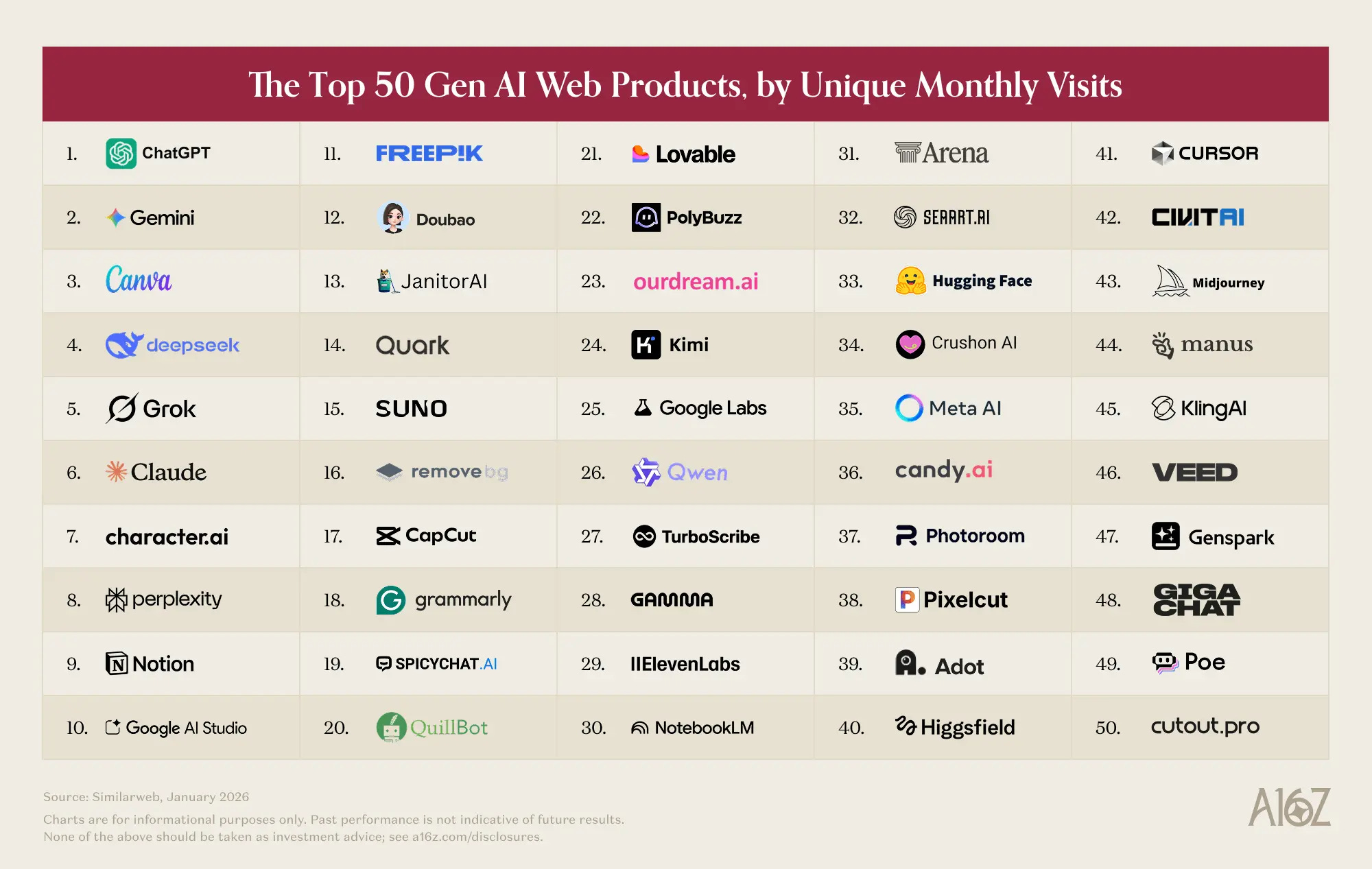
English-language commentary latched onto DeepSeek. The model-layer narrative proved irresistible. Yet the majority of Chinese entrants across both web and mobile were application-layer products: image editors, video generators, creative tools. Meitu, the Chinese photo and design software company, placed five separate apps in the global mobile Top 50. All five serve primarily overseas users.
A structural pattern emerges. In the previous edition of the same ranking, 22 Chinese-origin applications featured in the global mobile Top 50. Nineteen of them targeted overseas audiences. The sixth edition suggests that ratio has held or widened. These products compete on functionality, design, and pricing in markets where Chinese brand recognition carries no inherent advantage. They succeed or fail on product merit.
When a16z mapped the global AI consumer landscape, three distinct regional ecosystems appeared: a Western bloc anchored by ChatGPT, Gemini, and Claude; a Chinese domestic bloc led by Doubao and DeepSeek; and an emerging Russian cluster around Yandex. The Chinese companies that show up in both domestic and global rankings are almost exclusively application-layer players. Model companies serve their home markets. Application companies cross borders.