Editor’s Note: FlashPoint is our paid quick-strike column on market-moving China tech events. Today: BYD’s share of China’s battery market in the first nine months was more than four points below a year earlier. In September 2025, I compared what CATL and China’s carmakers each earn. In September 2026, I traced where BYD’s price-war costs land in its accounts. Now the battery data adds a view from the supplier side.
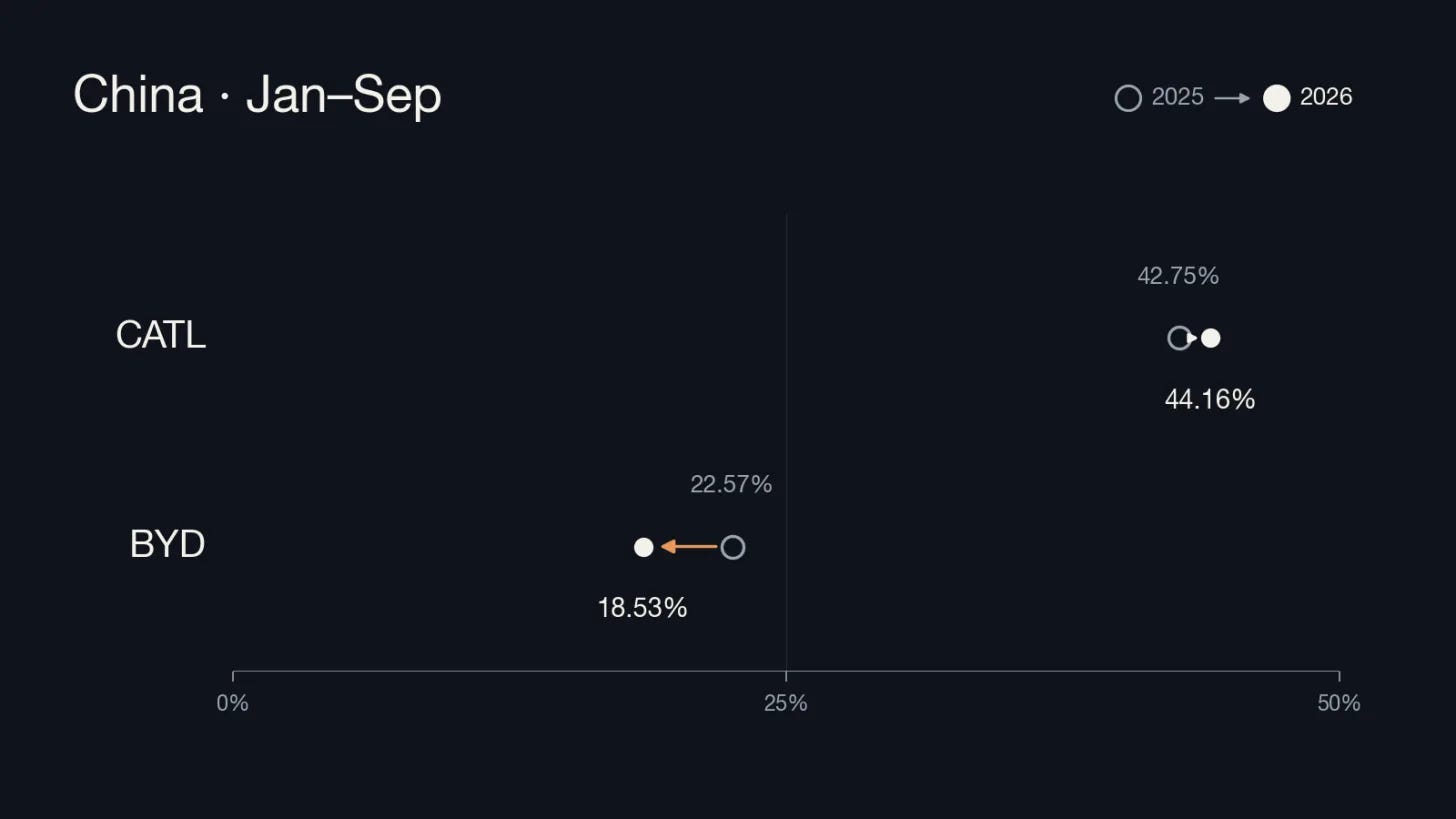
China’s power battery installations grew 16.7% in the first nine months of 2026, to 576.3 GWh. The figures come from the China Automotive Battery Innovation Alliance, the industry body that counts installations from vehicle production data. BYD, which makes both electric cars and the batteries inside them, went the other way. Its installations fell 4.3% to 106.44 GWh. Its share dropped 4.04 percentage points to 18.53%, the largest fall among the top 15 suppliers. CATL, the market leader, gained 1.41 points to 44.16%.
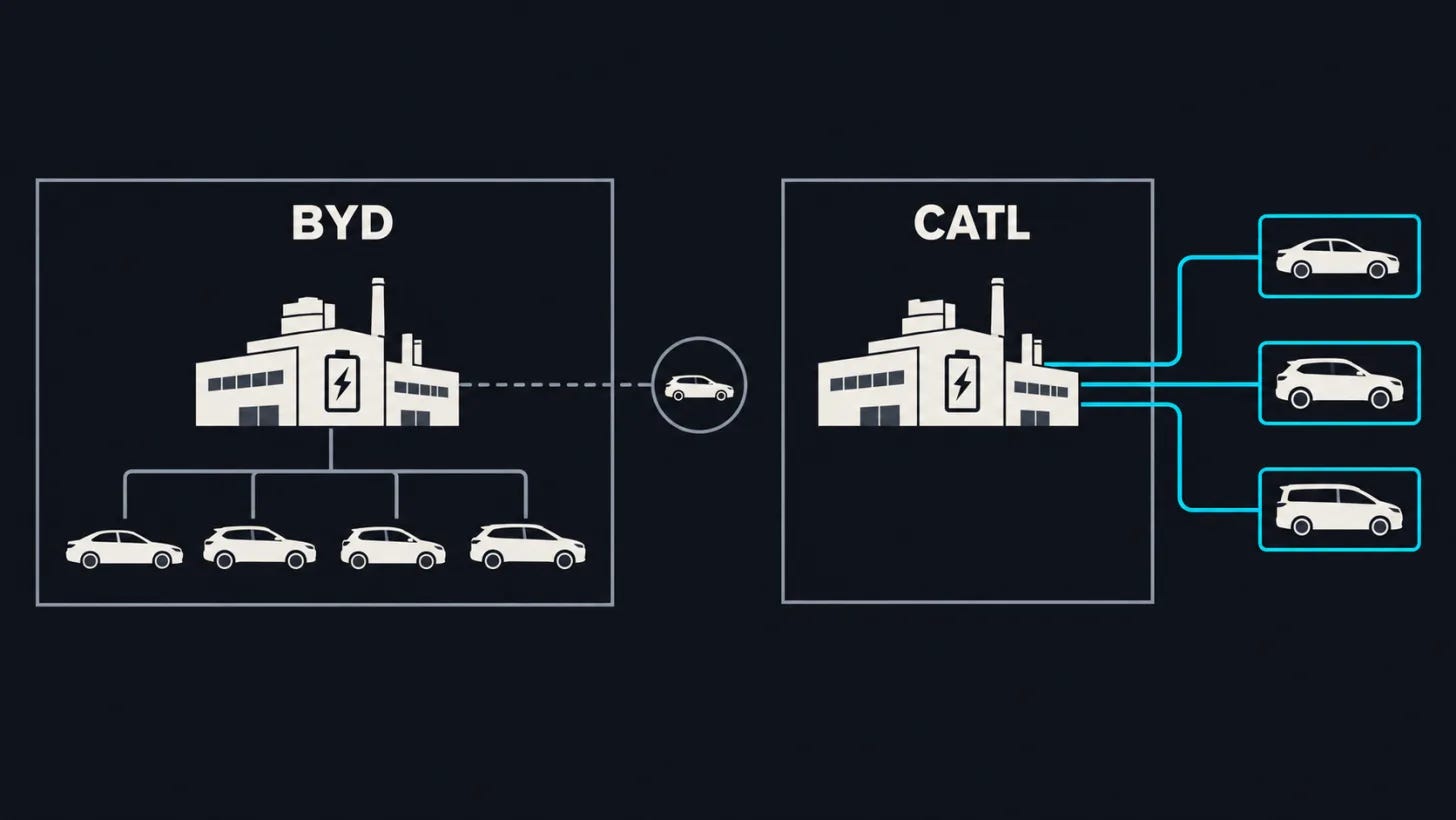
BYD still ranks second. I read the fall as a car problem that shows up in battery data. Most BYD batteries go into BYD cars. Call the limit this creates the Captive Ceiling. A parts business that sells mainly to its parent is bounded by the parent’s products: how many it sells, and how much of the part each one uses. Outside buyers are the way past that limit.
If reading a battery maker’s market share as a measure of its parent’s car sales is new to you, this is a preview of what Hello China Tech does every week: reading China’s AI, chip, robotics, and EV sectors from primary sources most English coverage never touches. Subscribe free to get every new analysis as it publishes.
The limit mattered less while BYD’s car sales rose. In a price war, making its own cells can keep the supplier’s margin inside the group. It also ties battery volume to one order book. BYD sold 3.13m new-energy vehicles, or NEVs, in the first nine months, down 3.94%. China’s NEV category covers battery-electric, plug-in hybrid and fuel-cell vehicles. The home market shrank. Figures from the China Association of Automobile Manufacturers, published by the industry ministry, put national NEV sales at 12.47m and exports at 4.01m, more than double a year earlier. Subtracting exports puts sales inside China down about 10.6%. CATL sells to many carmakers, which gives it more sources of demand as the market grows. The paid section sets out what BYD’s production and battery figures can and cannot show, then compares its overseas growth with CATL and other Chinese battery makers.