

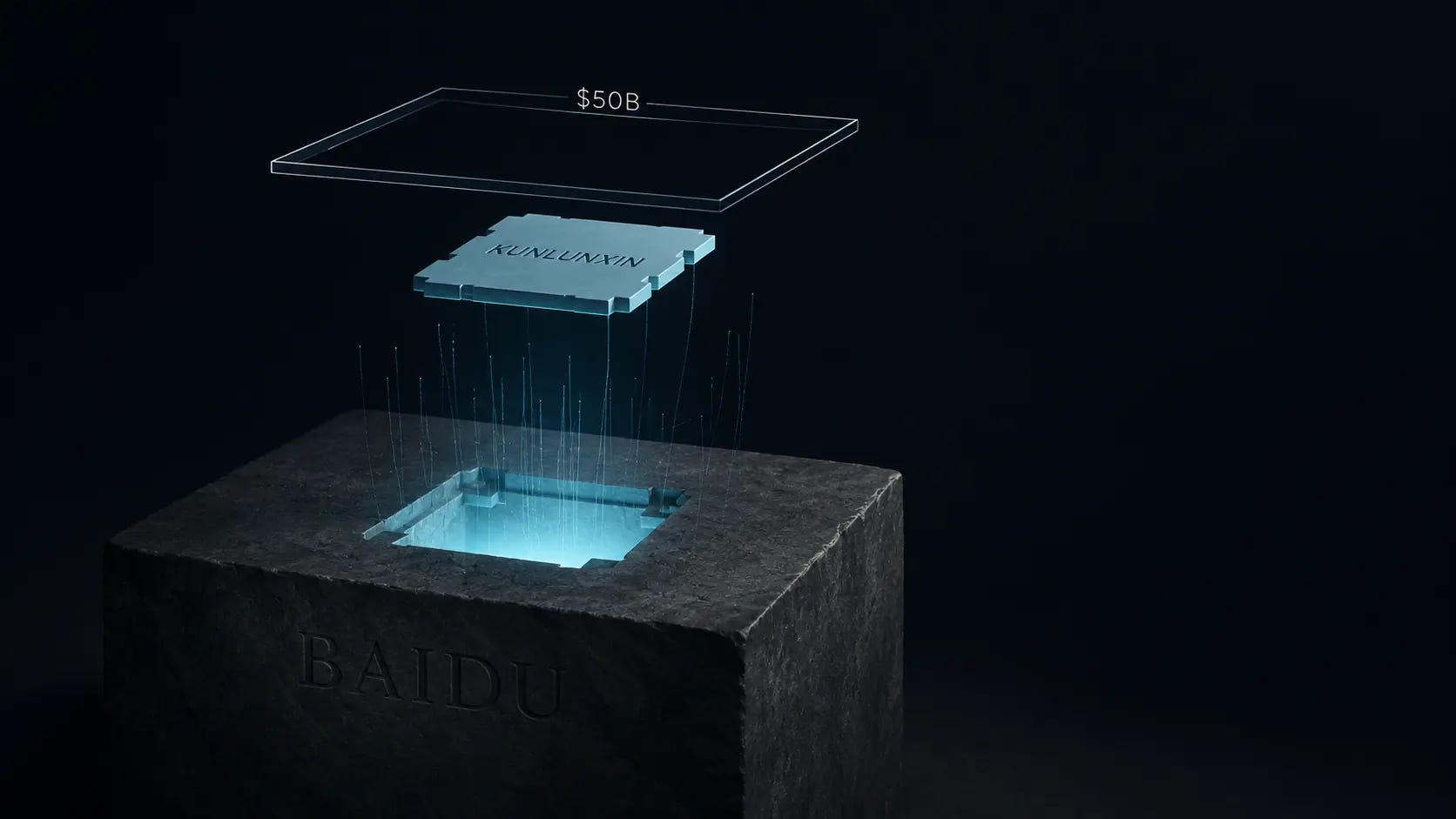
Baidu closed at $90.87 on August 18, down 12.73% on the day it reported second-quarter results. The company’s market capitalization settled around $31bn.
Kunlunxin, Baidu’s AI chip subsidiary, is seeking a dual listing in Shanghai and Hong Kong at a reported target valuation of $50bn, according to The Information. Baidu holds about 58% of Kunlunxin through Baidu (China) Co., Ltd.
At the reported target, Baidu’s stake in Kunlunxin would equal roughly 93% of Baidu’s market capitalization. The comparison implies a large holding-company discount.
An Arithmetic That Does Not Close
In January 2026, when Kunlunxin first filed confidentially for a Hong Kong IPO, I estimated the implied valuation gap at $36.7bn. At the time, Baidu traded at $51.4bn. I estimated Kunlunxin at about $18bn using one method. A separate comparable-company calculation suggested Baidu’s stake could be worth as much as $22bn, or about 45% of the parent’s market capitalization at the time.
Seven months later, the components have moved in opposite directions. Baidu’s market capitalization dropped to roughly $31bn. The reported Kunlunxin IPO target was $50bn. At 58% ownership, Baidu’s stake would be worth about $29bn on paper. That is roughly 93% of the parent’s entire market value before accounting for AI cloud, Apollo Go, Rmb 283.1bn in cash and investments, or any other asset.
Baidu still trades at a large discount to a simple sum of its disclosed asset values. The pattern suggests a structural divergence between where value is created and where it is priced.
The Collapse That Wasn’t
The headline number in the Q2 earnings release was a 68% drop in net income, to Rmb 2.3bn. Baidu’s shares fell 12.73% that day. Bloomberg led its coverage with the decline. But the number obscures the operating picture.
Baidu General Business, the reporting segment that excludes streaming subsidiary iQIYI, posted operating income of Rmb 3.1bn, down about 6% year over year. Operating margin held near 12%. Legacy business revenue fell 23% and online marketing declined 19%, but AI revenue growth and lower operating expenses partly offset these declines. The net income drop comes from below the line. Fair value gains on long-term investments shrank from Rmb 3.3bn a year ago to Rmb 1.1bn. Foreign exchange losses reached Rmb 1.2bn. Lower investment gains and a larger foreign-exchange loss account for most of the net income decline.
The real action is in the balance sheet and the cash flow statement. Capital expenditure for Q2 reached Rmb 11.4bn ($1.7bn), roughly triple the Rmb 3.8bn a year earlier. Combined with Q1, Baidu spent about Rmb 17.3bn on capex in the first half. Operating cash flow remained positive at Rmb 3.4bn. But free cash flow remained deeply negative because of the capex surge: negative Rmb 8.0bn for Q2, and negative Rmb 11.2bn for the first half.
Borrowing increased in the same period. Short-term loans rose from Rmb 7.6bn to Rmb 26.3bn. Non-current long-term loans rose from Rmb 3.4bn to Rmb 20.8bn, while the current portion fell from Rmb 14.8bn to Rmb 2.0bn. Lease right-of-use assets doubled from Rmb 9.3bn to Rmb 18.6bn. Total liabilities rose from Rmb 159.4bn to Rmb 174.8bn in six months. Baidu increased its borrowing while holding Rmb 283.1bn ($41.7bn) in total cash and investments.
The question is where the return on that spending shows up.
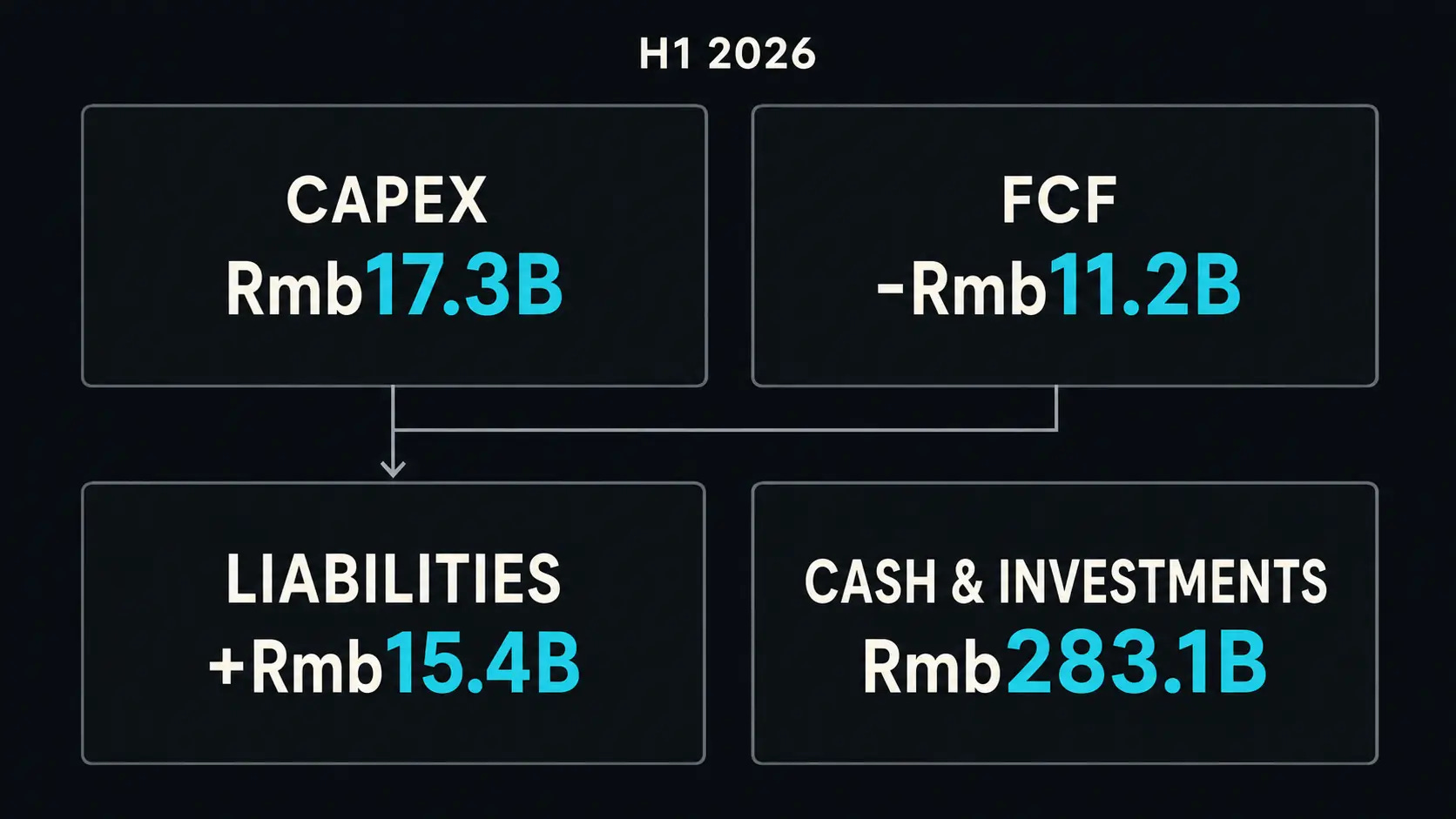
Baidu spent Rmb 17.3bn on capex in the first half of 2026 while total liabilities rose by Rmb 15bn. GPU Cloud revenue grew 283%. Kunlunxin is reportedly seeking a $50bn valuation in its planned IPO. The missing data is how much of Baidu’s cloud infrastructure uses Kunlunxin chips, and how much of Kunlunxin’s revenue comes from Baidu.
If the idea that one subsidiary could account for 93% of its parent’s market value is new to you, this is a preview of what Hello China Tech does three times a week: reading China’s AI, chip, robotics, and EV sectors from primary sources most English coverage never touches. Subscribe free to get every new analysis as it publishes.
