

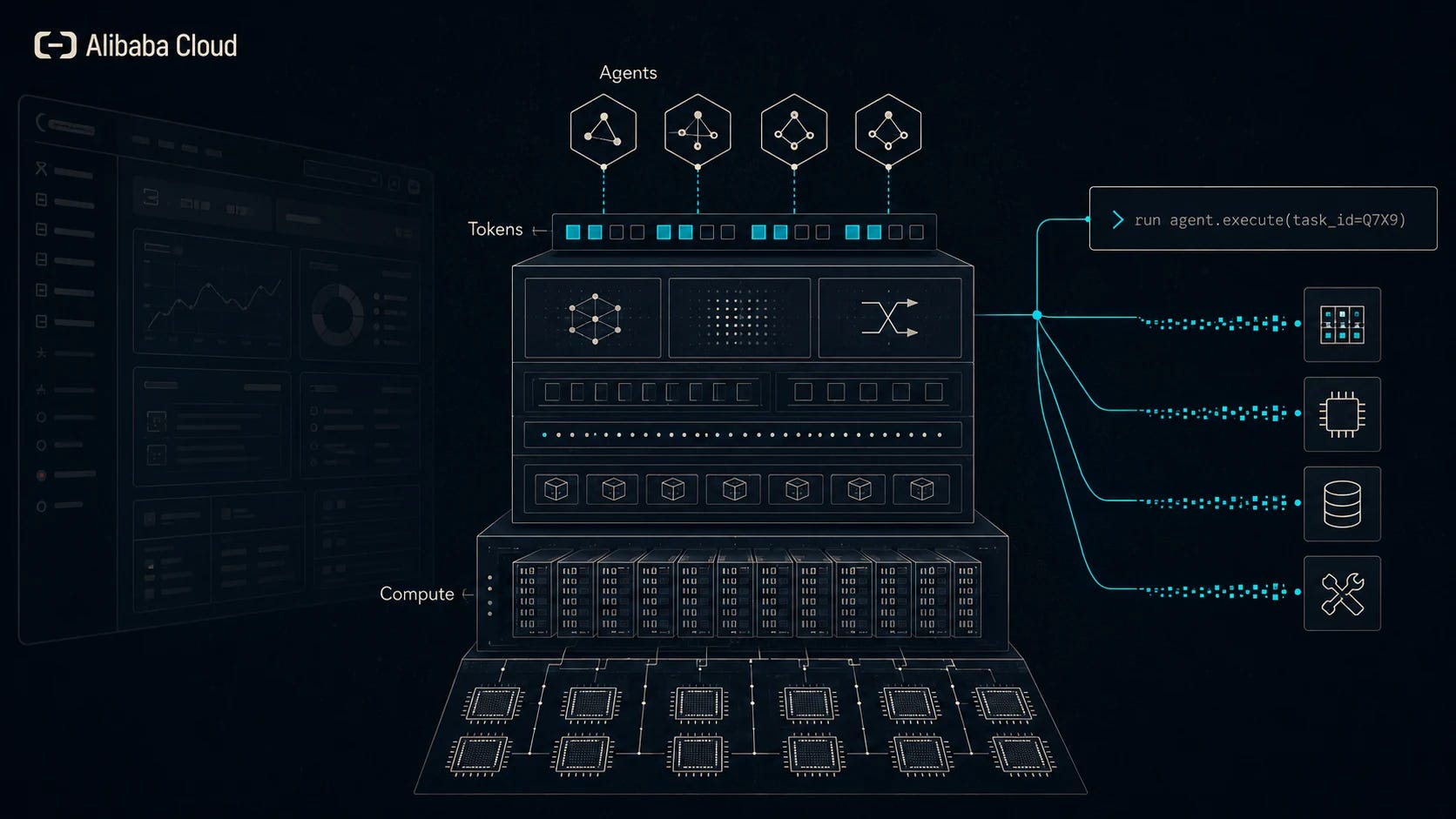
At this week’s Alibaba Cloud Summit, the company launched a new product website called Qianwen Cloud. Open it in a browser and you see nothing recognizable as a cloud service. No catalog. No console entry point. No navigation structure. A single command-line instruction fills the page: npx skills add QianWen-AI/qianwen-ai. That line is readable by an AI agent, meaningless to a casual visitor.
In 17 years of operation, Alibaba Cloud had never launched a standalone product website outside its main cloud site. The fact that its first one is designed to be read by software rather than people encapsulates what happened at this week’s summit: a major cloud provider publicly restructured its entire technology stack around the premise that AI agents, not human developers, will become the dominant consumers of cloud services.
The summit announcements spanned every layer. A new AI chip. A 128-card server cluster. A flagship model that ran autonomously for 35 hours. A platform retooled so every cloud product can be called by agents as a discrete function. The interface change matters because it changes who initiates consumption. A human developer buys capacity in planned blocks. An agent can trigger token, compute, storage, and tool usage repeatedly within a single task, without a human initiating each call. Taken individually, these are product launches. Taken together, they amount to a thesis: for the fastest-growing AI workloads, the unit of cloud revenue is migrating from compute hours to tokens, and the infrastructure must follow.
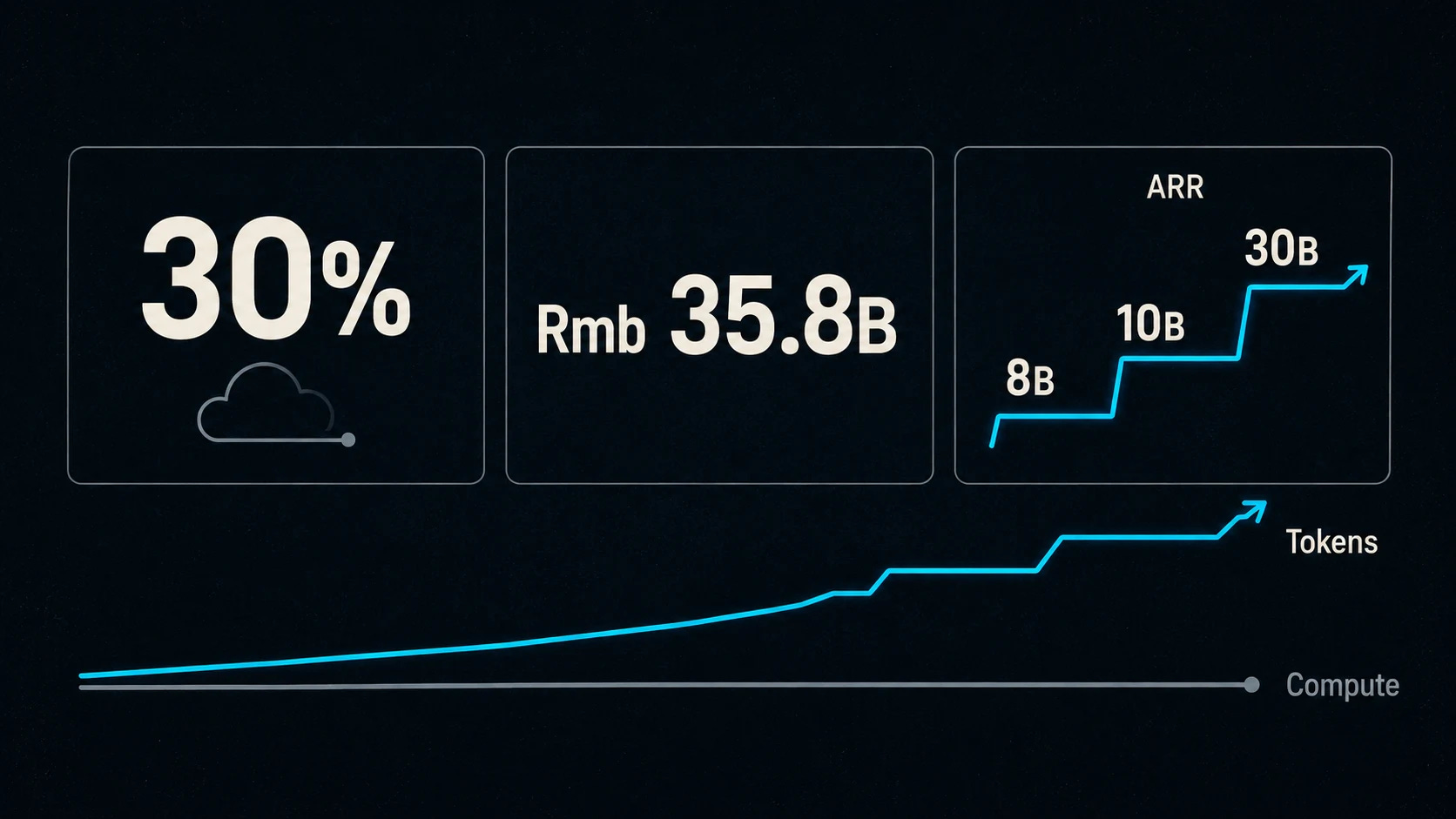
This thesis already has financial backing. One week before the summit, Alibaba’s March quarter earningsdisclosed that AI-related products now account for 30% of Cloud Intelligence Group’s external revenue, annualizing above Rmb 35.8 billion. Model-and-application-services ARR, which includes API calls on Bailian, Alibaba Cloud’s Model Studio platform, and AI software subscriptions, exceeded Rmb 8 billion. Management expects this model-and-app ARR to surpass Rmb 10 billion in the June quarter and Rmb 30 billion by year-end. Wu told analysts that this revenue stream carries higher gross margins than traditional infrastructure-as-a-service. If the trajectory holds, agent-driven model-and-app revenue appears positioned to overtake Alibaba Cloud’s legacy compute product line as the largest revenue contributor.
That revenue shift points toward a broader structural question: if the fastest-growing workloads on a cloud platform are generated by software rather than people, the assumptions baked into two decades of cloud product design may need revisiting.
In my March analysis, I argued that Alibaba’s most probable failure mode was not any single assumption proving wrong but multiple timelines slipping simultaneously. Last week’s earnings confirmed the company chose growth over near-term profit, burning Rmb 17.3 billion in free cash flow. The summit a week later revealed what that cash is building. Below, I trace the architecture Alibaba is constructing for an agent-first cloud, where the vertical integration could create margin leverage, and what the next two quarters need to prove before investors treat this as more than a product launch.