

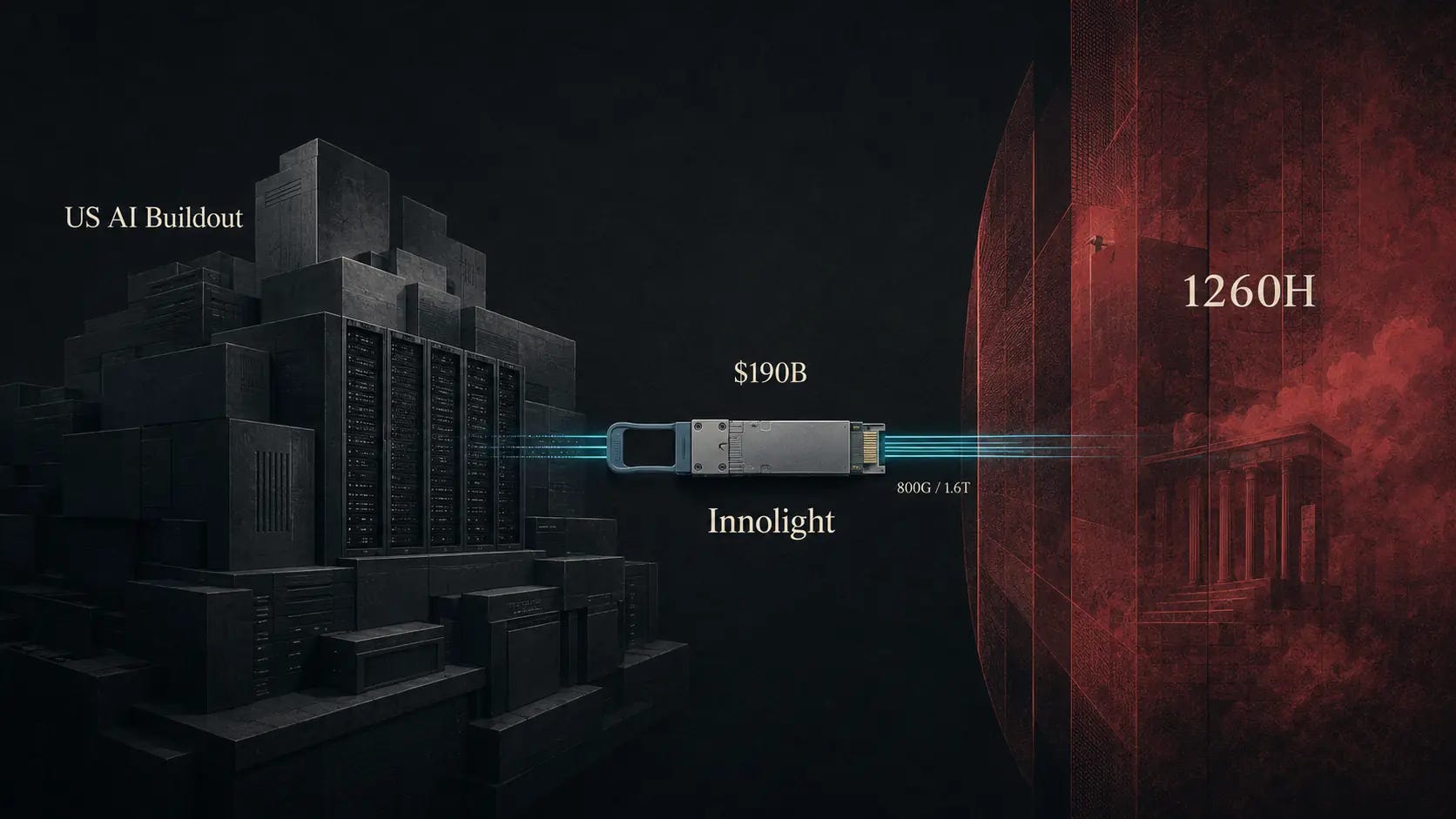
The company with the largest estimated share of high-speed optical transceivers for AI data centers is a Chinese manufacturer that few Western investors follow closely. Zhongji Innolight, based in Suzhou, posted Rmb 19.5bn ($2.9bn) in revenue in the first quarter of 2026, a 192% increase year on year. Net profit reached Rmb 5.7bn ($850m), up 262%. Gross margin hit 46%, a company record. That single quarter’s profit exceeded the company’s entire 2024 earnings.
Optical transceivers convert electrical signals into light and back. They connect servers, switches, and GPU racks inside data centers, moving the data that AI training and inference generate. As clusters scale from thousands to hundreds of thousands of GPUs, the physical capacity to move data between processors is emerging as a constraint alongside compute itself.
Market estimates put Innolight at roughly 35% to 40% of the global 800G optical module market and 50% to 70% of the emerging 1.6T segment. It supplies more than half of Nvidia’s 800G optical modules. In the broader optical components market, J.P. Morgan ranks Innolight alongside Coherent, a U.S.-based company, as a co-leader, each with roughly 20% share. The customer list is effectively a roll call of American big tech: Alphabet accounts for 22% of Innolight’s revenue, Amazon for 11%, Meta for 6.4%. More than 90% of revenue comes from outside China. This is a Chinese company whose commercial lifeline runs through North American data center budgets.
In the CSI 300, China’s benchmark index for large-cap A-shares, Innolight now carries the largest weighting at 5%, ahead of CATL, the dominant battery maker, at 4.1% and Kweichow Moutai, the country’s most iconic liquor brand, at 3%. A decade ago, the heaviest weights belonged to banks and consumer staples. That the top slot now belongs to a manufacturer of components connecting Nvidia GPUs captures a structural shift in what Chinese capital markets consider a core asset. The company’s market capitalization approached $190bn as of June 2026. It has reportedly filed for a Hong Kong secondary listing that could raise up to $7bn.
That same month, the U.S. Department of Defense added Innolight to its Section 1260H list of Chinese military companies, citing indirect state ownership through SASAC, China’s state asset regulator, and direct subordination to the Ministry of Industry and Information Technology. A company embedded in the AI infrastructure supply chains of Google, Amazon, and Nvidia now carries a Pentagon designation as a military-linked entity. The dependency runs in both directions. American hyperscalers draw heavily on Innolight’s manufacturing capacity to build AI infrastructure on schedule. Innolight relies on American capital expenditure flows to sustain the growth trajectory that has made it one of China’s most valuable technology stocks.
English-speaking investors have two familiar frameworks for Chinese technology companies: cash-burning startups exploiting a captive domestic market, and sanctioned incumbents building parallel ecosystems. Innolight fits neither. It is a globally embedded manufacturing platform inside the AI stack. Understanding its trajectory requires tracking three forces at once: the spending cycles of American hyperscalers, the escalation path of U.S.-China technology restrictions, and an optical technology transition that could reshape where the profit pool sits.