

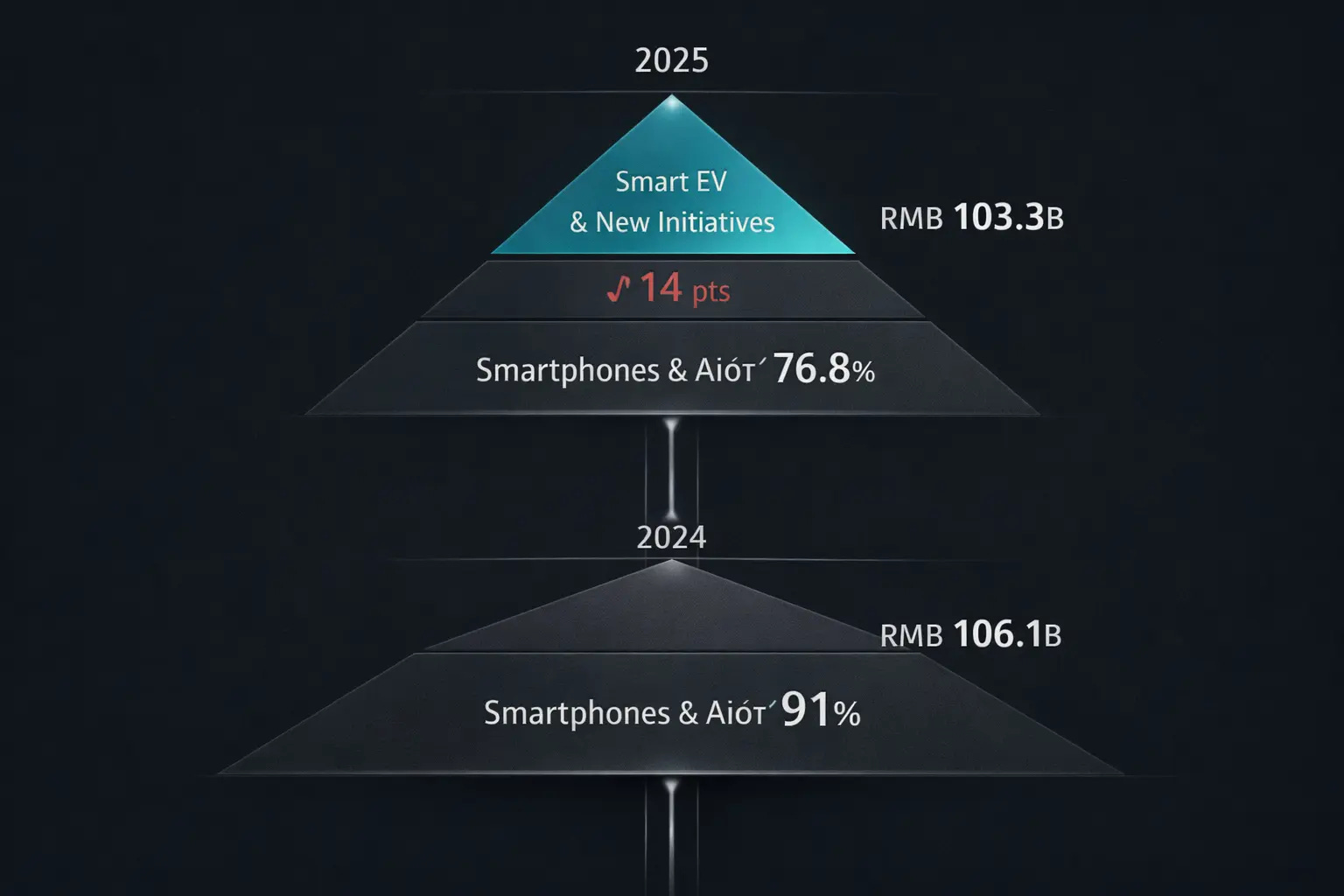
Xiaomi’s 2025 annual results, released on March 24, read like a victory lap. Full-year revenue reached RMB 457.3 billion, crossing the RMB 400 billion mark for the first time, up 25 percent year-on-year. Adjusted net profit hit RMB 39.2 billion, a 43.8 percent increase and an all-time high. The smart electric vehicle business alone generated RMB 103.3 billion in revenue. The broader segment that houses it, which also includes AI research, robotics, and chip development, recorded positive income from operations for the first time.
By almost any conventional measure, this was Xiaomi’s best year. But the most important story in this earnings report has nothing to do with records.
One year ago, Xiaomi’s smartphone and AIoT segment generated 91 percent of total group revenue. In 2025, that share fell to 76.8 percent. A 14-percentage-point shift in revenue composition within a single year is not incremental adjustment. It is the financial signature of a company whose economic center of gravity is migrating from smartphones toward electric vehicles and artificial intelligence.
The shift is undeniable. What remains far less clear is how to read the financial results of a company in transit. The profit numbers the market is celebrating have become increasingly difficult to decompose, blending the economics of a maturing car business with the costs of an AI program whose commercial model remains unproven.
The RMB 0.9 Billion Fog
The segment Xiaomi calls “Smart EV, AI and Other New Initiatives” reported income from operations of RMB 0.9 billion for full-year 2025, the first time this division has finished a year in positive territory. Vehicle deliveries tripled to 411,000 units. Average selling prices rose 7.1 percent to RMB 251,000. By any operational reading, the car business has achieved genuine scale in its second year of sales.
The RMB 0.9 billion figure, however, requires careful unpacking. This segment does not measure the car business in isolation. CFO Alain Lam was direct on the earnings call: “You cannot just look at this segment as just an auto segment. It includes other new businesses.” Those businesses include Xiaomi’s trillion-parameter MiMo foundation model, a robotics program that recently demonstrated three hours of autonomous factory operation, in-house chip development, and the Xiaomi miclaw AI agent platform now in beta testing.
The segment generated RMB 25.8 billion in gross profit on RMB 106.1 billion in revenue, a 24.3 percent margin. Operating expenses reached RMB 24.8 billion, an 87.7 percent year-on-year increase, consuming nearly all of that gross profit. The RMB 0.9 billion is what remained. The question the earnings report leaves unanswered: how much of the RMB 24.8 billion relates to building and selling cars, and how much funds AI, robotics, and chip R&D?