


The signals arrived in sequence, then all at once. In April 2025, Reuters reported that OpenAI was building an internal prototype of an X-like social media platform, complete with a social feed built around ChatGPT’s image generation. Seven months later, in November 2025, OpenAI rolled out group chats inside ChatGPT, allowing up to 20 people to collaborate with the AI in a shared conversation. Then, in the last week of January 2026, three of China’s biggest tech companies, Baidu, Tencent, and Alibaba, launched their own AI group chat products almost simultaneously. Over the same stretch, Snap struck a $400 million deal with Perplexity to embed AI search inside Snapchat, Meta pushed its Meta AI app with a short-form video feed called “Vibes,” and xAI integrated Grok deeper into X’s social timeline.
Over the course of a single product cycle, the leading AI labs and platforms converged on the same conclusion: they needed social.
The obvious question is why. These companies possess models that can write code, analyze research papers, generate photorealistic images, and reason through complex problems. Why would they reach for something as ancient and messy as social interaction?
The answer points to a structural crisis that most AI coverage has underplayed. People do not use AI products often enough or deeply enough for the business models to work. And social may be the most structurally complete response to this problem.
The Engagement Ceiling
The numbers are sobering.
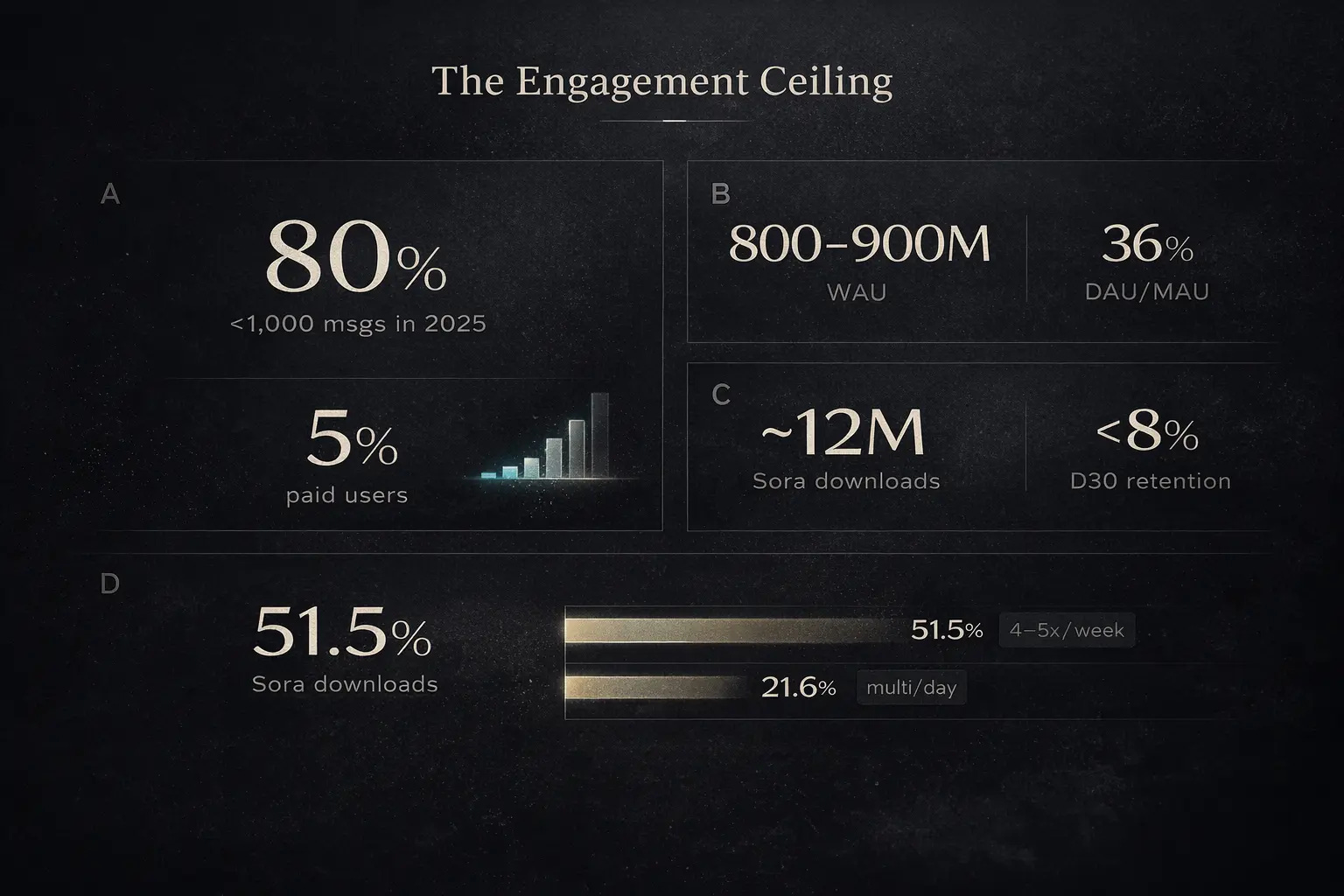
Benedict Evans laid them out in February 2026: 80% of ChatGPT users sent fewer than 1,000 messages in all of 2025. At face value, that averages to fewer than three prompts per day. Only 5% of ChatGPT’s users pay for the service. Even US teens, supposedly the most digitally adventurous demographic, use AI chatbots a few times a week or less.
The a16z “State of Consumer AI 2025” report builds a complementary case. ChatGPT has an estimated 800 to 900 million weekly active users across platforms, according to third-party data aggregated in the report, making it one of the most widely adopted products in history. But weekly active is the operative term. a16z estimates a DAU/MAU ratio of just 36%. And despite an aggressive year of product launches (group chats, the Sora app with an estimated 12 million downloads but sub-8% thirty-day retention according to third-party tracking, the Atlas browser, shopping research, tasks, study mode), the report’s verdict was blunt: “We would argue that none of the new experiences have truly ‘broken through’ in terms of either usage or retention.”
Chinese data tells a parallel story. Only 51.5% of Chinese AI users engage with large language models four to five times a week, and just 21.6% use them multiple times daily.
Evans’s assessment cuts to the core: “If people are only using this a couple of times a week at most, and can’t think of anything to do with it on the average day, it hasn’t changed their life.” OpenAI itself acknowledges the gap, describing a “capability gap” between what the models can do and what people actually do with them. Evans reads this less generously: “seems to me like a way to avoid saying that you don’t have clear product-market fit.”
This is the crisis behind the social push. The engagement ceiling is a structural consequence of the one-on-one chatbot paradigm. Open a chat, ask a question, get an answer, close the app. The pattern resembles search: intermittent, utilitarian, easily dropped. Model improvements alone do not change this fundamental dynamic. As Evans writes: “It’s at least equally likely that they’re stuck on the blank screen problem, or that the chatbot itself just isn’t the right product and experience for their use-cases no matter how good the model is.”
The Social Hypothesis
Whether AI social will succeed remains genuinely uncertain. But social stands out as one of the few product directions capable of simultaneously addressing the engagement, retention, and monetization challenges that every major AI company now faces. Enterprise copilots, AI browsers, and voice assistants may also expand usage, but none currently combines frequency, network effects, behavioral data density, and commercial surface area as directly as shared social or collaborative environments. a16z’s retention data, Evans’s frequency analysis, and OpenAI’s own recent move into advertising testing (announced February 9, 2026, targeting Free and Go tiers in the US) all independently confirm that these pressures are real and intensifying.
Social features address five distinct structural problems at once.
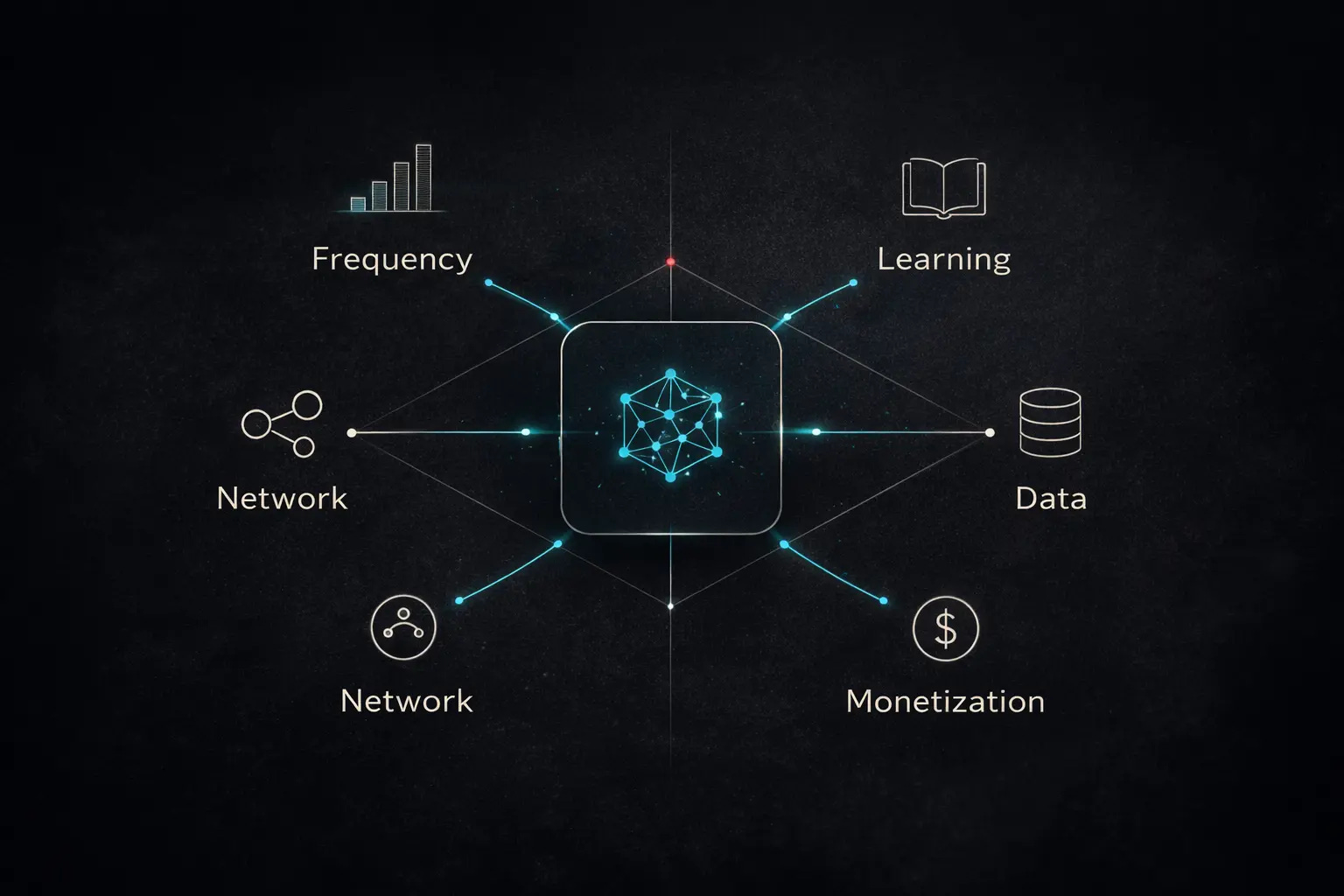
Frequency: from tool to environment.
A tool gets picked up when needed and put down when finished. A social space has people in it, which creates reasons to return whether or not you have a specific task. Chinese AI discourse has crystallized this shift with the phrase “常驻在场” (perpetual presence). The significance has been widely noted: for the first time, AI can move from being a one-time response tool to becoming part of users’ daily relationship networks and collaboration environments. Tencent’s design philosophy has been described as a shift from asking AI questions to coexisting with AI, transforming the chatbot from a search box into what one Chinese-language account called a “silicon-based group member who can read context, get the joke, and get things done.”
Network effects: the structural moat AI companies lack
Evans identified OpenAI’s most fundamental weakness: “It doesn’t have unique tech. It has a big user base, but with limited engagement and stickiness and no network effect.” Users can switch from ChatGPT to Gemini or Claude at zero cost. Ben Thompson made a related observation: ChatGPT’s consumer moat rests on the difficulty of “changing the habits of 800 million+ people,” but habit alone is inertia, not structural lock-in.
Social features create structural lock-in of a different kind. If your friends, family, or coworkers are in an AI group chat, you stay. This is precisely why Tencent built its AI social product “Yuanbao Pai” on top of WeChat and QQ relationship chains, letting users share invitation links directly to WeChat friends and instantly bringing their social graph into the AI environment. The same logic explains why Meta embedded Meta AI across Facebook, Instagram, and WhatsApp, and why Snap paid Perplexity $400 million to live inside Snapchat’s social fabric rather than standing alone.
User education: dissolving the blank screen
OpenAI’s “capability gap” means users do not know what AI can do for them. In a one-on-one chat, you face the blank prompt alone. In a group setting, you watch others interact with AI, and this implicit education through observation lowers the barrier far more effectively than tutorials or feature announcements.
Baidu’s group chat product, according to one detailed account, is designed around this insight. Each group includes multiple specialized AI agents (a health advisor, a personal assistant, a content expert) that any member can invoke. You do not need to figure out what to ask; you see someone else summon the health advisor and realize you can do the same. According to the same report, the AI agents also proactively contribute based on conversation context, using what is described as an OODA-style loop (Observe-Orient-Decide-Act) to determine when to speak and when to stay quiet.
Data quality: richer signals from social interaction
A one-on-one query produces a simple request-response pair. A group conversation produces relationship dynamics, preference patterns, decision-making processes, and cultural context, all far richer signals for model improvement and personalization. AI group chats, one analysis noted, enable platforms to construct what it termed “user-side digital twins” (用户侧数字孪生): persistent models of individual users derived from their social behavior, communication style, and collaborative patterns. The Reuters report on OpenAI’s social media prototype separately highlighted that both Meta and X possess massive amounts of public content posted by their users, precisely the kind of behavioral and preference data that OpenAI lacks.
Monetization: from subscriptions toward advertising and commerce
In late 2025, Ben Thompson argued that OpenAI’s refusal at that time to launch ads, three years after ChatGPT’s debut while signing deals for over a trillion dollars of compute, amounted to “a dereliction of business duty.” OpenAI has since acted: on February 9, 2026, it began testing ads in ChatGPT for US users on the Free and Go tiers, with explicit commitments that ads do not influence answers and advertisers cannot see conversations. The move confirms the monetization pressure that had been building throughout 2025.
But advertising in a one-on-one tool context remains structurally awkward. Social contexts offer more natural commercial surfaces: group trip planning leads to restaurant recommendations, collaborative shopping research leads to product discovery, shared media consumption leads to content promotion. Tencent’s 1 billion yuan (approximately $140 million) Spring Festival red packet campaign is a case in point: a socially driven distribution and habit-formation subsidy, designed to replicate the explosive adoption of WeChat Pay during the 2015 Spring Festival. The red packets themselves are activation, not revenue. But if they succeed in seeding AI-powered social spaces, those spaces create durable surfaces for commercial integration: group shopping, content promotion, and task-driven recommendations all become structurally possible once users are embedded. Snap’s Perplexity integration follows related logic, explicitly designed to open “a new stream of revenues” beyond Snap’s struggling ad business.
Different Assets, Different Experiments
What makes this moment particularly revealing is that the US and China have converged on the same structural conclusion while taking sharply different approaches, shaped by the assets each side already controls rather than by abstract product philosophy.
