
Weekend Brief: China’s Innovation Infrastructure — When Governance Becomes Code
Four articles reveal the architectural pattern reshaping Chinese tech — from AI regulation to city models.

Four articles. Four sectors. One architectural pattern that explains them all.
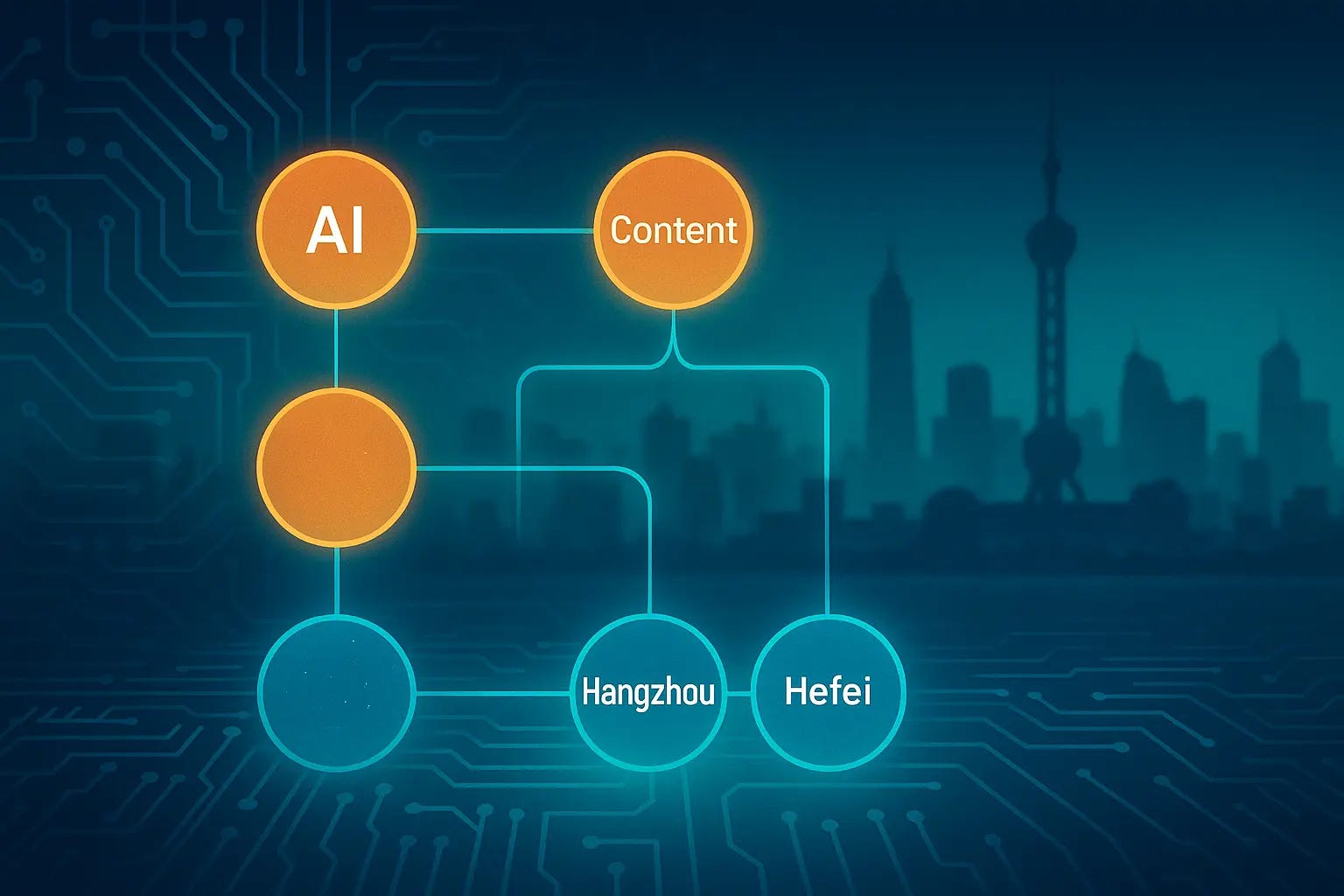
Over recent months, I’ve analyzed China’s approach to AI regulation, examined two contrasting city models, and explored content governance. Read separately, they’re sector stories. Read together, they reveal something more fundamental: China is building governance as infrastructure, regulation as enabler, control as code.
The Pattern Beneath the Headlines
China’s AI regulation isn’t about restriction — it’s about creating predictable pathways. While the U.S. deregulates and Brussels builds risk taxonomies, Beijing processes 801 AI service approvals through a two-tier system that treats compliance as developmental infrastructure.
The content labeling mandate embeds accountability at the technology layer. Dual watermarks — visible and metadata — make untraceable synthetic content technically impossible. Not censorship. Engineering.
Hangzhou’s ecosystem emerged from accidents: Alibaba stayed, universities transformed, merchant networks deployed capital. Coordination without a coordinator. When DeepSeek and Alibaba moved five days apart in September 2025, it wasn’t planned — it was emergent alignment from contingent forces.
Hefei’s model took the opposite path: deliberate government-led venture investing that transformed a provincial capital into a semiconductor hub. The “$21B memory chip bet” isn’t just CXMT — it’s testing whether this model survives its fiscal crisis.
Why It Matters
Traditional frameworks miss this. The debate fixates on “state control vs. market freedom” — a binary that obscures the actual mechanism.
China isn’t choosing between control and innovation. It’s building systems where regulatory approval enables downstream development, where government capital anchors industrial clusters, where ecosystems coordinate through signaling rather than commanding.
The implications:
For investors: You’re not evaluating companies — you’re evaluating financing ecosystems with no Western equivalent. Due diligence must account for fiscal sustainability of backing entities, sector overcapacity from copycat programs, geopolitical exposure.
For competitors: Understanding Chinese advantages requires understanding this architecture. Dismissing coordination as “state direction” misses how it actually works.
For policymakers: Three different systems — U.S. deregulation, EU risk frameworks, China’s approval infrastructure — are running parallel experiments. Each reveals trade-offs the others haven’t confronted.
The Unresolved Questions
Hefei’s patient capital depends on exits that may not materialize. Hangzhou’s alignment has no intrinsic reason to persist. The regulatory predictability may constrain the creativity it’s meant to enable.
These aren’t conclusions. They’re live experiments being run at national scale.
What You’re Missing
You just read a synthesis connecting regulatory infrastructure, capital coordination, and ecosystem emergence across Chinese tech. This pattern took months to identify and articulate.
Here’s what free subscribers don’t see:
When Alibaba announced its $53B AI bet in September 2025, Premium subscribers received exclusive on-the-ground analysis from China — not explaining what happened, but why it matters: the four critical signals determining whether this becomes a monopoly or money incinerator, and the most likely endgame (a state-sanctioned duopoly with Huawei that reshapes China’s tech landscape). Intelligence you won’t find in Western coverage.
When DeepSeek adopted TileLang five days later, Premium subscribers got the insider perspective: this wasn’t a technical choice, it was phase two of building a China-controlled AI stack. The deep-dive explained why coordination isn’t conquest when Nvidia’s CUDA moat remains this deep — analysis grounded in understanding how Chinese tech ecosystems actually coordinate.
The difference between free and Premium isn’t volume — it’s access and depth.
Free subscribers recognize patterns after they’ve formed. Premium subscribers get China-sourced intelligence that explains how these patterns emerge — before Western media catches on.
Follow on 𝕏 for daily insights | Questions? Reply to this email — I read every message.