

The Denial
On July 30, The Wall Street Journal reported that Tesla advisers had discussed a spinoff, sale or closure of the China business, and that some executives had been told to prepare for a separation ahead of a possible merger with SpaceX. The planning reflected a standing instruction from Musk, according to the Journal’s sources: run the company with a “laser” down the middle, so a US-China rupture would take out one side and leave the other trading.
Musk answered on X hours later. “This has never even come up in a discussion ever. Absurdly fake news.” Tesla’s China unit told Chinese media the report was untrue. No 8-K followed.
The denial is broad in an unusual way. It rejects the conversation itself, a step further than denying a decision. The analysis that followed took the same frame. Reuters Breakingviews argued a buyer would demand a discount and that a carved-out unit would stay dependent on licenses from its former parent. A Reuters legal analysis walked through why shared software, IP and data governance would slow any deal. All of it argues about a transaction that may never happen.
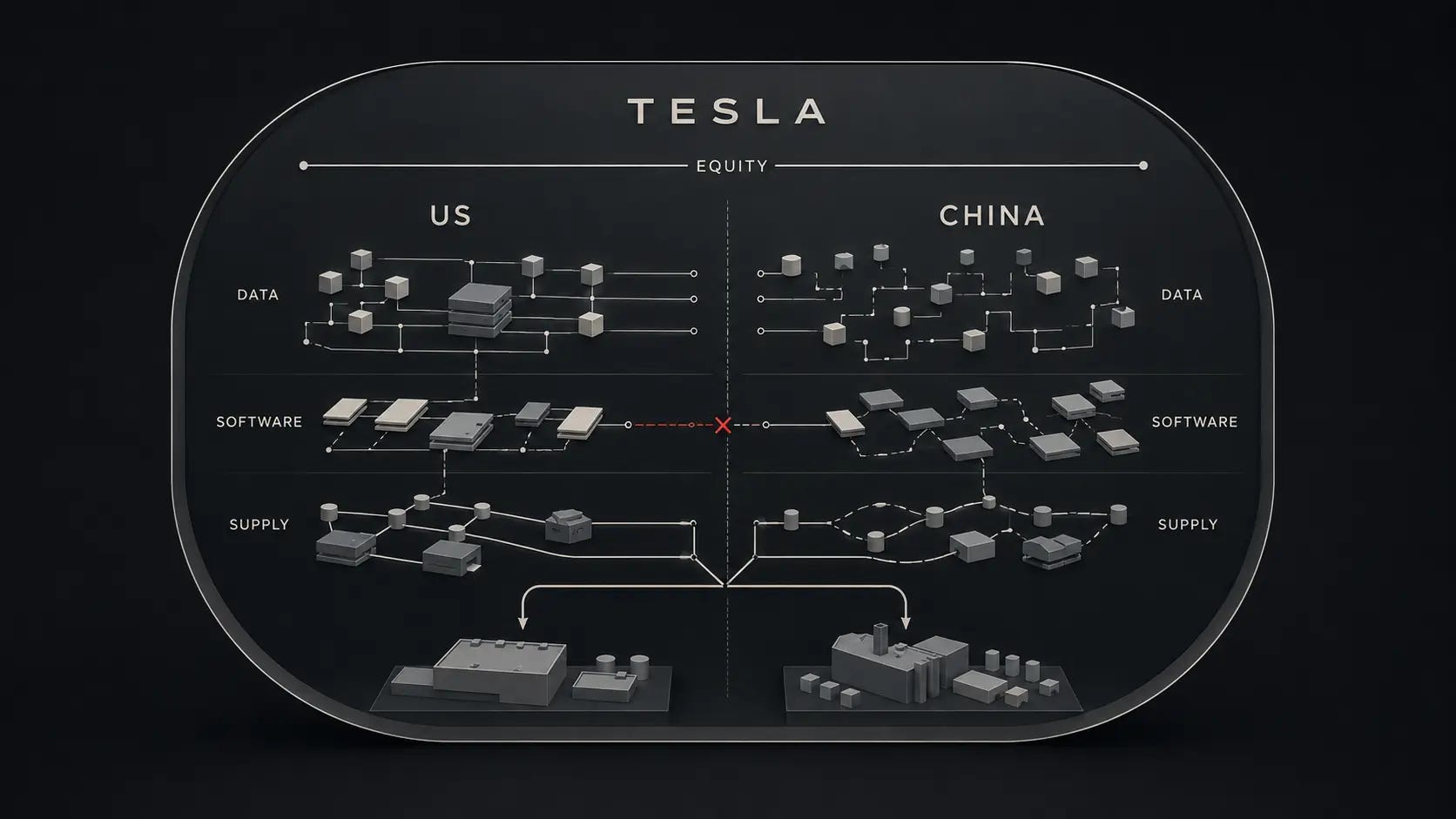
Operational separation does not require a transaction. Tesla’s China business has regionalized along four lines: a hard data boundary set by Chinese rules, software stacks diverging under rules on both sides, supply chains split by end market under tariff and continuity pressure, and a local funding base from Chinese banks. A sale would transfer the equity easily enough. The software licenses, data governance and valuation gap are the hard parts. Soft isolation may therefore be an equilibrium rather than a waypoint to a transaction.
Two Walls, One Company
Beijing built the first one. Since 2021, data from China-market vehicles has stayed on servers in Shanghai. Foreign carmakers cannot independently hold the surveying qualifications needed to collect road-mapping data, so Tesla licenses maps and lane-level navigation from Baidu, the country’s dominant search company. Material over-the-air updates that change driver-assistance behavior must be filed with or approved by MIIT, China’s industry ministry. A June 2025 draft guidance classified data used to train autonomous driving as important data, needing a security review before it leaves the country.
Each requirement reads as ordinary compliance. Stacked, they cost Tesla something. When it shipped a feature-limited China release in February 2025, it could neither move Chinese road data to its US clusters nor train on an equivalent local set, and Baidu engineers were in its Beijing office by March fitting the system to Chinese lane-level navigation. China joined Tesla’s supervised FSD markets in May 2026, still as a Level 2 system. Chinese industry media report that local training capacity is being built, though Tesla has not disclosed its scale or legal entity.
Washington built the second. The Commerce Department’s connected vehicles rule took effect on March 17, 2025. Software restrictions bind from model year 2027, connectivity hardware from model year 2030. March 17, 2026 is the legacy line: older code keeps its exclusion only while entities under Chinese jurisdiction refrain from maintaining, enhancing or modifying it. Example 38 reaches software developed through a China-based subsidiary that retains servicing obligations or contractual rights.
Tesla helped shape that perimeter. In an October 2024 comment letter it asked Commerce to keep firmware outside the definition and to exclude software that merely supports other systems. The final rule did both, narrowing covered software to what directly enables connectivity or automated driving.
The rule reaches Tesla through legal entity rather than corporate nationality. Chinese supplier filings then show who is financing the regionalization below the automaker.
This piece runs the Identity Squeeze framework in reverse, applying it to an American company being pulled apart by two regulators rather than a Chinese one assembling an American identity. If that lens is useful, subscribe free and get every new analysis as it publishes.