

Two Documents, One Day
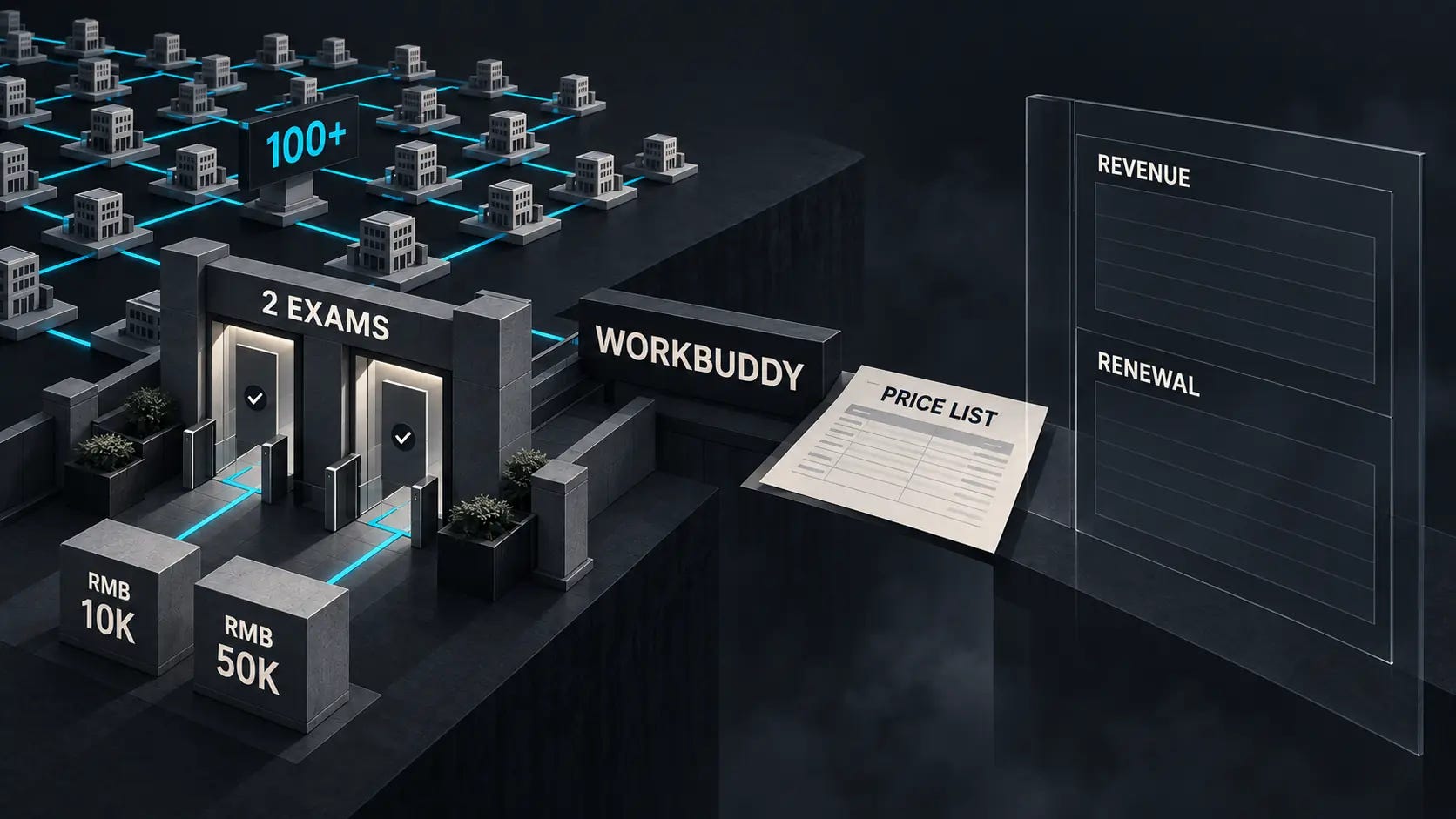
On September 2, Tencent opened WorkBuddy, its AI office agent, to outside developers and hardware makers. More than 100 partners joined, covering HR software, tax and accounting, business intelligence, marketing and securities data, plus glasses, recorders and earphones. English-language outlets covered it as an ecosystem story.
Tencent Cloud published a second document the same day. It sets out who may resell WorkBuddy.
The general bar for a reseller in Tencent Cloud’s partner system is registered capital of at least Rmb 1m, one year of trading, three full-time salespeople and a Rmb 10,000 deposit. WorkBuddy adds a layer of its own. At least three staff must complete a WorkBuddy product-sales exam, and at least three must pass a second certification named in the document as the Tencent WorkBuddy Efficiency Agent OPC Practitioner. The document does not require the two groups to be different. The partner posts another Rmb 50,000, taking the deposit to Rmb 60,000, about $8,800, and signs a confidentiality undertaking bearing the company seal.
No other product in that document carries its own bar. Exams for TDSQL, Tencent’s distributed database, and TencentOS, its server operating system, appear only as substitutes for the generic sales exam. WorkBuddy’s two are additional.
The consumer product went into closed testing in February. A separate enterprise edition launched on June 5. Three months later it has a professional certification.
The Machine Is Easier to See Than the Market
Tencent has gone furthest in making a product-specific channel visible. Rivals are moving toward enterprise distribution through different structures. Baidu launched a partner alliance for its DuMate agent in July, with tracks for resellers, software partners and delivery partners, promising industry-leading commissions without naming a rate. Alibaba sells QwenWork through Alibaba Cloud’s procurement structure. ByteDance moved the sales arm of Feishu, its collaboration suite, into its cloud unit Volcano Engine and folded the Feishu product team into Doubao.
The state has been building admission rules in parallel. Analysys, a Beijing research house, identified a cluster of second-quarter policy measures covering tiered governance of agents, anthropomorphic AI services, and national standards for agent interconnection.
All of this arrived quickly, and on a thin base of commercial evidence. Analysys counted about 60.6m interactions in June across the seventeen platforms it lists, with WorkBuddy at 20.97m.
Enterprise software usually earns its channel in the other order. A vendor proves that customers renew, then recruits resellers to scale what works. Here the infrastructure for selling WorkBuddy is more visible than the evidence needed to measure what it sells. Customers and usage exist. No company disclosure carries a reliable number that lets an outsider size paid demand or measure renewal.
There is a reason the channel comes first. A Tencent Research Institute survey of 2,012 online respondents, fielded in March and published in May, found 9.8% had paid for a large-model product. The sample skews young and better educated, which may flatter the number. Caijing, a Beijing financial magazine, polled 417 technology workers in late August in a directed sample. Among those who picked WorkBuddy as their one indispensable agent, 79.7% worked outside product and engineering, the people least able to expense a tool. A Chinese software founder put it plainly: no company here buys a Rmb 20,000 enterprise product without a salesperson in the room. Individual plans do sell. But a payment rate that low pushes Tencent toward employers, and enterprise customers in China are reached through direct sales and on-site work.
Tencent’s own second-quarter release shows the gap. It describes WorkBuddy as achieving rapid user growth and healthy retention, with strong willingness to pay through subscriptions and token top-ups. Three adjectives, and no number attached to the product anywhere. The one quantitative anchor is a footnote naming Analysys and defining its metric as monthly desktop visits in June.
Tencent has published a great deal about how WorkBuddy works and how it will be sold, and little that lets an investor measure demand. Its pricing page comes closest to showing the commercial design.
Hello China Tech publishes three analyses a week on China’s AI, chips, robotics, and EVs, built from primary sources rather than second-hand coverage. If reading a vendor’s public price list as its most complete financial disclosure is the kind of reading you want more of, subscribe free and get each one as it publishes.