

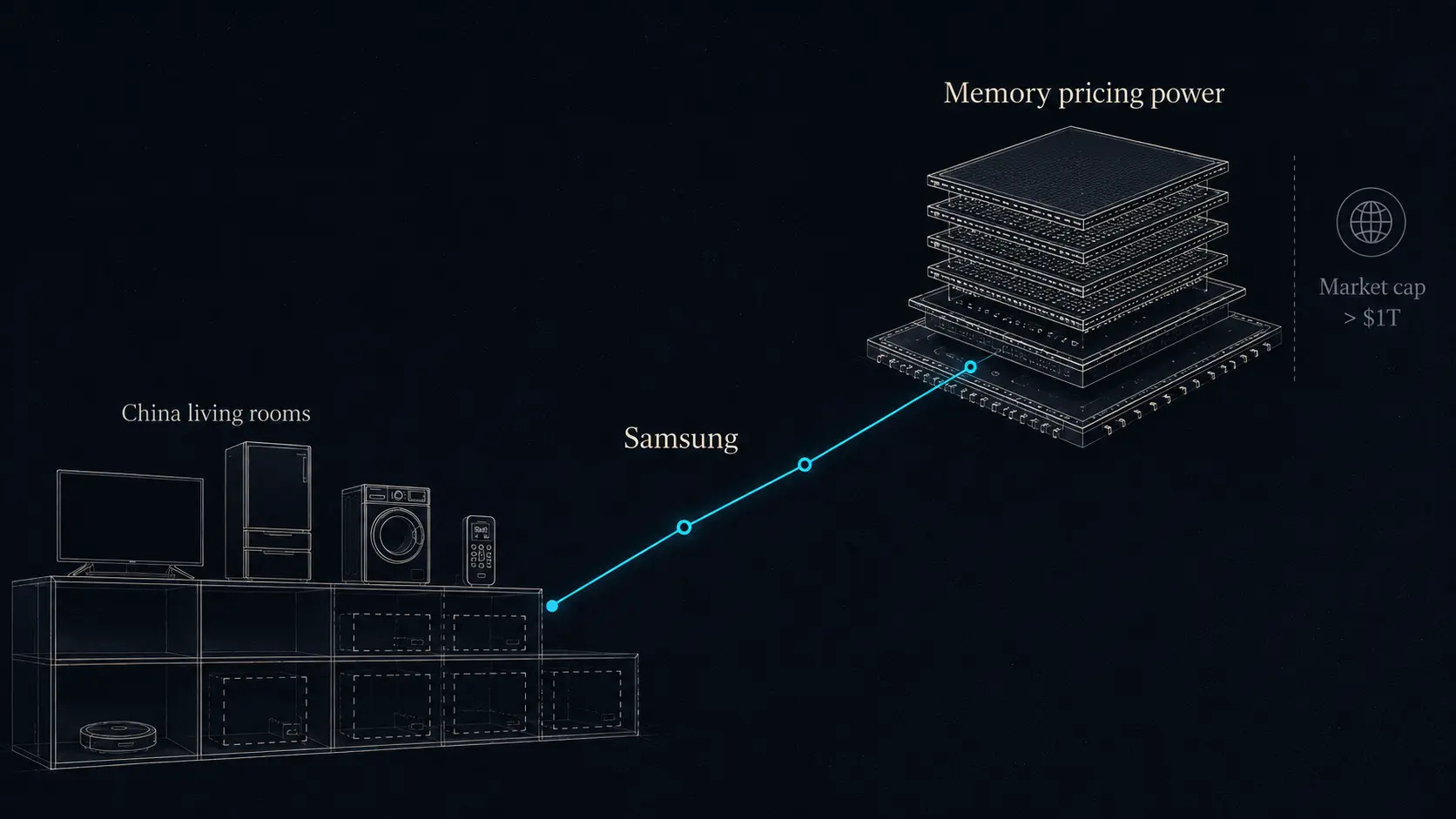
On May 6, 2026, Samsung Electronics announced it would stop selling televisions, monitors and home appliances in mainland China. The list covers refrigerators, washing machines, air conditioners, audio products, projectors, vacuum cleaners and air purifiers. Production at its Suzhou home-appliance factory is not affected. Smartphones and chips remain on sale in China. But after 34 years, Samsung’s TV, display and home-appliance presence on mainland Chinese shelves is effectively over.
Samsung says existing customers will continue to receive after-sales support under Chinese consumer-protection rules, and the company is reviewing support measures for business partners.
The same day, Samsung’s stock surged 13%. Its market capitalization crossed $1 trillion, making it the second Asian company after TSMC to reach that threshold. The semiconductor division had just reported quarterly operating profit equivalent to roughly 94% of the entire group’s earnings.
Investors did not treat this as a defeat. They treated it as overdue housekeeping.
The juxtaposition is revealing. A company can lose a major consumer market and still become more valuable when investors believe that market no longer matters to its profit base. That paradox points to a deeper structural shift in who captures value in the electronics supply chain, and what “winning” means at different layers of the stack.
Samsung’s TV and home-appliance division recorded its first-ever operating loss in 2025. WSJ put the deficit at 200 billion won, or about $138 million. In China specifically, the numbers had long been worse. Market research firm AVC Revo put Samsung’s offline share at 3.62% for color TVs, 0.41% for refrigerators and 0.38% for washing machines as of early April. Separately, full-year 2025 AVC data cited by Jiemian showed its online TV share at just 0.67%.
The last meaningful presence was a niche following for Samsung’s “The Frame” lifestyle television on social media. The exit even triggered a final burst of demand. Jiemian reported that some stores received a wave of customer inquiries, while JD.com said Samsung TV transaction value rose more than 200% year over year after the announcement. But that was residual brand equity, not a national business. Samsung was no longer a mass-market player. It had a following too small to sustain a national sales and service operation.
From Peak to Footnote in a Decade
Samsung entered China’s appliance market in 1992. Its broader China business peaked in 2013, when total China revenue hit $25.7 billion across categories including smartphones and large-screen TVs, with market-leading positions in both.
The competitive story was structural, but Samsung also weakened its own position through a series of local missteps. Three moments help explain the decline.
The exit was not abrupt. Jiemian reported that Samsung had largely stopped supplying the mainland market after the Lunar New Year holiday. One Samsung store employee estimated total remaining inventory at roughly 30,000 units.
The first was the Galaxy Note 7 battery crisis in September 2016. Samsung initially excluded China from its global recall, publicly claiming Chinese units were safe. When Chinese units also caught fire, the company’s local team delayed acknowledgment until regulators intervened. The episode attached a “double standard” label to Samsung’s brand in China. The trust damage bled from smartphones into appliances and televisions. Smartphone revenue in China dropped 38% that year and never recovered.
The second was a series of factory closures that hollowed out Samsung’s local manufacturing base. The Shenzhen and Tianjin phone factories closed in 2018. The last Chinese phone production line, in Huizhou, shut in 2019. The sole remaining television factory in Tianjin ceased operations in 2020. Each closure removed a layer of local supply chain integration.
The third was a failed outsourcing experiment. In 2021, Samsung handed its white-goods business, including refrigerators, washing machines and air conditioners, to two Chinese distributors, one focused on premium retail and the other on small-town shops. Within two years, the arrangement collapsed. The premium distributor lacked volume to sustain a meaningful retail presence; the small-town partner sold Samsung hardware through channels that undercut its positioning. Pricing discipline broke down and after-sales service became disorganized. By the time Samsung reclaimed direct sales in 2024, the retail infrastructure it needed had already consolidated around domestic brands.
The later failures, especially channel outsourcing and product adaptation, point to the same organizational constraint. Samsung’s China operation functioned as an execution arm, not a decision-making unit. Product definition, pricing authority, and channel strategy all required sign-off from Seoul. This architecture might work in stable markets where global product-market fit translates across geographies. China’s appliance market after 2016 was not stable. Competitors iterated monthly. Samsung’s approval cycles ran quarterly to annually. The mismatch compounded over time, and by the time it showed up in market-share data, recovery had become unlikely.
Category-level data sharpen the picture. The appliance business peaked slightly later than Samsung’s overall China revenue. Samsung sold roughly $3 billion of TVs and $1 billion of home appliances annually in China during 2014–2015. By its 2026 operating plan, TV sales targets had fallen to about 5% of that peak. White-goods targets stood at about 1%.
Samsung’s exit completes a pattern that began with Japanese brands a decade earlier. But the more interesting question is not why foreign appliance makers lost China. It is what Samsung’s financial results reveal about where value has migrated in the electronics supply chain, and why the market rewarded a retreat. The answer involves three mechanisms: panel self-sufficiency, Mini LED cost compression, and memory pricing power.
