

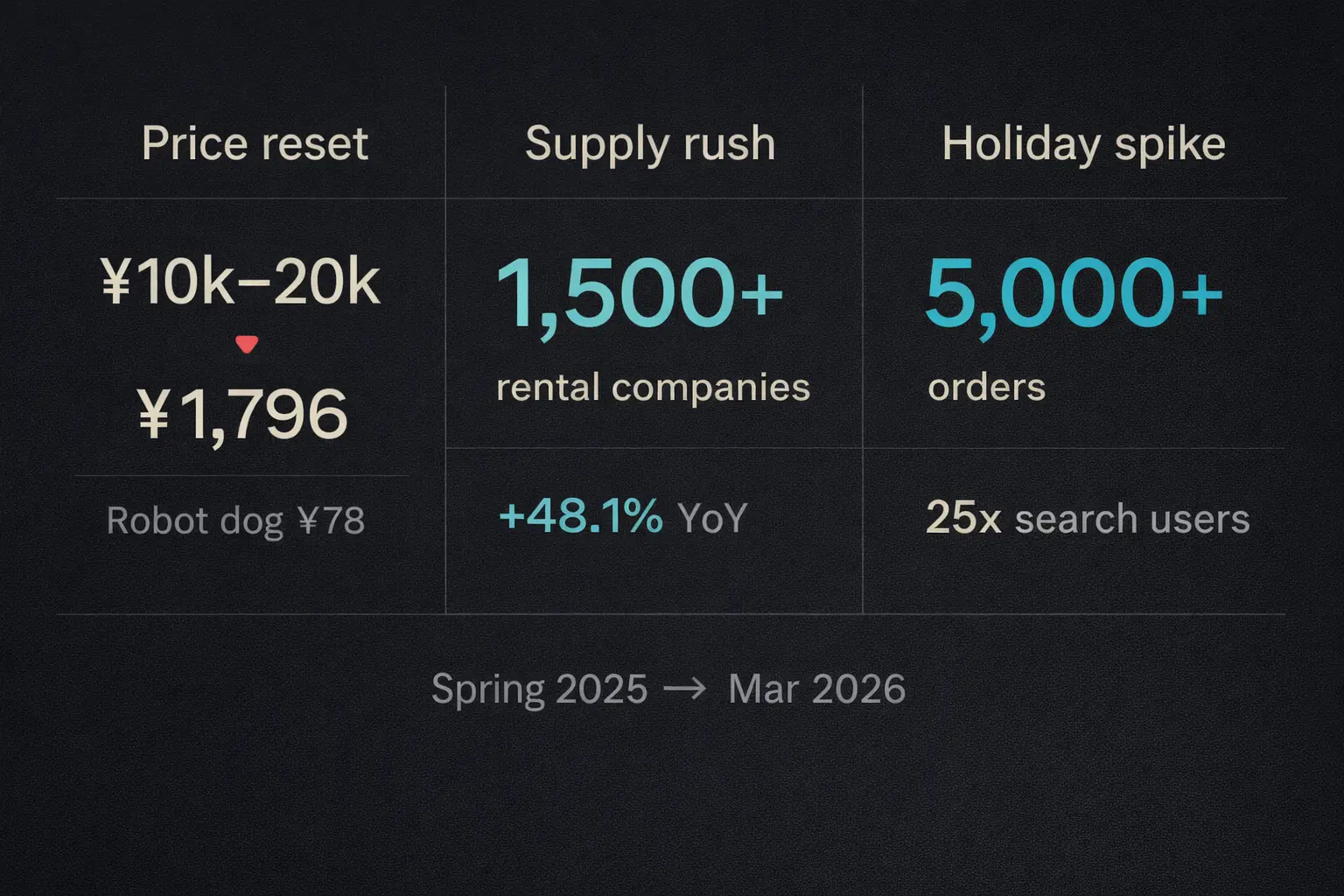
In the spring of 2025, renting a humanoid robot for a corporate event in China cost between 10,000 and 20,000 yuan per day. By March 2026, JD.com’s rental storefront lists a Unitree humanoid, with on-site engineer included, starting at 1,796 yuan. A robot dog rents for 78 yuan a day. An 80 percent price decline in twelve months.
Yet the rush of entrants tells the opposite story. Over 1,500 robot rental companies registered across China in 2025, a 48 percent year-over-year increase. In December, Agibot (智元机器人), a humanoid robot manufacturer, launched Qingtian Rent, a rental platform it controls. Hillhouse (高瓴), a prominent Chinese venture capital firm, led its seed round weeks later. JD.com opened a self-operated rental store. A competitor called Wanji Yizu raised an angel round and announced plans to cover 300 cities. When Qingtian Rent opened recruitment for city partners in mid-February, over 16,000 people had applied for 600 positions by month’s end.

The prevailing narrative frames robot rental as an emerging technology platform, the hardware equivalent of cloud computing’s pay-as-you-go model. IDC has listed Robot-as-a-Service among the six defining trends for embodied intelligence. One Chinese industry analyst projects the rental market to approach 10 billion yuan in 2026, up from under one billion. The 2026 Spring Festival provided supporting data: Qingtian Rent reported a 70 percent order surge during the holiday week, with cumulative volume exceeding 5,000. JD.com saw robot-related search users increase 25-fold year over year.
These numbers are real. They also mask a structural problem.
In China’s current rental market, every deployed robot effectively arrives with a human engineer. That engineer handles transport, on-site calibration, live operation, battery swaps, troubleshooting, and safety. In practice, every commercial rental deployment today is engineer-bundled. Scale has not yet loosened that dependency. The human escort is the operating model. And it inverts the economics that make service businesses grow efficiently. Traditional SaaS expands by pushing marginal human cost toward zero. Robot-as-a-Service expands by attaching a salaried body to every unit in the field. The binding constraint on this industry is not the supply of machines. It is the supply of people who can operate them.
China’s robot rental boom is the embodied AI industry’s most inventive revenue channel and its most revealing self-portrait. The market grows because robots can entertain audiences at a price event organizers will pay. It requires a human behind every machine because robots cannot yet do much else. As I have previously argued, the distance between capital flowing into embodied AI and the technology’s functional readiness remains wide. Rental economics now measure that distance from the demand side.
