

Editor’s Note: FlashPoint is our premium quick-strike column on market-moving China tech events. Today: Meituan, China’s dominant food delivery platform, redefines AI agents as a new customer category. I have examined WeChat’s emerging AI access protocol, Meituan’s Q1 financial shift, and the delivery war’s Rmb 62bn damage.
On June 1, 2026, Meituan CEO Wang Xing used the Q1 earnings call to introduce a new direction: beyond serving consumers (To C) and merchants (To B), Meituan would serve AI agents (To A). One week later, the company created an AI Transformation department inside its core local commerce division, ranked parallel to food delivery and Instashopping, its instant-retail arm, reporting directly to the division’s CEO. In May, Meituan released an agent-callable “Errands Skill,” packaging on-demand courier ordering as a callable function for AI assistants. These capabilities remain early and selective. The first published capability is courier ordering, while broader food-delivery and local-services integrations through WeChat’s AI ecosystem remain in testing. Meituan is preparing for a world in which it may not control the user’s first AI interaction, offering itself as the fulfillment engine behind external agents.
The near-term counterparty is Tencent. Yuanbao matters less for immediate traffic than as a test path toward WeChat, where Tencent’s agent framework could become the real routing layer for local-services demand.
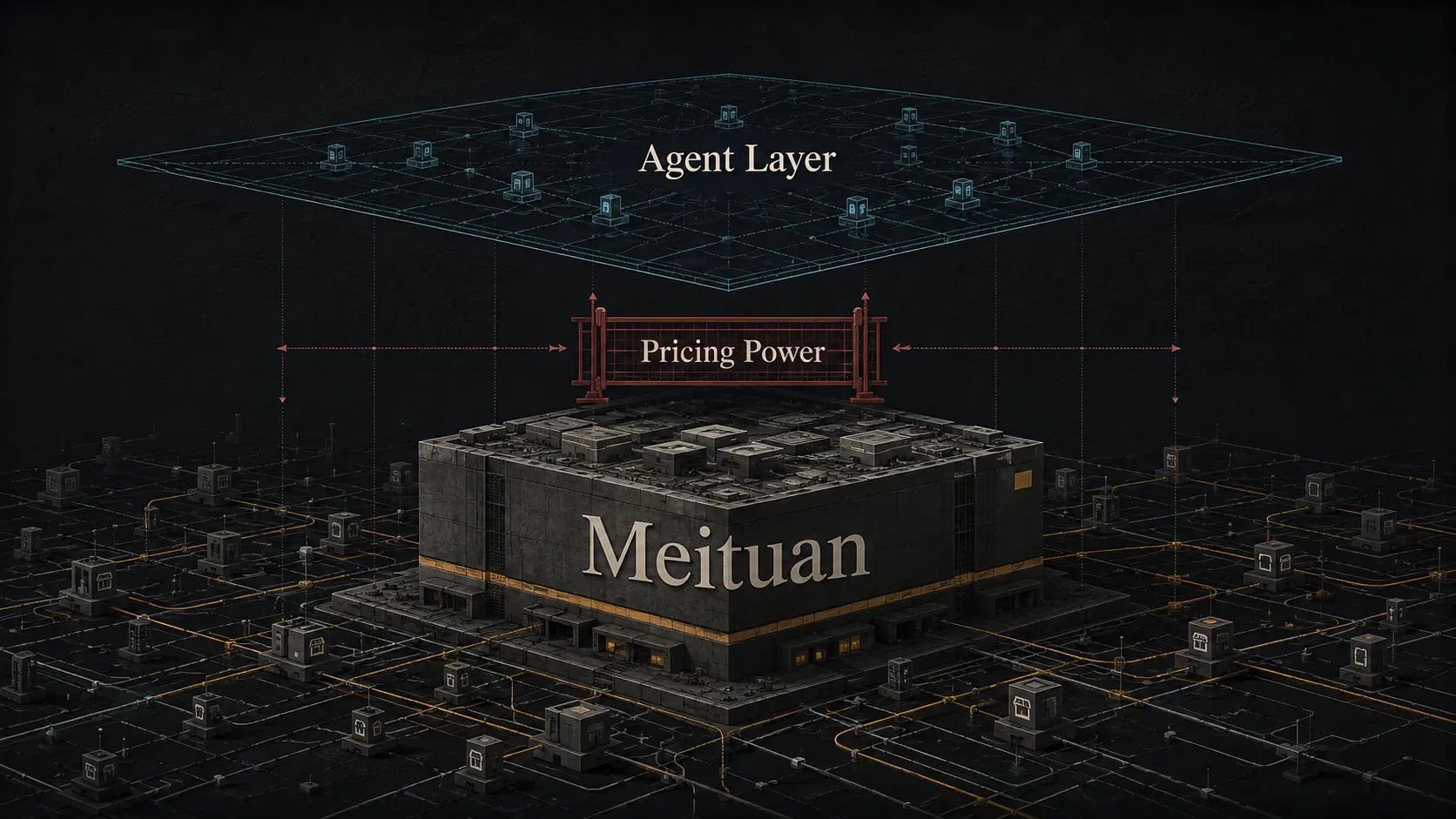
The defensive logic is straightforward. ByteDance’s Doubao, which had 345 million monthly active usersin March, is building a closed loop from AI conversation to local services to delivery. Alibaba is applying a similar closed-loop logic through Qwen, its AI assistant, and its own commerce services. If either succeeds, users complete local-services transactions without Meituan entering the chain. “To A” concedes that Meituan may not own the conversation. The bet: an agent completing a local-services task would, in most Chinese cities, still depend on Meituan’s rider fleet and merchant network for fulfillment. Agents will call Meituan. The question is whether Meituan can price the call.
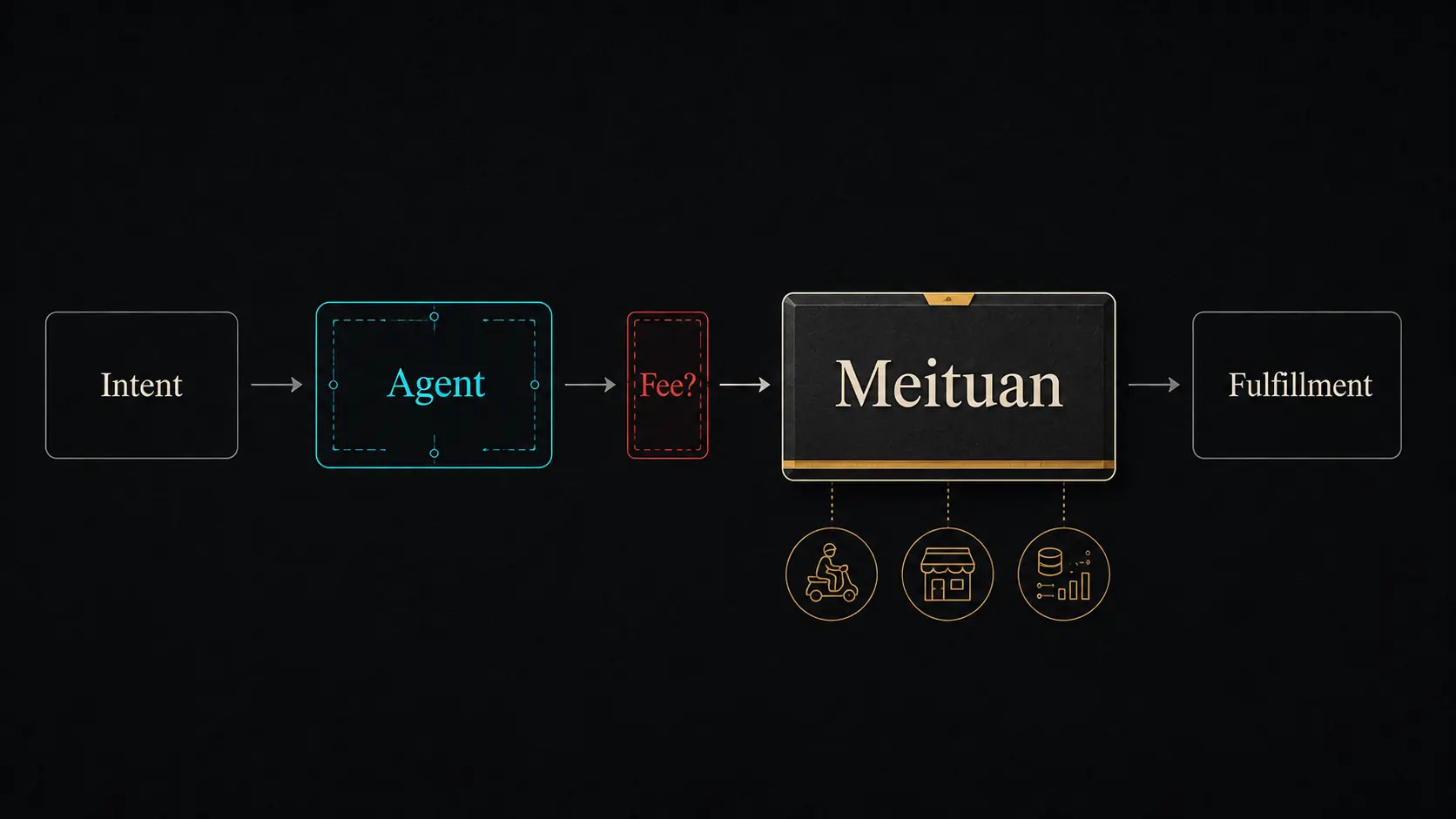
The organizational details reinforce the reading. The new department is led by Mu Yao, a former general manager of Dianping, Meituan’s reviews-and-local-discovery platform, with operating experience rather than an AI research background. The appointment suggests Meituan treats AI transformation as a merchant-integration problem, not a research project. Separately, the team from Meituan’s roughly Rmb 2bn acquisition of an AI venture founded by Meituan co-founder Wang Huiwen released Tabbit 1.0, an AI browser initiated in August 2025. It is the team’s first high-profile general-purpose product nearly three years after the acquisition. Tabbit functions primarily as a hedge: if external agent entry points turn hostile, Meituan retains a fallback.
In Q1, core local commerce losses narrowed sharply, a reprieve driven by the delivery war cooling rather than AI-generated efficiency gains, opening a window for strategic repositioning. Meituan’s standalone AI assistant has reached only 1.69 million Android downloads. Annual AI spending exceeds Rmb 10bn, substantial but still smaller than the AI investment scale associated with Alibaba, ByteDance, and Tencent. “To A” is shaped by that spending gap.
The strongest counter to the dependency-risk argument is Meituan’s data. Tens of millions of daily transactions across more than 2,800 cities and counties have given Meituan merchant quality scores, real-time availability signals, and local demand patterns that rivals would struggle to replicate quickly. If that data becomes the quality standard in WeChat AI’s dispatch logic, Meituan operates as the data infrastructure beneath the recommendation layer, not merely the delivery endpoint. Wang Xing compressed the logic into one image: even Einstein, working as a personal secretary, would not know whether a restaurant has an available table. The constraint is information, not intelligence, and Meituan has accumulated it across years of transaction volume at scale.
The broader pattern, however, offers less comfort. As I examined during 618, Tencent is positioning WeChat as the orchestration layer above partners that hold fulfillment capability. Should Tencent introduce priority-routing fees at that layer, Meituan’s monetization model faces compression from above. The common risk for heavy-asset infrastructure providers is that the interface owner gradually captures the customer relationship and compresses the execution layer’s margins. Local services may prove different because the underlying data is hyper-local and tied to physical operations. But “may prove different” is a hope, not a demonstrated advantage.
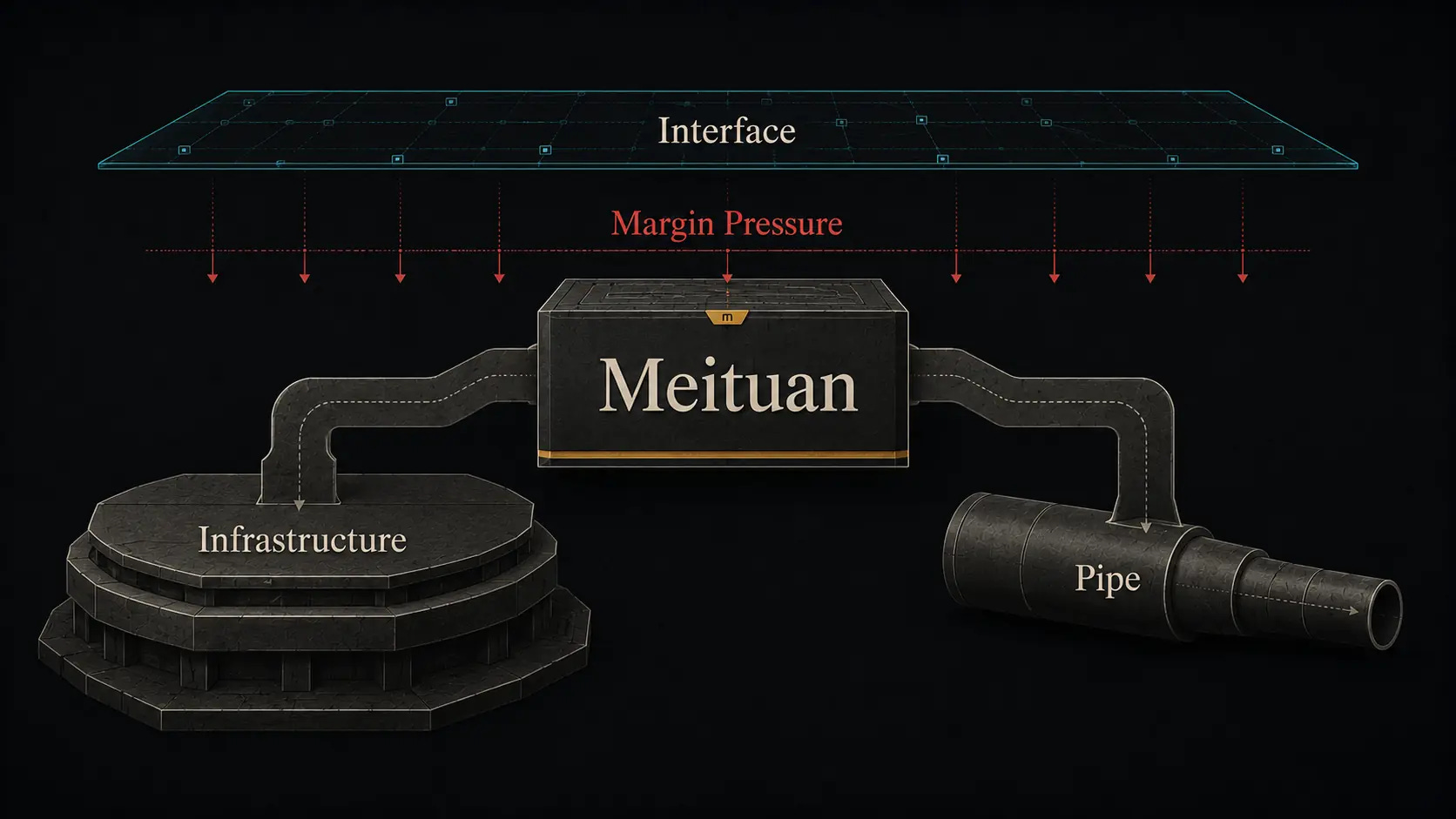
If Meituan’s data assets embed into the dispatch layer as a quality benchmark, “To A” represents a genuine adaptation to the agent era. If agents treat delivery as a commoditized API call, the strategy amounts to a rebranding of a weaker position. The difference between strategic infrastructure and a low-margin pipe is pricing power. Meituan has opened the door. Whether it keeps the key depends on what its data is worth to the agents walking through it.