

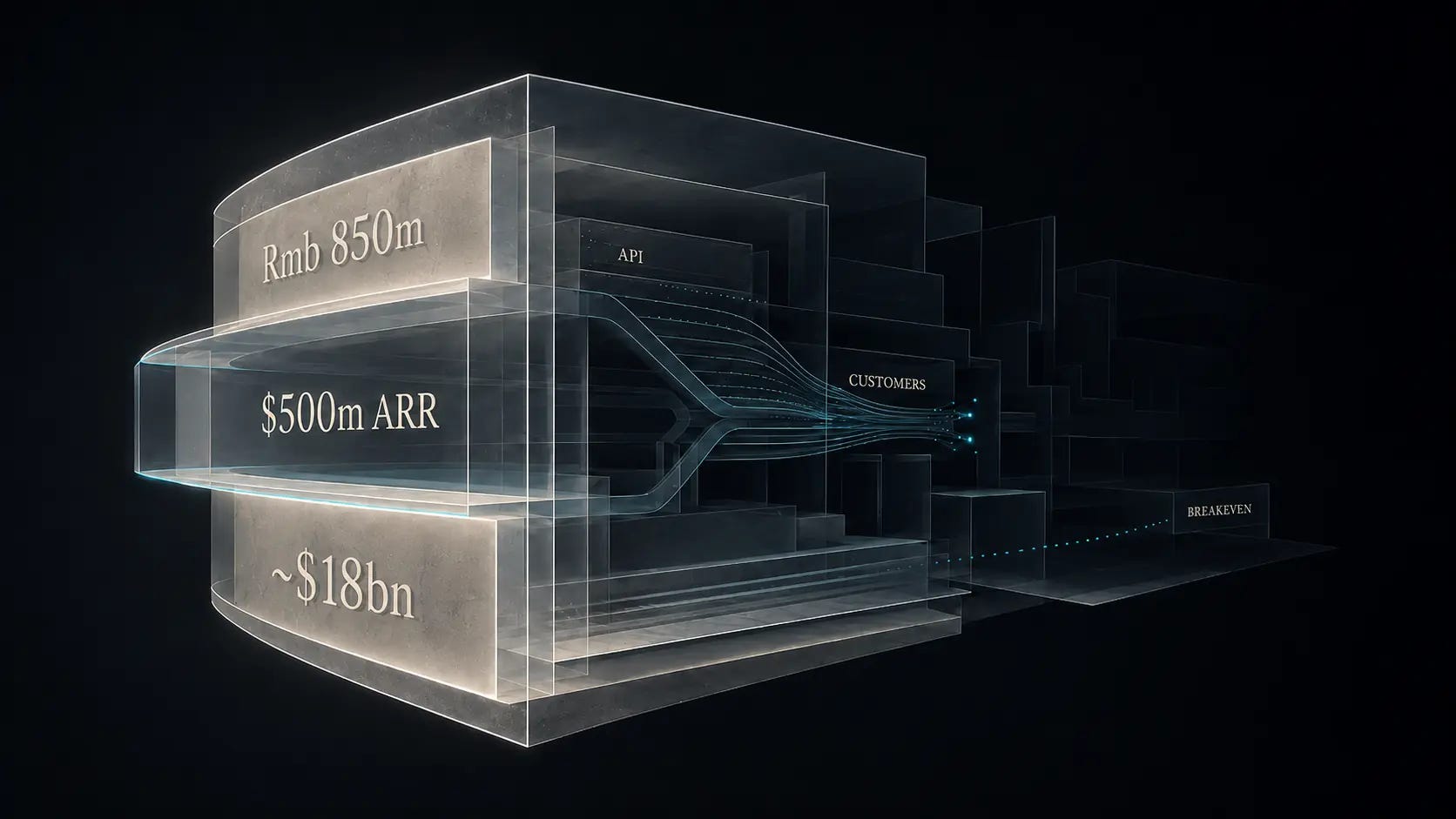
Kuaishou’s second-quarter results, published on August 19, disclosed one substantive Kling number: revenue above Rmb 850m (about $125m), up more than 200% year on year. Kling is the AI video generation unit that Kuaishou, the short-video platform that competes with ByteDance’s Douyin, carved out in July with about $2.8bn in signed investor commitments. The round can extend to $3bn, which would put the post-money valuation near $18bn. Kling has not filed publicly for a Hong Kong listing. But the financing agreement already puts an IPO on a contractual clock, with repurchase rights attached.
That is the official record, and it is thin. On August 25, National Business Daily, a Chinese financial newspaper, published figures from an unaudited internal data set it had obtained. The set covers the share of revenue from API clients rather than subscribers, its concentration in a few overseas accounts, a first-quarter loss, and an internal breakeven target. Kuaishou declined to answer the paper’s questions. None of these figures has appeared in an exchange filing.
Three records of Kling’s business now exist. The exchange filings show scale. Broker research shows part of the revenue mix. The leaked data set goes further, into customer concentration and losses. The numbers a future IPO investor would most want, who pays Kling, through which channel, and how easily they can stop, sit in the outer layers or nowhere at all. The public record supporting a valuation of roughly $18bn still contains that gap.
What Kuaishou does disclose follows a pattern. It publishes totals and counts. Quarterly revenue above Rmb 650m in Q1. An annualized revenue run rate approaching $500m in March. Business clients and developers exceeded 20,000 in mid-2025; by June 2026, Kuaishou said Kling had nearly 50,000 enterprise customers. More than 100m users. On the first-quarter earnings call, founder Cheng Yixiao described the business as driven by enterprise API and professional subscriptions together, and offered no ratio. Totals show scale. Counts show reach. Neither shows structure.
Even the historical financials carry an asterisk. The July financing announcement reports Kling’s 2025 revenue of about Rmb 1.1bn ($162m), its Rmb 1.9bn ($279m) net loss, and its negative net assets of Rmb 9m, all on an unaudited pro-forma basis. The basis assumes the restructuring had already been completed. The figures describe a company that did not yet exist in that legal form. A business priced at nearly $18bn in its latest private round rests, in public, on pro-forma numbers and a leak.
A prospectus will eventually have to answer a plain question: who actually pays Kling, and how easily can they leave?
Most of the answer is already visible, scattered where few bother to look: a broker’s report, an earnings briefing that never reached a filing, and the product pages of the storefronts that sell Kling’s videos.
Hello China Tech publishes three analyses a week on China’s AI, chips, robotics, and EVs, built from primary sources rather than second-hand coverage. If reading an $18bn valuation against the three layers of its public record, filings, broker notes, and a leak, is the kind of analysis you want more of, subscribe free and get each one as it publishes.