


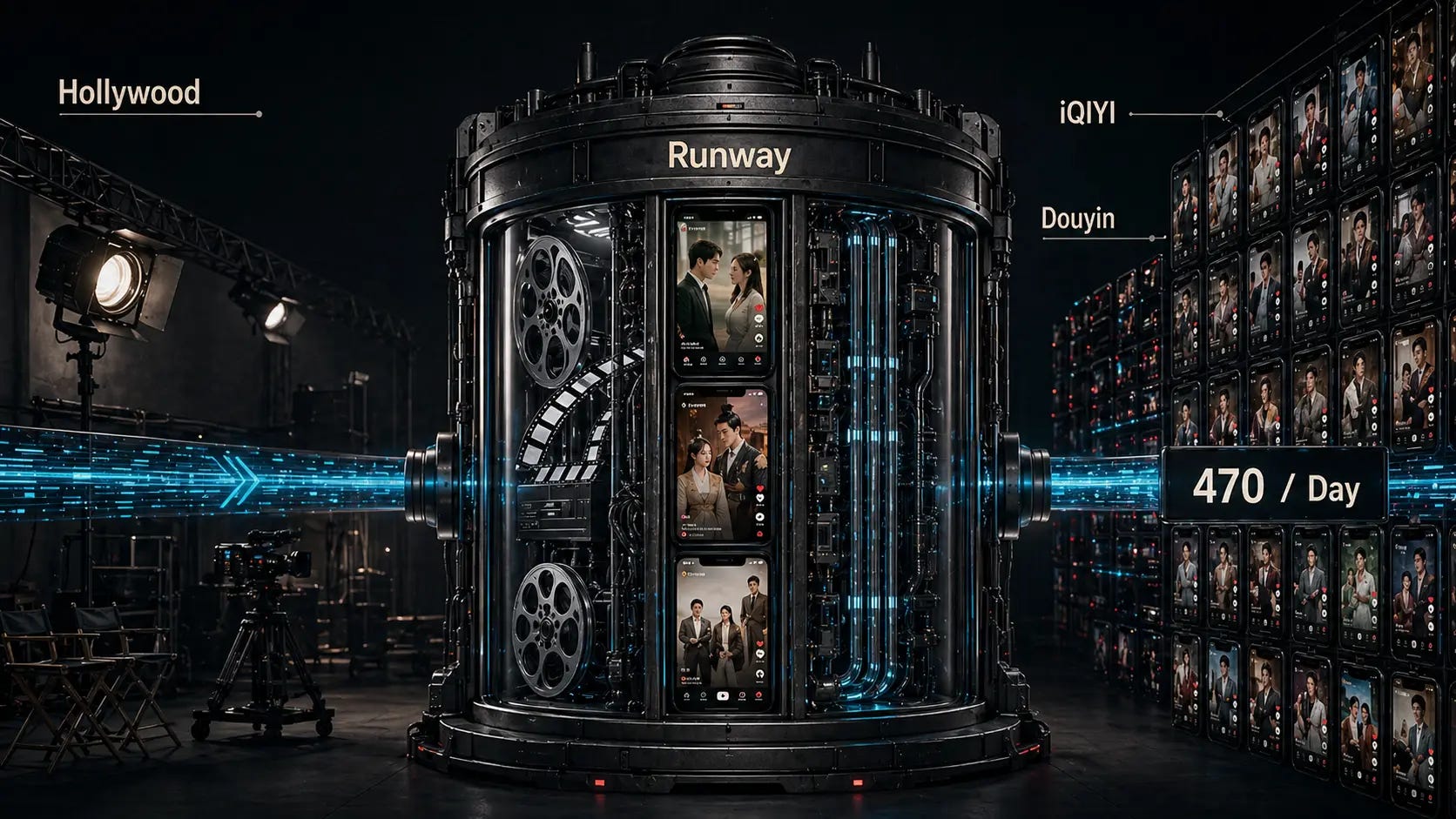
In the span of a single week this April, three figures from three different corners of the entertainment industry arrived at essentially the same conclusion.
Cristóbal Valenzuela, CEO of AI video startup Runway, told an audience at the Semafor World Economy summit that studios should take $100 million and spread it across 50 films instead of spending it on one. “Same quality. Same amount of output, visually. But you make way more content,” he said. “It’s a quantity problem.”
In Cannes, Mathieu Kassovitz, the French director behind the 1995 film La Haine, predicted that “in two years from now nobody will care” whether characters on screen are human or generated by AI. He announced plans for an AI film studio in Paris and noted that AI had cut his anticipated visual effects budget from $50 to $60 million down to $25 million. Kassovitz was speaking at the World AI Film Festival, a separate event from Cannes’ official competition, which has signalled strong resistance to AI-generated films.
And in Beijing, Gong Yu, the founder and CEO of iQIYI, often described as China’s Netflix, laid out what he called the “112 law”: AI would reduce unit content costs by one order of magnitude, increase the number of creators by one order of magnitude, and expand total output by two orders of magnitude. He unveiled Nadou Pro, an AI production toolkit designed to cover nearly every stage of filmmaking from scriptwriting to final rendering, and declared the shift “once in a decade.”
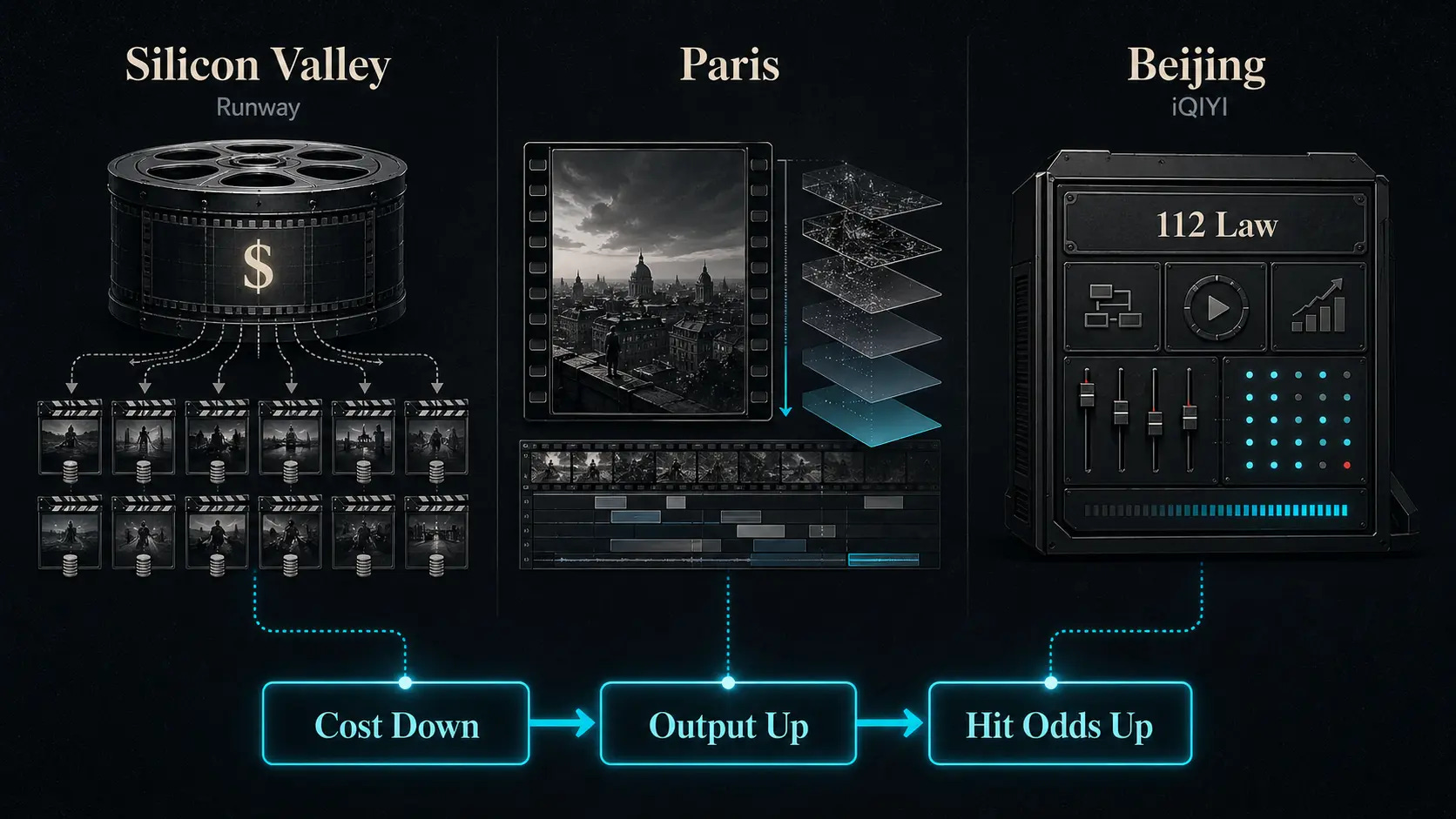
Three continents. Three distinct markets. One shared thesis: AI compresses production costs, which means more content can be produced, which means the odds of producing something great improve through sheer volume.
The logic is intuitive. It has also already been tested. Short dramas are not feature films. But China’s AI short drama market offers the clearest industrial-scale test so far of the logic now spreading across film and television: lower costs should lead to more experiments, and more experiments should improve the odds of producing something people care about.
For readers unfamiliar with the format: AI short dramas are serialised, mobile-first shows with episodes lasting 2 to 5 minutes, distributed through algorithm-driven platforms and monetised through advertising and micropayments. Think of them as soap operas rebuilt for smartphone attention spans. In January 2026, Chinese platforms launched more than 14,600 new AI-generated titles. That works out to roughly 470 per day. By February, 127,800 were in active circulation.
The production economics behind those numbers have shifted just as dramatically. A live-action short drama that cost upward of Rmb 1 million ($137,000) to produce in 2024 can now be generated for Rmb 50,000 to 100,000 ($7,000 to $14,000) using AI tools. At the cheapest tier, outsourced workshops quote Rmb 30,000 to 40,000 per complete series. Entry barriers have compressed dramatically: a single operator working with current video generation tools can produce 40 minutes of distribution-ready content per day.
This is, by any measure, the quantity thesis in action. The question is whether it has produced the results that Valenzuela, Kassovitz, and Gong are promising.
More Shots, Fewer Goals
The quantity thesis rests on a probabilistic assumption: if a hit is partly a matter of chance, then producing more content improves the absolute number of hits. More shots on goal, more goals.
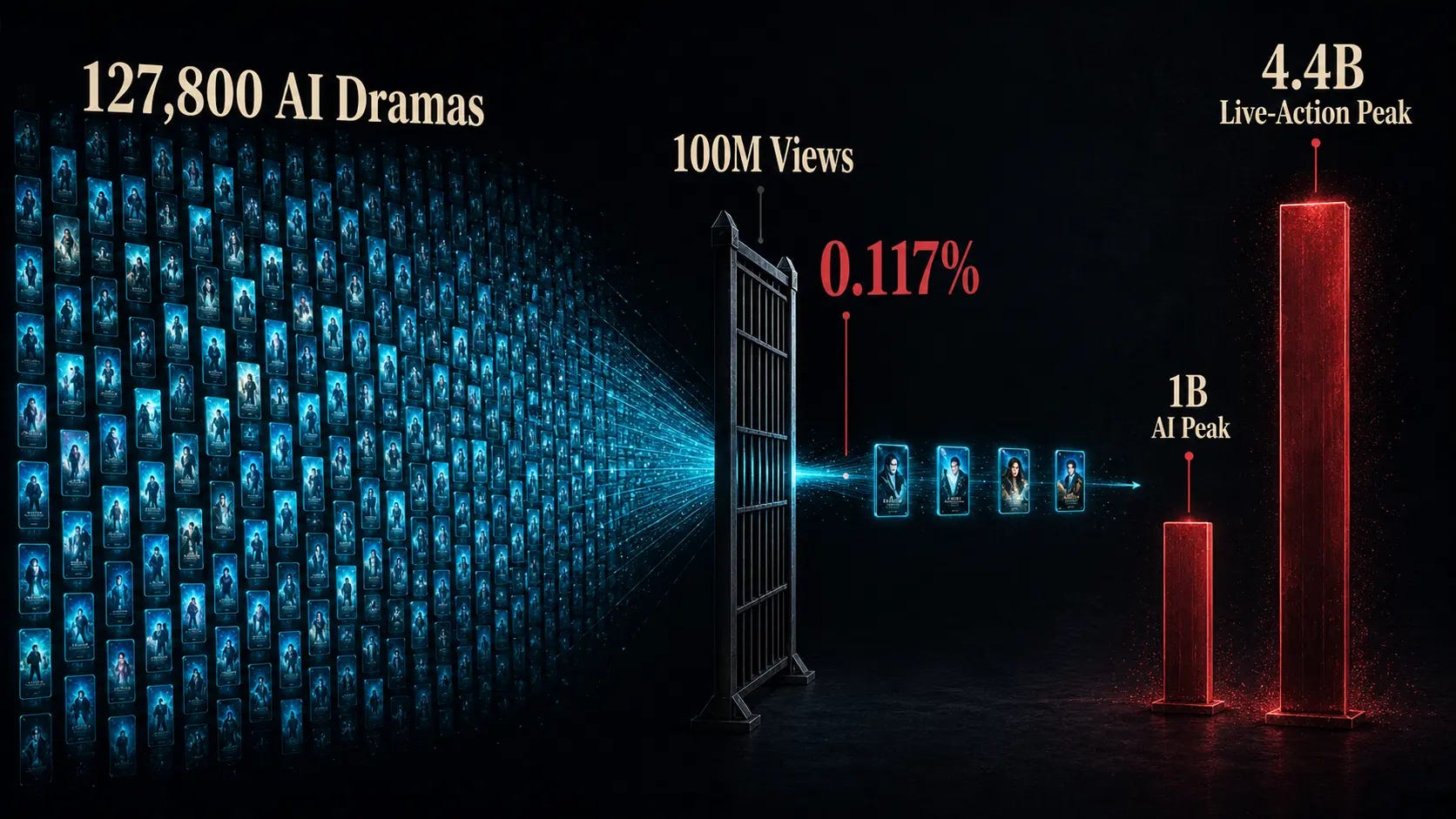
China’s AI drama market offers the clearest available test of this logic. Of the 127,800 AI-generated dramas in circulation by February 2026, the proportion that crossed the 100-million-view threshold stood at 0.117%. In 2025, Douyin’s ecosystem launched 60,000 AI dramas. 96 reached the benchmark. And the breakout rate has been declining as production volume climbs.
The performance ceiling tells a parallel story. The highest-viewed AI drama in circulation has reached approximately 1 billion views. The most successful live-action short drama accumulated 4.4 billion. AI content accounted for roughly 30% of total short drama viewership during the 2026 Spring Festival holiday. Yet that share was carried by sheer volume rather than audience loyalty. No AI-generated title has yet entered the broader cultural conversation in the way that popular live-action hits routinely do, generating fan communities, launching performer careers, or driving merchandise.
The quantity thesis assumes that hit probability is independent of production method. China’s market, the largest test case available, suggests otherwise. What the data reveals about audience behaviour, structural dynamics, and the real bottleneck in entertainment carries implications well beyond short dramas and well beyond China.
