

For 2 years, one of DeepSeek’s most distinctive features had nothing to do with its models. The company consistently turned away outside money.
Liang Wenfeng, the founder, made this clear from the start. He had built DeepSeek out of profits from High-Flyer, his quantitative hedge fund, which posted a 56.6% annual return and over Rmb 5 billion in revenue in 2025. He reportedly turned down partnership approaches from Tencent and Alibaba, wary that outside involvement of any kind could compromise his decision-making authority. “VCs manage money for LPs. They all need returns,” he said in one conversation. “So we can never see eye to eye.”
The strategy appeared vindicated in January 2025, when DeepSeek released R1. Trained for roughly $5.6 million, R1 matched the performance of systems that cost orders of magnitude more. Here was evidence that a lean, independent team could compete at the frontier without billion-dollar compute budgets.
15 months later, that story needs updating.
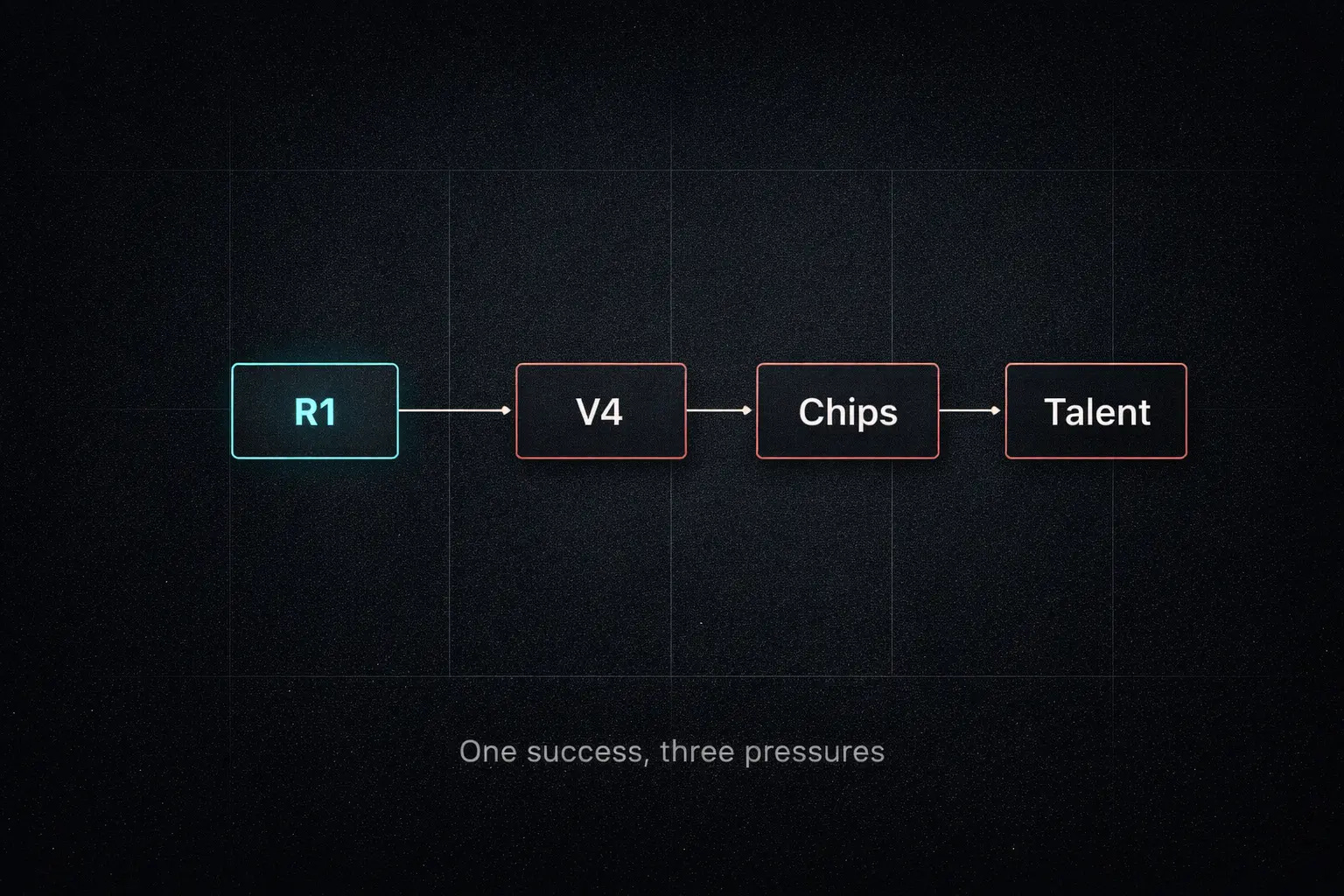
According to The Information, DeepSeek is now in discussions to raise at least $300 million at a valuation above $10 billion. This would be the company’s first external funding round. In the same period, at least 5 core researchers have left for competitors. The next-generation V4 model has reportedly slipped from around the Lunar New Year to February, then March, and now late April. And DeepSeek has begun recruiting data center operations and delivery staff in Ulanqab, a major computing hub in Inner Mongolia, suggesting a move toward heavier physical infrastructure.
Each of these signals tells a story on its own. Together, they point toward a common structural problem. DeepSeek is trying to operate simultaneously as a frontier research lab, a company diversifying its chip supply chain, and a startup that needs to retain expensive talent in an overheated market. All 3 roles compete for the same finite pool of engineering hours, management attention, and money. The tension among them offers a compelling explanation for DeepSeek’s unusually long release gap.
The deeper question is why all 3 pressures intensified at the same time, and whether $300 million can resolve tensions that originate in the company’s identity rather than its bank account. Full analysis for subscribers below.
