

Three Chinese semiconductor companies reported financial results in the same week of May 2026. Taken individually, each tells a company-specific story.
SMIC, the country’s largest contract chipmaker, posted $2.5 billion in Q1 revenue and guided Q2 growth of 14 to 16 percent sequentially. Hua Hong Semiconductor, a smaller foundry specializing in power and analog chips, saw net profit attributable to shareholders rise 458.1 percent year-on-year. And CXMT, China’s sole significant DRAM manufacturer, updated its IPO prospectus to reveal Q1 net income attributable to shareholders of Rmb 24.8 billion, enough in a single quarter to exceed the Rmb 23.5 billion it lost cumulatively in 2023 and 2024 combined.
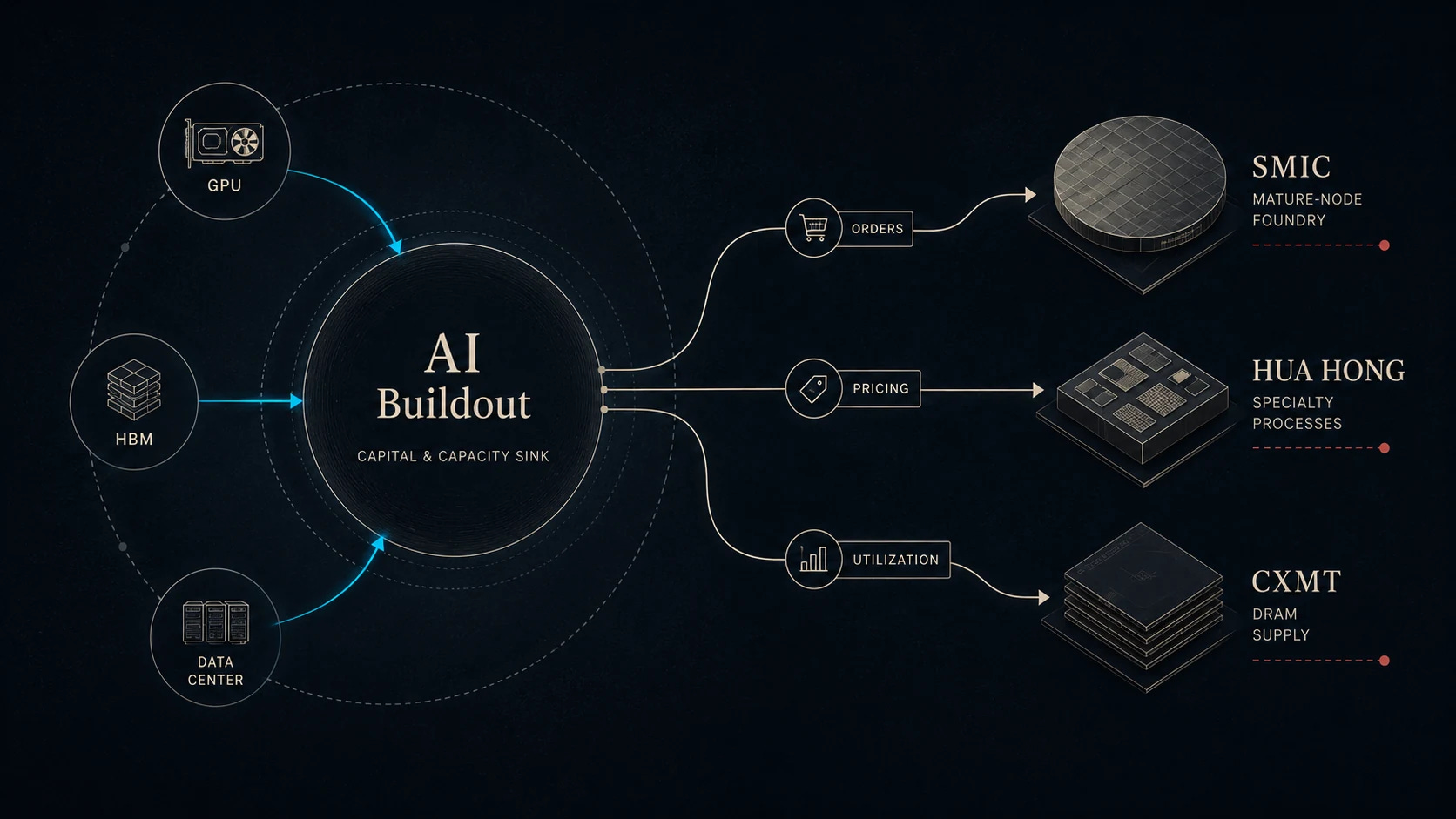
Taken together, these three sets of numbers describe a shared structural driver. The global AI buildout, which concentrates the most advanced manufacturing capacity on GPU and HBM production, is squeezing supply for everything else. That squeeze is redirecting orders toward the geography with the most aggressive mature-node expansion underway. China’s chip sector appears to be benefiting, in part, from the very supply dynamics that trade restrictions helped set in motion.
SMIC’s co-CEO Zhao Haijun used a specific phrase on the company’s earnings call to describe this dynamic: the “AI siphon effect”. The term is worth unpacking. In Zhao’s usage, it describes AI demand pulling capacity and orders away from traditional chip categories, while giving Chinese fabs with mature-node supply more room to raise prices. It captures a transmission mechanism that trade-restriction frameworks tend to miss.
Zhao used the phrase for SMIC’s business specifically. But the same gravitational logic applies more broadly. In foundry, the siphon appears as order reshoring and mature-node tightness. In specialty processes, it appears as rising demand for power, MCU, and analog platforms. In memory, it appears as global DRAM allocation shifting toward data center customers, leaving Chinese domestic demand underserved.
Five channels, one direction
Zhao laid out five pathways through which AI demand translates into orders for SMIC’s fabs at 28nm and larger nodes. They fall into three tiers of causation.
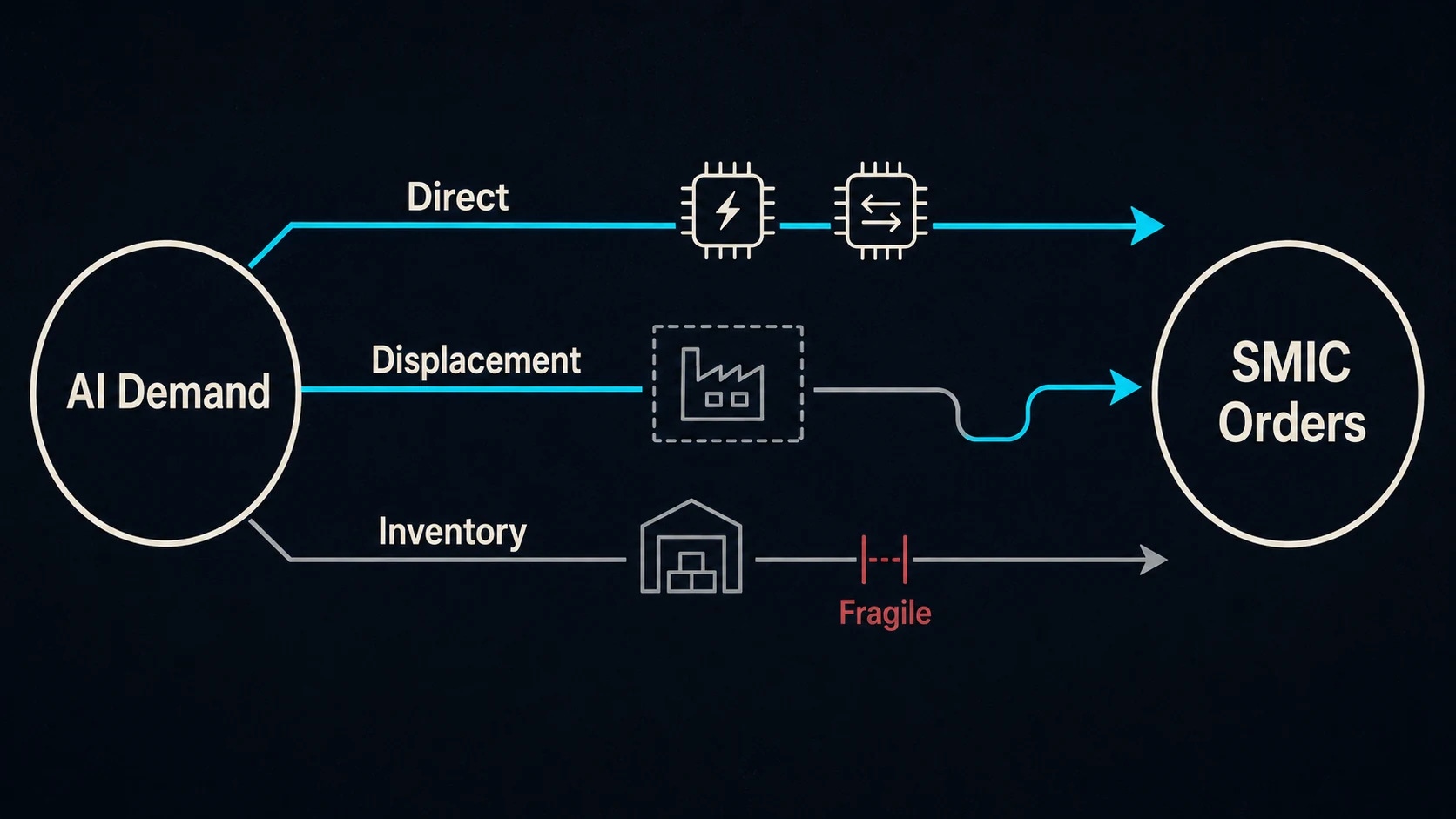
The first tier is direct pull. AI servers require large quantities of supporting chips, particularly power management ICs and data-transmission components, manufactured on mature process nodes. SMIC’s BCD platform, which produces power management chips for AI server boards, is capacity-constrained. At the same time, TSMC, Samsung, and memory IDMs are reallocating fab capacity toward AI-related production, exiting or de-prioritizing niche products like NOR Flash and SLC NAND. Those orphaned product lines seek alternative foundries.
The second tier is displacement. Global customers whose capacity allocation at leading foundries has been reduced are placing orders with Chinese fabs. Domestic chip designers serving AI-adjacent markets (electric vehicles, robotics, edge inference) are ramping volume, pushed by supply uncertainty abroad. A separate channel is policy-driven: localization preferences are bringing domestic logic, networking, and communications customers onto SMIC’s platforms even where the immediate trigger is not AI capacity pressure.
The third tier is behavioral amplification. Customers are building inventory preemptively, concerned that supply constraints will worsen. This channel is the most fragile: it depends on sentiment rather than structural demand, and it can reverse rapidly if supply conditions ease.
The distinction matters for durability. Tier-one demand persists as long as AI infrastructure investment grows. Tier-two demand persists as long as leading foundries prioritize advanced nodes over mature ones. Tier-three demand could unwind in a single quarter if customers perceive a shift in supply balance. Together, they explain why SMIC can guide 14 to 16 percent sequential revenue growth in Q2 while simultaneously raising prices on supply-constrained product categories.
SMIC’s Q1 data aligns with this three-tier reading. China-region revenue share rose to 88.9 percent, from 84.3 percent a year earlier, consistent with order reshoring. Blended average selling price increased 2.5 percent sequentially. Eight-inch wafer revenue grew 6 percent quarter-on-quarter, driven primarily by pricing power rather than volume. The industrial and automotive segment expanded from 9.6 percent of wafer revenue a year ago to 14 percent. The utilization rate fell to 93.1 percent from 95.7 percent the prior quarter, but management attributed the decline partly to new start-up capacity entering the denominator and partly to smartphone order adjustments tied to earlier memory supply concerns. The overall pattern points less to an underutilization problem than to a business reallocating capacity toward higher-demand categories. Management also noted that SMIC is signing long-term agreements with customers to lock in future demand, suggesting an effort to convert displacement orders into stickier relationships.
What connects a foundry raising prices, a specialty fab posting 458.1 percent profit growth, and a memory maker generating more net income in one quarter than its cumulative losses over two years? The analysis below examines how the siphon effect operates at each layer, what the consolidation moves by SMIC and Hua Hong reveal about the sector’s next phase, and where the tailwind meets its limits.
