

After Sora’s retreat in late March 2026, Seedance 2.0 looked like the model to beat in China’s AI video market. It topped benchmarks, powered a viral content wave across Douyin, and attracted enterprise clients willing to build production pipelines around it. What happened next surprised the market.
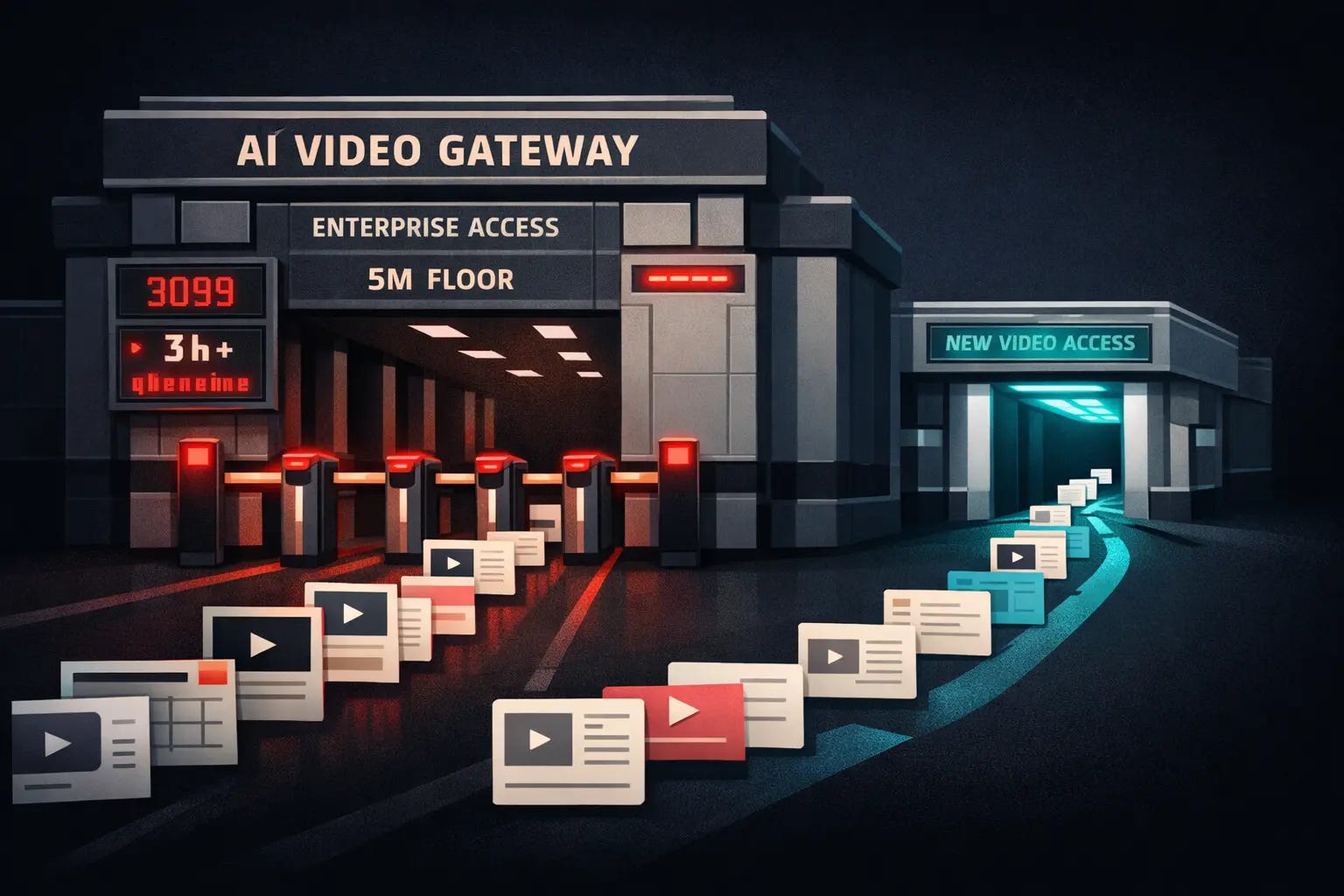
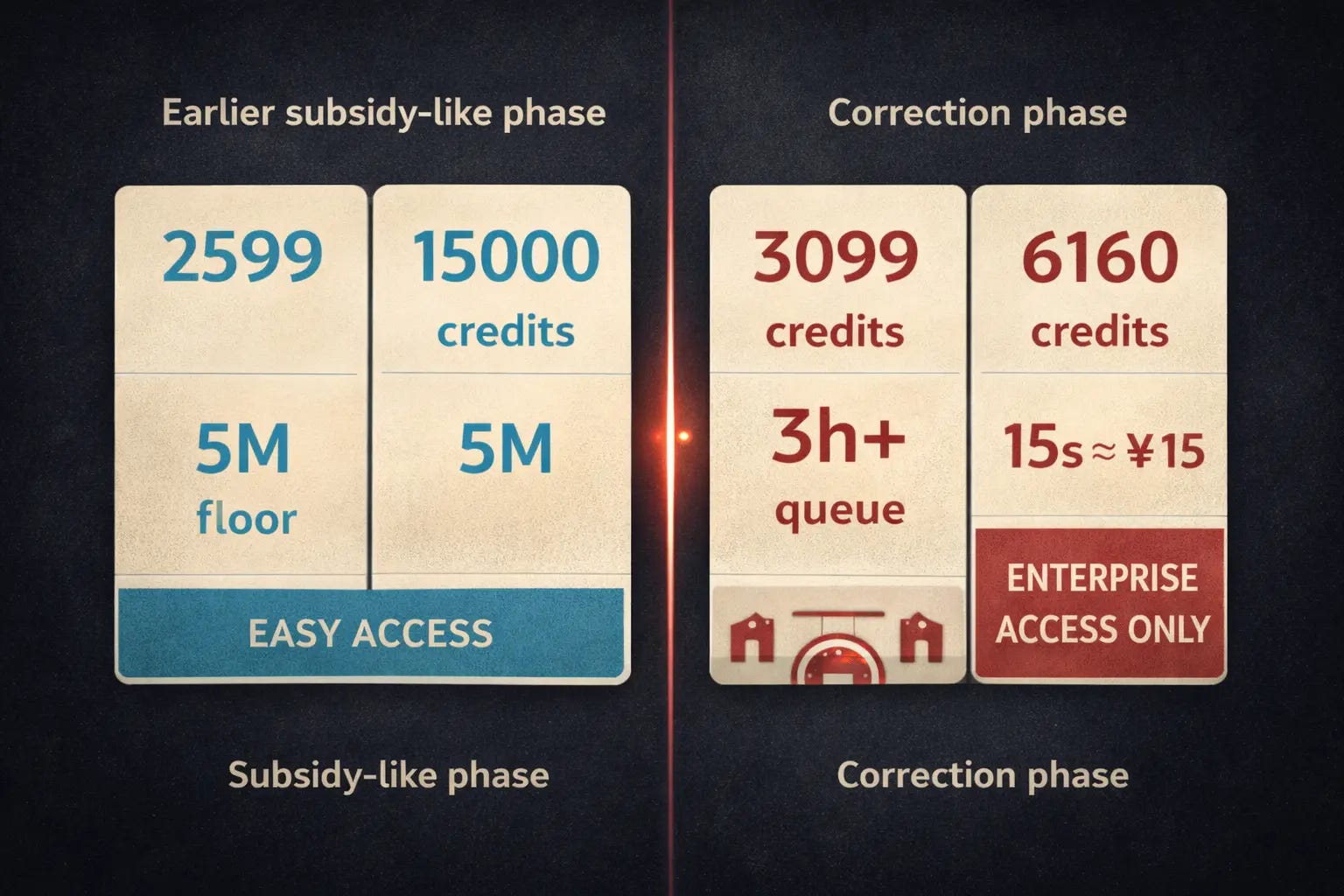
Rather than consolidating its lead through ecosystem expansion, Bytedance raised prices. Repeatedly. Within a single month of Sora’s shutdown, Jimeng, Bytedance’s consumer-facing AI creation platform, implemented at least three price increases. The premium tier’s annual subscription jumped from Rmb 2,599 to Rmb 3,099. Monthly credit allocations were cut by a third to more than half, depending on the subscription level. The cost of generating raw materials for a 2-minute AI comic drama climbed from roughly Rmb 7 to Rmb 80. Access to Seedance 2.0’s realistic human video mode required a separate enterprise agreement with a Rmb 5 million ($690,000) spending floor.
Premium subscribers still faced queue times exceeding 3 hours. Ordinary users sometimes waited behind 80,000 others. Only large production companies with partnership agreements could access the full-capacity, no-queue version of Seedance.
The frustration among paying customers was tangible. Content studios that had built their entire production pipelines around Seedance found their cost structures upended between one billing cycle and the next. Small and mid-sized teams, many of them producing AI comic dramas at slim margins, were particularly exposed. For a segment that depends on predictable per-unit costs, the rapid repricing felt less like a market adjustment and more like a penalty for early adoption. A secondary market emerged on Xianyu (Alibaba’s resale platform) and Xiaohongshu, where legacy Jimeng membership cards with grandfathered pricing were being resold for as much as Rmb 20,000.
These pricing moves carried a signal that mattered more than benchmark scores. They revealed the compute economics that AI video’s subsidy period had obscured.
Consider the contrast. Sora shut down because its costs could not be justified against roughly $2.1 million in total revenue, a 30-day user retention rate of 1%, and an estimated investment-to-revenue ratio of 2,500 to 1. Bytedance avoided Sora’s fate by building genuine demand. Its consumer-facing strategy, built around viral templates such as pets fighting movie monsters, pushed AI video into mainstream creator workflows. But demand built on subsidized compute remains a cost center until pricing catches up. The viral wave that made Seedance famous also consumed compute at a rate that the original pricing could not sustain.
The broader lesson extends to any company running AI video at commercial scale. Foundation model inference is resource-intensive. Video generation consumes tokens at rates that dwarf text or image workloads: a single 15-second clip burns through roughly 300,000 tokens. When millions of recreational users generate clips with minimal revenue attached, the arithmetic deteriorates quickly. Bytedance’s official API pricing, announced in March at Rmb 28 per million tokens with video input and Rmb 46 without, translates to roughly Rmb 15 ($2) per 15-second clip, or about Rmb 1 per second. At that rate, even modest daily usage across a large creator base adds up to significant compute costs.
Bytedance’s price hikes were a correction, not a strategy. They signaled the gap between viral growth and sustainable unit economics. And they opened a window.
The AI video market in China had been a two-player contest between Bytedance and Kuaishou, the short-video company behind Kling AI. Kling had quietly built an annualized revenue run rate exceeding $300 million by January 2026, with fourth-quarter 2025 revenue reaching Rmb 340 million ($47 million). But a third entrant was preparing to change the geometry of competition.
The market expected consolidation after Sora’s exit. What arrived instead was a challenger, timed to exploit the distance between Bytedance’s pricing ambitions and its customers’ patience. The next phase of AI video competition looks less like a technology race and more like a contest over infrastructure.
