


The Debate That Went Blind
In May, Andrew Ng’s post on X, which drew over 810,000 views, argued that there would be no AI jobpocalypse. U.S. unemployment sat at a healthy 4.3%. Software engineering hiring remained strong. The narrative of mass AI displacement, he argued, was driven by frontier labs exaggerating their capabilities and companies blaming layoffs on algorithms rather than pandemic-era overhiring.
In March, Anthropic published what may be the most rigorous empirical study of AI’s labor impact to date. Its researchers combined theoretical LLM capability scores with actual Claude usage data across 800 U.S. occupations to build a new metric: “observed exposure”. The headline finding: no systematic increase in unemployment among highly exposed workers since ChatGPT’s launch.
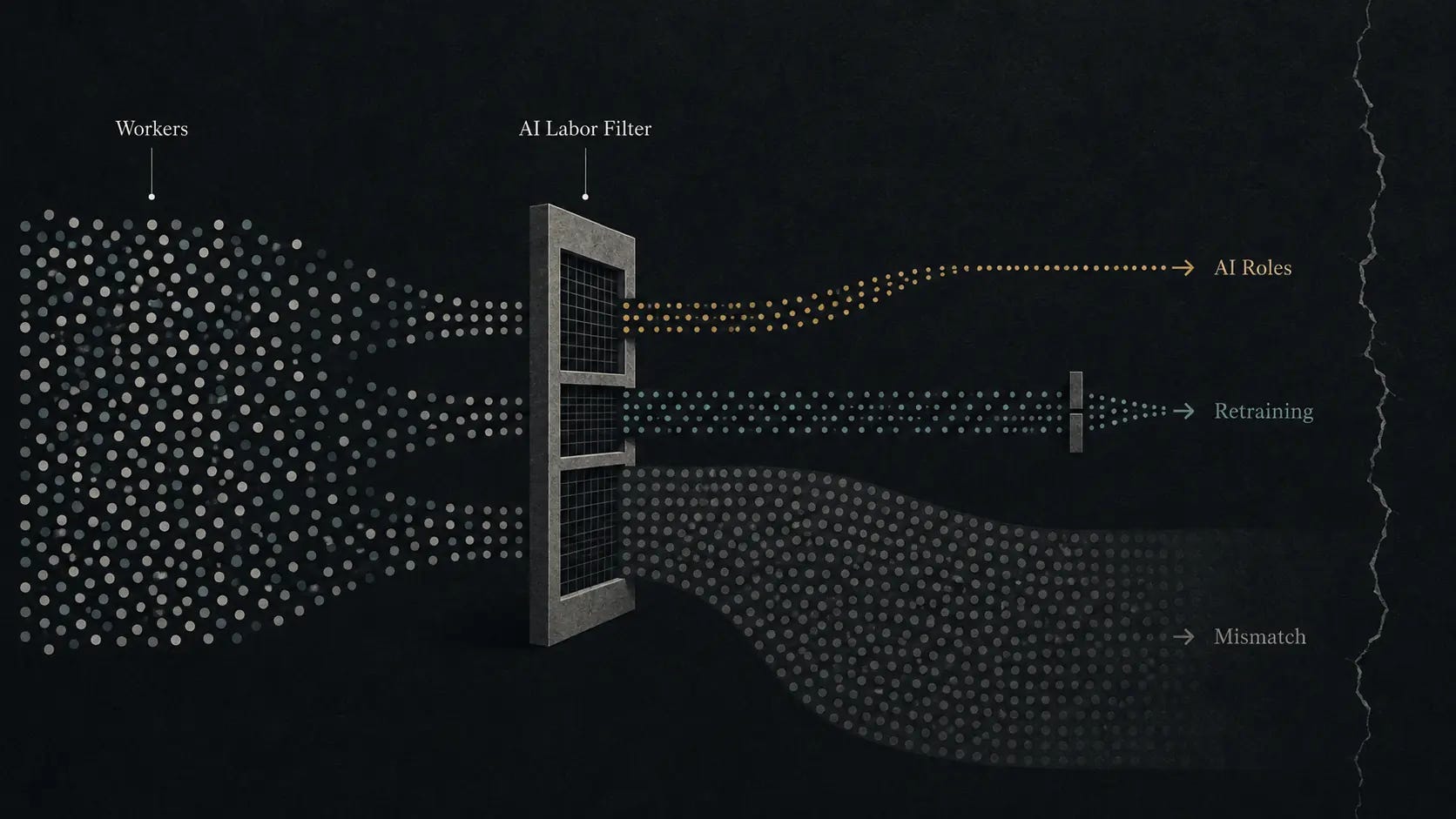
Both analyses share a blind spot. One of the most consequential real-time tests of AI and employment is running in China, where 12.9 million students registered for this year’s gaokao, the national college entrance exam held in June, in June and universities are restructuring degree programs at a pace few modern education systems have attempted. The early results show neither mass displacement nor business as usual. China’s data points toward a labor market fracturing along a new fault line, where the gap between adapted and unadapted workers is widening before any retraining system has proved it can keep pace.
Three Numbers That Don’t Add Up
China’s National Bureau of Statistics released May unemployment data on June 22. The headline, 5.1% nationwide, looks stable. The age breakdown does not. Workers aged 16 to 24 face 15.6% unemployment, excluding students. Ages 25 to 29: 7.2%. Ages 30 to 59: 4.1%. Youth unemployment has improved from 16.9% in March but remains nearly four times the prime-age rate.
Set that against the hiring data. Zhaopin, one of China’s largest recruitment platforms, reports that graduate-targeted AI engineer postings grew 31.1% year-on-year. Data engineers: 28.3%. Robotics algorithm engineer postings rose 57%. AI-related roles accounted for more than 80% of Alibaba’s 2027 intern recruitment. A Zhaopin employer survey found that 76.4% had increased demand for interdisciplinary talent over the past year. The juxtaposition of surging AI hiring demand alongside persistently high youth unemployment points toward a structural mismatch rather than a cyclical downturn.
The education system is restructuring to match. MyCOS Research Institute, which has published China’s benchmark graduate employment report for 18 consecutive years, released its latest findings in June. The six “green card” majors, those with the strongest outcomes in income, job relevance, and satisfaction, are all engineering disciplines, including electrical engineering, microelectronics, and automation. Computer-related majors such as information security and network engineering, which had featured on the list in earlier years, have dropped off. During the 14th Five-Year Plan period (2021 to 2025), Chinese universities added 10,200 undergraduate program sites and withdrew or suspended admissions for 12,200. The cumulative adjustment ratio exceeded 30%. In 2026, it crossed 10% in a single year for the first time.
On June 21, Richard Liu, JD.com’s founder and chairman, told the APEC Business Leaders China Forum in Beijing: “In the future, robots will handle all deliveries. There won’t be any need for couriers.” He then described the Nirvana Plan: partnerships with more than 120 schools to train JD’s 700,000 blue-collar employees in robot repair and maintenance. This was a forum pledge, not a disclosed timeline. “I don’t want our 700,000 brothers to have no food or work,” Richard Liu added.
Three signals, one market. High youth unemployment. An AI hiring surge. The most aggressive university restructuring in recent decades. And a CEO predicting his workforce’s obsolescence while investing in its transformation.
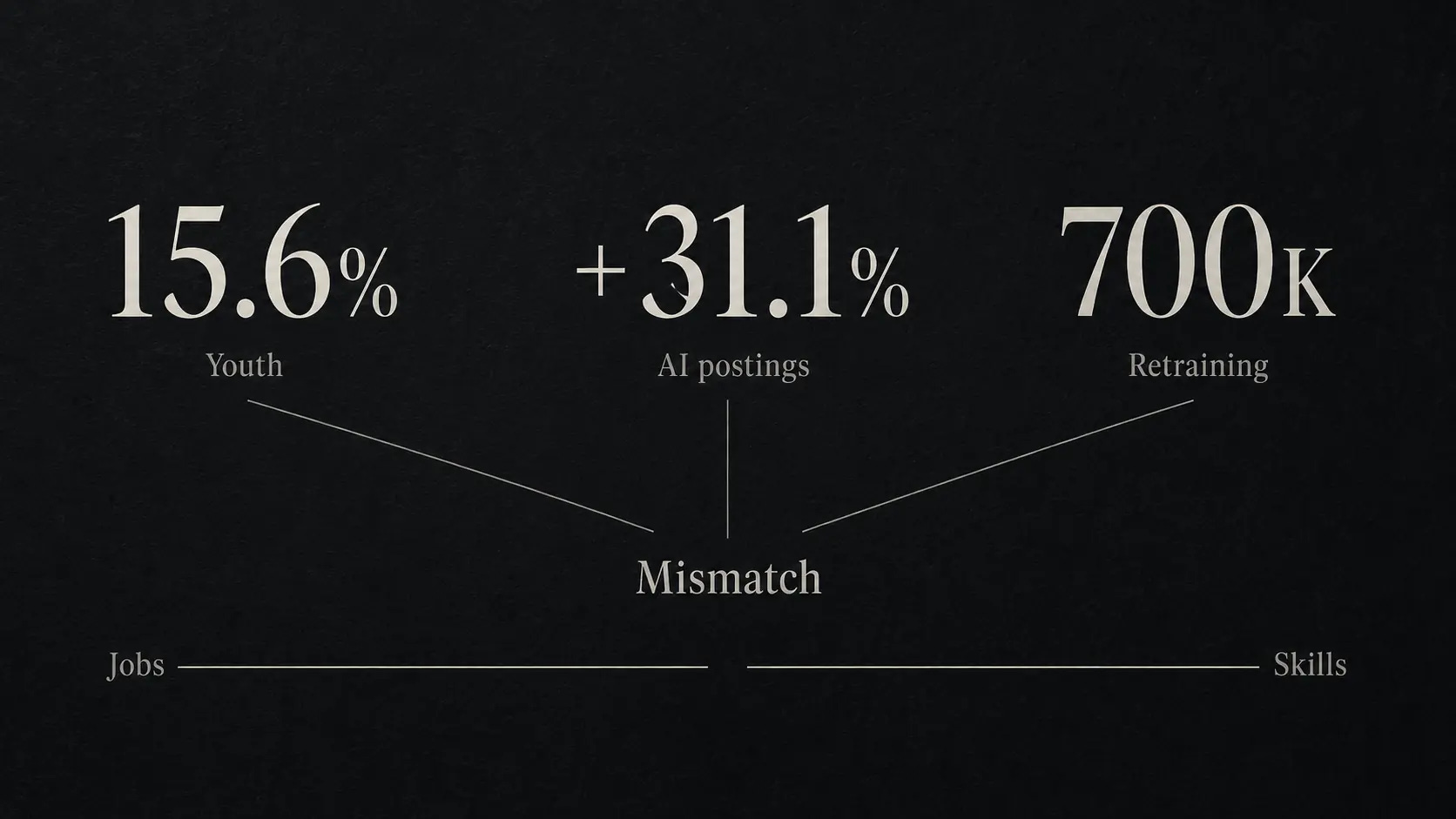
Which side does the data vindicate? The answer is not visible in the headline unemployment rate. It sits in the gap between capability and deployment, in the economics of replacing low-margin labor, and in whether China’s three retraining systems can move faster than the mismatch they are trying to close.
