


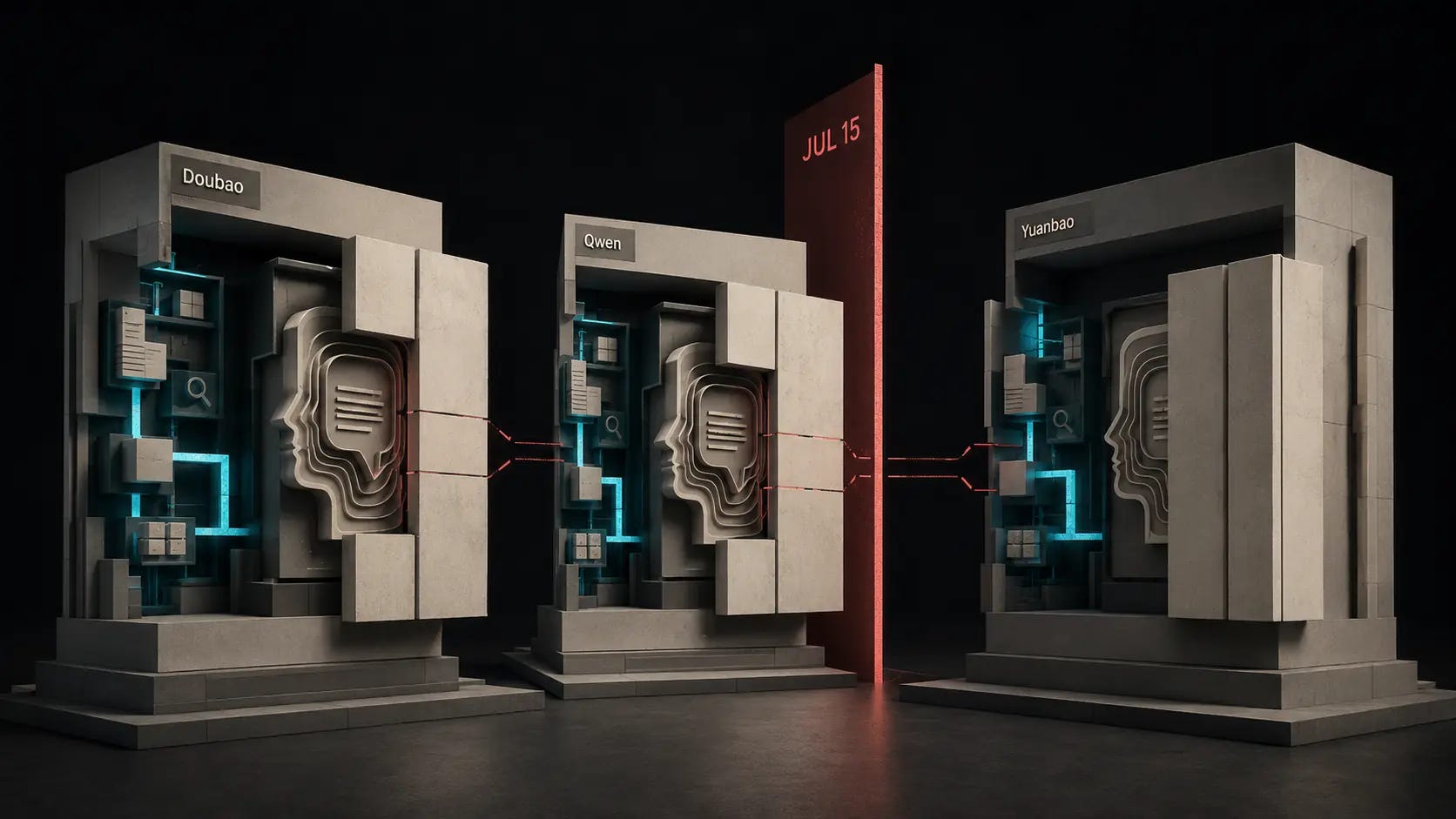
Two Weeks, 3 Giants, 8 Million AI Characters
Between late June and early July 2026, 3 of China’s largest technology companies removed AI companion features from their flagship consumer apps in rapid succession. Tencent shut down the user-built agent section of Yuanbao (元宝, its flagship consumer AI app) on June 30. ByteDance announced on July 3 that Doubao (豆包, one of China’s most widely used AI chatbots, with close to 350 million monthly active users as of early 2026) would remove its user-built companion features on July 15. Alibaba’s Qwen (通义千问, the company’s consumer AI chatbot) followed on July 4, removing humanlike and user-created agents on July 10 and ending its remaining agent services on July 15. NetEase Cloud Music’s Miaoshi (妙时, a standalone AI companion app) had already set its full shutdown for July 14.
ByteDance disclosed in 2024 that users had created more than 8 million agents on Doubao, which then had 26 million monthly active users. Many had spent months, in some cases years, building virtual friends and emotional confidants through daily conversation. Doubao gave users until October 15 to save character data and chat histories. Qwen advised users to back up records before shutdown. Neither platform offered a way to transfer a character’s accumulated identity into another product. ByteDance offered one partial alternative in Maoxiang (猫箱), a standalone freemium companion app, but its monthly active users had already dropped from a peak above 6 million to roughly 3.9 million by June. Its auto-renewing monthly subscription costs Rmb 25.
No public evidence suggests the 3 companies planned this together. The timing points toward a synchronized exit: the same pressures converging on the same companies, producing the same outcome within days.
The First Market-Level Verdict
When a single AI companion startup fails, the autopsy is company-specific. When 3 of the world’s largest technology companies exit the same category within 2 weeks, the signal is structural. The verdict applies to one specific model: free, user-built companions inside general-purpose apps. Dedicated companion products, including ByteDance’s own Maoxiang, continue to operate.
Character.AI, the leading US-based AI companion platform, offers a reference point. The product attracts tens of millions of monthly active users. Revenue has not kept pace.
The Chinese shutdowns suggest this gap between engagement and revenue may be a persistent feature of the category rather than a temporary monetization lag. And they raise a question that extends beyond China: if AI companionship cannot sustain itself on the balance sheets of companies with enormous compute budgets and built-in distribution, where does that leave the category?
The more consequential question, for investors and builders tracking the global AI sector, is why all 3 acted within the same 2-week window. The shutdowns have been reported in English, but the regulatory framework, economic structure, and broader product shift behind them have received little sustained analysis.
What made 3 companies reach the same conclusion within 2 weeks? The answer starts with a regulation that has received limited attention outside China, runs through a set of economics that made companion features untenable inside general-purpose apps, and ends in a divergence between Chinese and American visions of where AI value lives.