

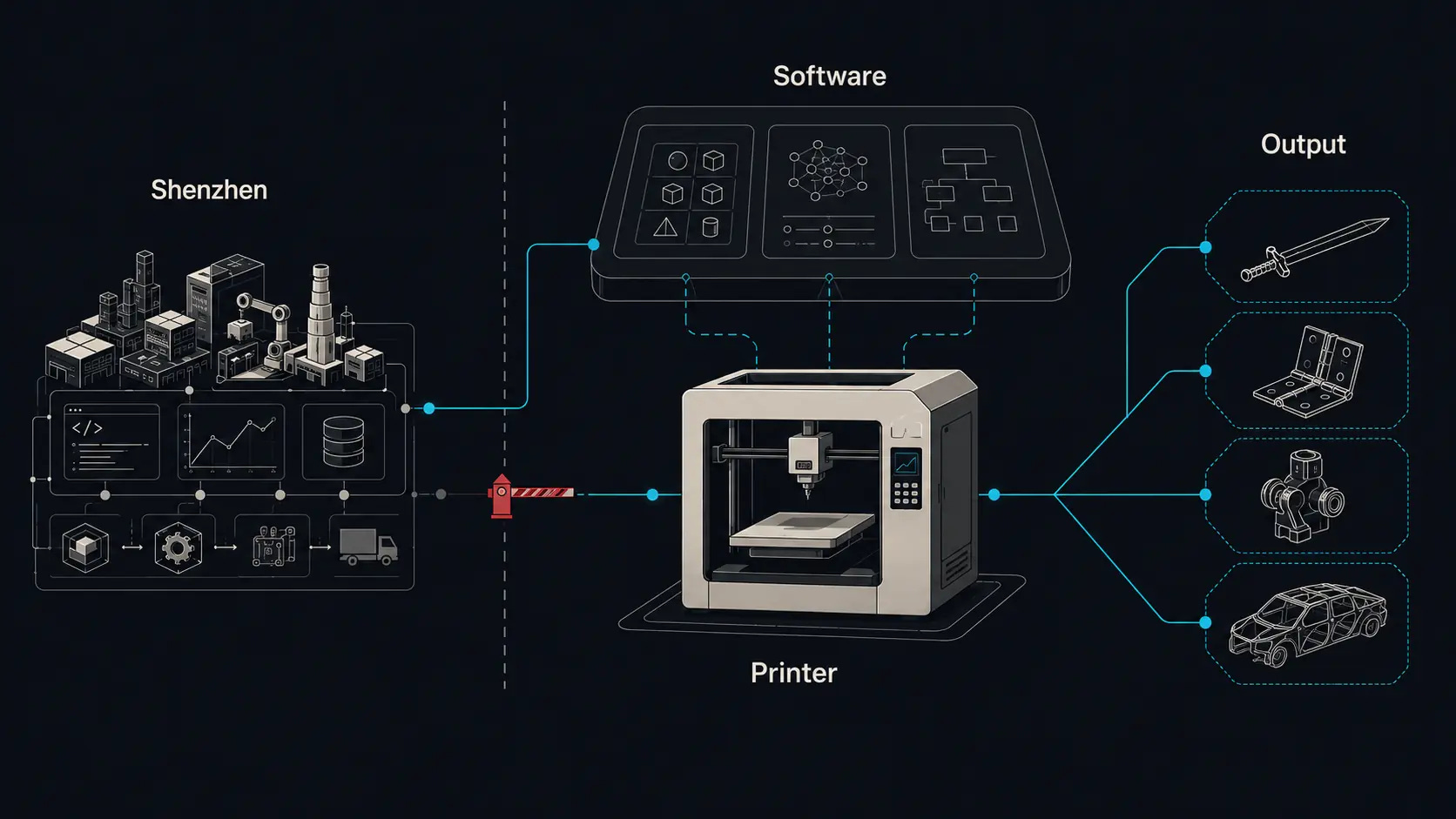
A father in England wanted to make his son a toy sword. He lacked his own father’s carpentry skills. A desktop 3D printer solved it: £0.10 of filament, a few hours of machine time, and the sword materialized. Odds are, the printer came from Shenzhen.
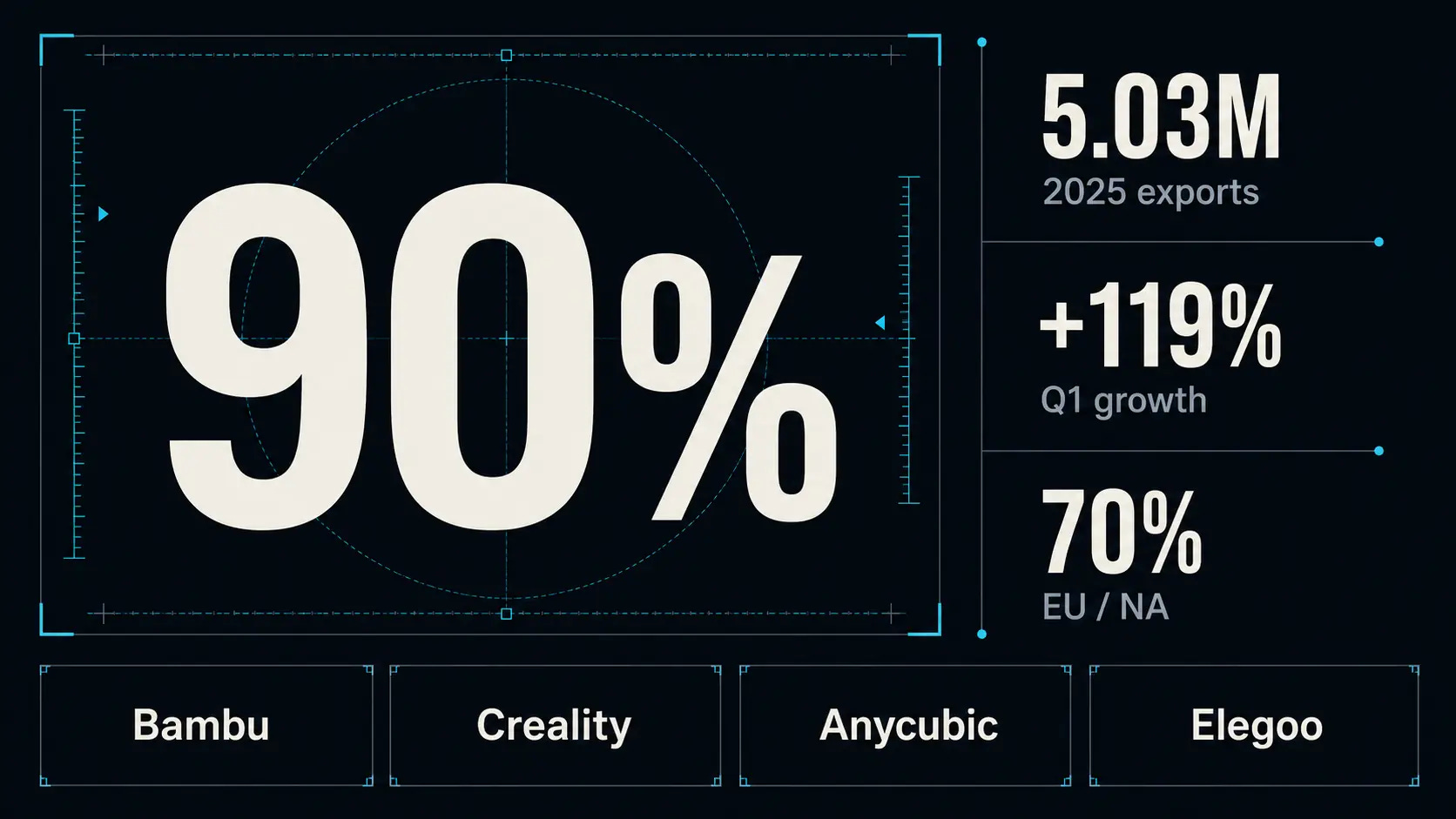
In 2025, Chinese manufacturers exported 5.03 million 3D printers, up 33% by volume from the prior year, with total export value reaching RMB 11.35 billion. In Q1 2026, exports surged another 119%.
Four Shenzhen companies account for roughly 9 in 10 consumer 3D printer shipments worldwide: Bambu Lab, founded in 2020 by five former DJI executives; Creality, which listed on the Hong Kong Stock Exchange on May 29, 2026, as the first listed pure-play consumer 3D printer maker; Anycubic; and Elegoo. About 70% of their machines end up in Europe and North America.
Printers from the leading Chinese brands increasingly ship with proprietary software, cloud connectivity, and access to a design library. Together, these turn a desktop device into a closed-loop manufacturing system built on a Chinese-designed platform. China’s most visible exports have been finished products: phones, solar panels, electric vehicles. Consumer 3D printers add a different category: manufacturing capability itself, priced as consumer electronics.
Two Weapons, One Decade
Two forces built the dominance. The first was price. Creality’s CR-10, released in 2016, cut the entry cost of a capable printer from roughly $1,000 to $500 and outsold the industry average by a factor of 20. Within a few years, Chinese manufacturers had pulled consumer 3D printing into mainstream consumer-electronics pricing.
The second was usability. Early printers required assembly, manual calibration, and hours of troubleshooting. Bambu Lab, whose founding team came entirely from DJI, applied the drone maker’s core insight: eliminate the gap between unboxing and usable output. Its 2022 debut, the X1, used gyroscope-based vibration suppression, lidar monitoring, and automated calibration to remove manual setup. Time named it one of the year’s best inventions. Follow-on models at $399 and $199 reached a mass audience. Revenue reportedly grew from under RMB 2 billion in 2023 to an estimated RMB 10 billion-plus in 2025.
Western 3D printing companies weakened in parallel. Spain’s BCN3D went bankrupt in 2025. America’s Desktop Metal entered restructuring. Germany’s TRUMPF exited additive manufacturing. In the consumer segment, only Prusa Research, a Czech company, retains meaningful non-Chinese share at roughly 5.8%. The pattern points to a shared vulnerability: Western manufacturers optimized for precision and capability while leaving usability and cost to the market. The Shenzhen companies that replaced them drew on a resource their rivals lacked: a consumer electronics supply chain, engineers from the drone industry, and infrastructure to iterate from prototype to mass production in weeks.
Creality’s May 2026 IPO captured the sector’s internal dynamics. The stock opened 80% above its HK$18.80 offering price, with Hong Kong retail investors oversubscribing the public tranche 3,829 times. Yet Creality went public as the number 2 player. Its prospectus disclosed 2025 revenue of RMB 3.13 billion but a net loss of RMB 182 million, driven by pre-IPO share issuances, listing expenses, and rising sales and R&D costs. Adjusted for those items, net profit was RMB 92.4 million. The prospectus identified the market leader only as “Company A” with a 42.7% GMV share. Industry data identifies that company as Bambu Lab, far ahead of Creality’s 11.2%, despite entering the market 6 years later.
Price built the market. Usability expanded it. The third phase is ecosystem: the software, content, and AI tools that determine how useful a printer remains after purchase. That layer is where the strategic weight now sits, and where the implications extend beyond consumer electronics.
