

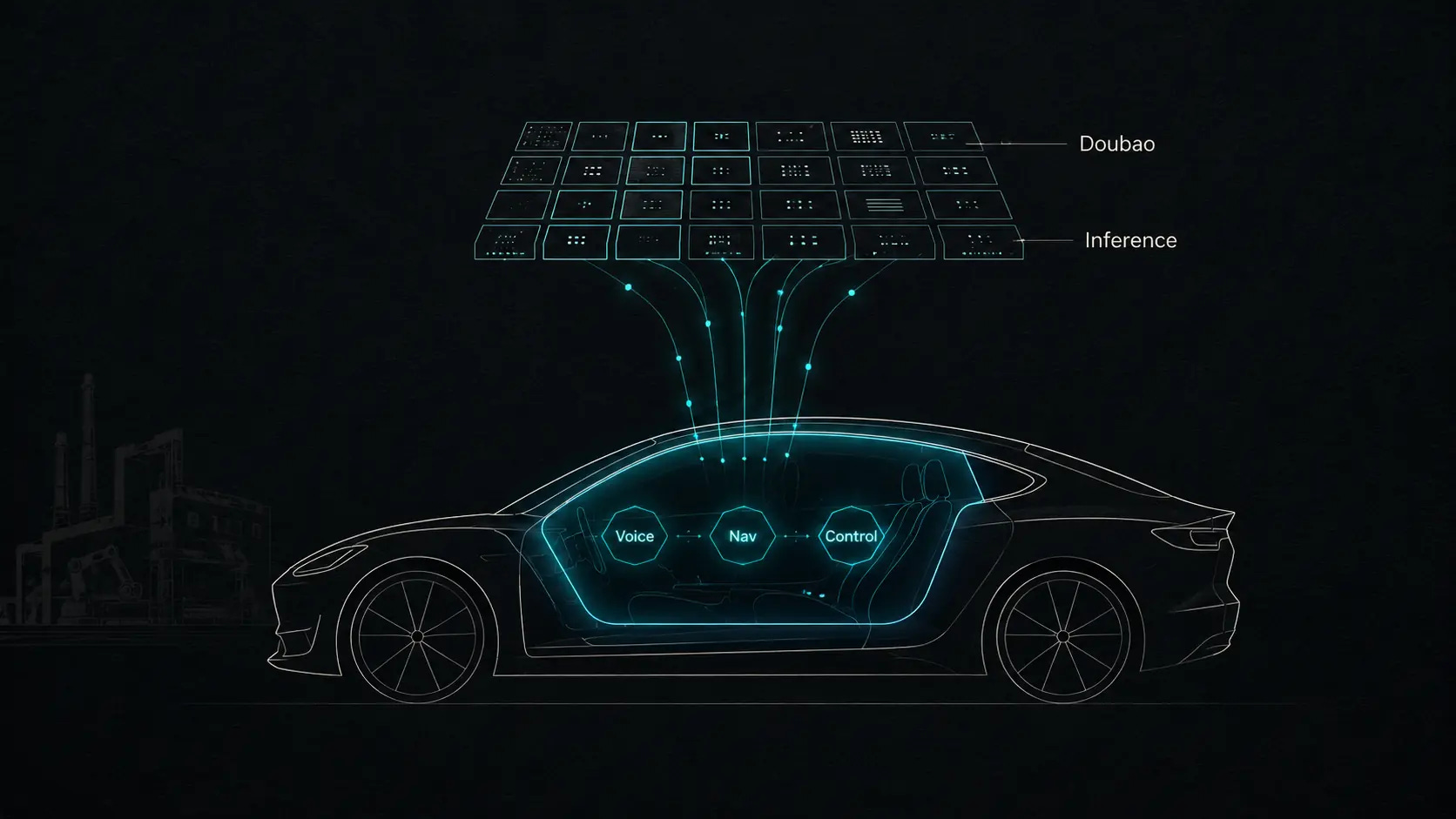
On June 6, ByteDance issued at least its third public denial of car-making in under a year. The company has “no plan to manufacture vehicles or launch an automotive brand,” a spokesperson said. Three days later, a new automotive brand called AIVA held its launch event in Beijing. AIVA positions itself as an “AI-native car” brand, built on Doubao, ByteDance’s large language model. According to Chinese reports, Volcano Engine, ByteDance’s cloud and AI platform, is involved not merely as a cockpit supplier but as a partner in product definition. Its internal codename at ByteDance is “Project A,” led by Volcano Engine vice president Yang Liwei.
ByteDance says it has no equity relationship with AIVA’s parent company, Saidou Technology. Public reporting does not show ByteDance on the shareholder register. On paper, the relationship is a pure technology-services arrangement. But the pattern of deep involvement paired with formal distance points toward something more deliberate: a platform strategy modeled on Huawei’s Hongmeng Zhixing, its co-branded smart-car alliance with automakers, where the technology partner shapes the product without owning the vehicle brand. ByteDance is borrowing Huawei’s partnership architecture, not its revenue model. Huawei captures value through hardware, branded channels, and deeper control over the intelligent-vehicle stack. ByteDance has none of those hardware anchors. The pattern suggests that ByteDance is treating cars less as hardware products than as inference endpoints for its AI models.
Huawei’s Blueprint, Without the Hardware
Saidou Technology emerged from a restructuring of SERES Group’s underperforming Landian (蓝电) brand. In May 2026, Landian completed a Rmb 6.671bn capital increase. A Chongqing state-backed investment vehicle became the largest shareholder at 34.5%, SERES fell to second position at approximately 33%, and CATL-linked capital joined the shareholder base. The shareholder structure underlines ByteDance’s formal distance from the project.
For SERES, the restructuring reflects necessity as much as ambition. Landian had failed to gain traction, with total 2025 sales below 20,000 units and the E5 Plus averaging roughly 500 units a month in early 2026. A technology partner with consumer-AI credibility offered a path to relevance that Landian could not build alone.
Yet ByteDance’s presence is visible across the project. The name “Saidou” (赛豆) is widely read as combining SERES’ first character, sai (赛), with Doubao’s dou (豆). The first product is a crossover called AIVA ME7. It is expected to be produced at SERES’ Phoenix factory, which has also produced the AITO M7, one of the anchor models in Huawei’s Hongmeng Zhixing alliance. And according to LatePost Auto, a well-sourced Chinese tech outlet, Volcano Engine’s involvement in AIVA is expected to exceed the depth of its existing partnership with SAIC’s Roewe brand, where the two sides already jointly defined hardware specifications, custom system architecture, and over 2,000 vehicle-service interfaces.
This arrangement sits at the top of a three-tier partnership hierarchy. Chinese industry analysts have drawn the parallel to Huawei’s own supplier / HI / Hongmeng Zhixing structure explicitly. One critical difference separates the two platforms. Huawei sells proprietary hardware at every tier: range extenders, LiDAR sensors, electric drivetrain components, computing chips. ByteDance sells none. Its entire automotive offering is software and cloud services.
That makes ByteDance’s approach easier to extend across automakers. It also raises the question of what, exactly, ByteDance captures from a car sale.
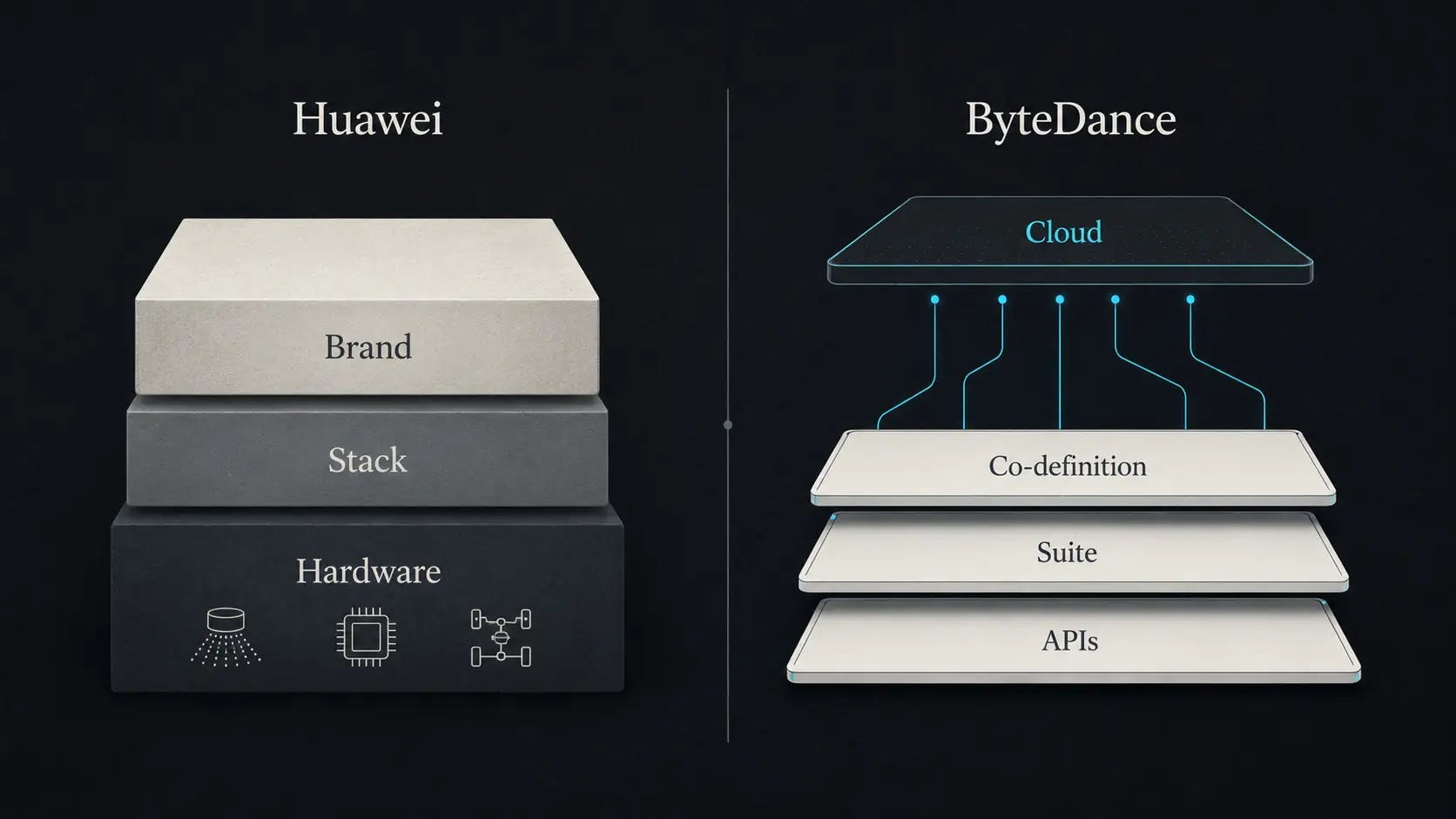
The architecture mirrors Huawei’s. The revenue logic does not. ByteDance appears to be positioning the car cockpit as a surface that generates inference demand, not as a source of hardware margin.
