

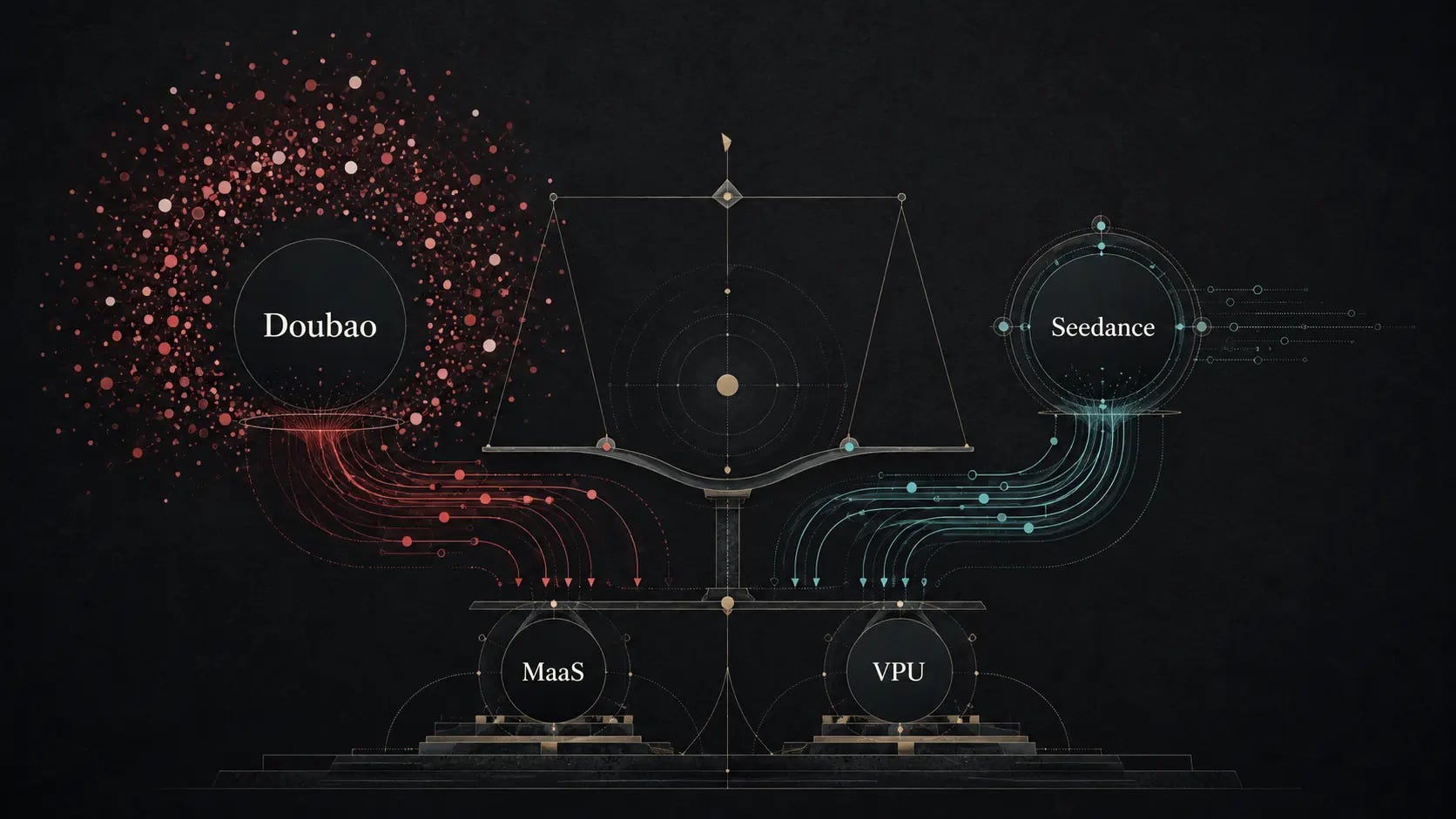
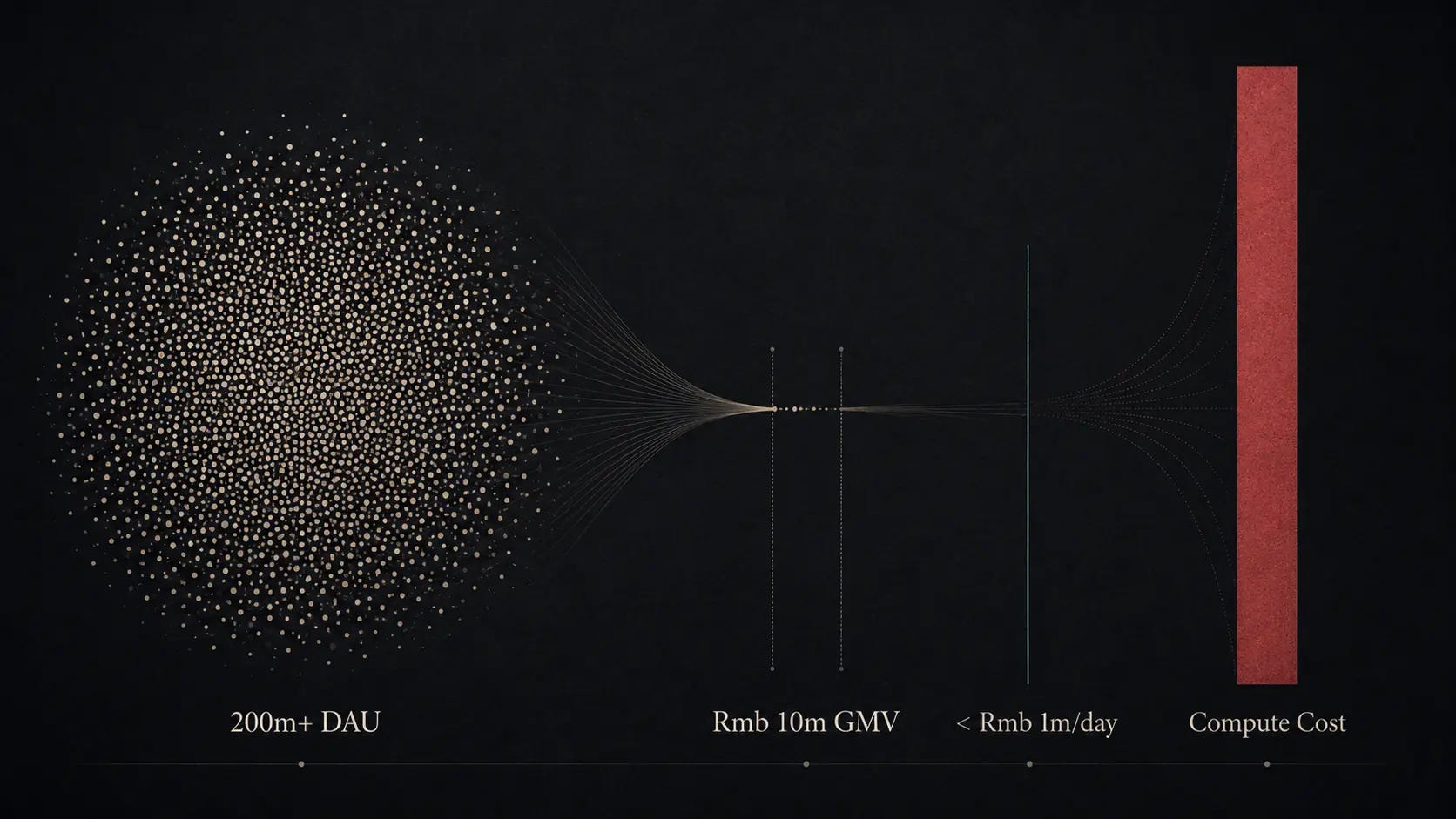
Doubao, the AI assistant from ByteDance, TikTok’s parent company, has 345 million monthly active usersas of Q1 2026. That figure exceeds Alibaba’s Qwen and DeepSeek combined. More than 200 million people open it daily. By the metric that defined China’s consumer internet for two decades, raw user scale, Doubao leads by a wide margin.
The financial picture tells a different story. According to LatePost, one of China’s most authoritative tech publications, Doubao generates less than Rmb 1m per day in revenue, primarily from e-commerce commissions. Its daily compute costs run into the tens of millions of yuan, an estimate based on Volcano Engine’s published API pricing, Doubao’s model margins, and user behavior patterns. For a user spending 15 to 20 minutes a day on text chat, the cost is only a few fen (hundredths of a yuan). Multimodal features, from image recognition to voice and video chat, can push that compute bill several to dozens of times higher. That daily figure covers inference only. It does not include the cost of building training clusters, which require tens of thousands of AI chips plus supporting infrastructure.
One comparison sharpens the disparity. Running Doubao reportedly costs more than operating all of Bilibili, China’s equivalent of YouTube for a younger demographic. Doubao’s total daily user time is less than one-eighth of Bilibili’s. The cost per minute of user attention is roughly an order of magnitude higher. And the e-commerce layer that is supposed to monetize those users? Daily gross merchandise value sits at roughly Rmb 10m, spread across 200 million daily users. The conversion from attention to commerce is negligible.
ByteDance plans to raise 2026 capital expenditure above Rmb 200bn, roughly 60% of its 2025 profits, according to a South China Morning Post report cited by LatePost. The AI build-out is accelerating. The consumer product at its center generates almost no revenue. The gap between investment and return pointed toward a strategic reallocation.
The Lesson from San Francisco
Around April, ByteDance executives visited Anthropic. What they encountered was a company that had inverted the relationship between scale and revenue that ByteDance has long relied on.
Anthropic’s Claude Code launched in May 2025. Within 6 months it reached $1bn in annualized revenue. By February 2026 it had doubled to $2.5bn. Anthropic serves roughly 30 million daily users. Its valuation reached $965bn, surpassing that of OpenAI, whose ChatGPT serves nearly 900 million weekly consumers. The contrast is stark. With a fraction of the user base, Anthropic reached a higher valuation than OpenAI by selling enterprise and developer productivity rather than relying primarily on mass consumer chat.
Shortly after the visit, ByteDance began reallocating AI resources from consumer-facing products toward enterprise services. The sequence is suggestive. The pivot may have been forming independently. But the timing makes the visit a notable data point.
The question is whether ByteDance has an asset that can turn AI from a consumer cost center into an enterprise revenue engine. The answer begins with a product that rarely features in the company’s consumer narrative.