

When Baidu released its fourth-quarter and full-year 2025 earnings on February 26, the most significant detail was not a number. It was a label.

Buried in the footnotes, Baidu announced a structural change to how it presents its financials. What was previously called “Baidu Core” became “Baidu General Business”, split into three categories: Core AI New Business, Traditional Business, and Other. Search advertising, the operation that defined Chinese internet for two decades and funded every AI ambition the company pursued, now falls under “Traditional Business.” In the same quarter, Baidu disclosed its AI business metrics as a standalone segment for the first time.
Among China’s major technology companies, Baidu appears to be the first to restructure its financial reporting around AI as the primary identity. Alibaba, Tencent, and ByteDance all generate significant AI revenue, but none has publicly reorganized its reporting segments to this degree. The timing reveals both confidence and necessity.
The Transition in Numbers
The headline figures frame the core challenge. Full-year 2025 revenue reached RMB 129.1 billion ($18.9 billion), down 3% year over year. Fourth-quarter revenue came in at RMB 32.74 billion, down 4%. For a company declaring the start of its AI era, the top line is still contracting.
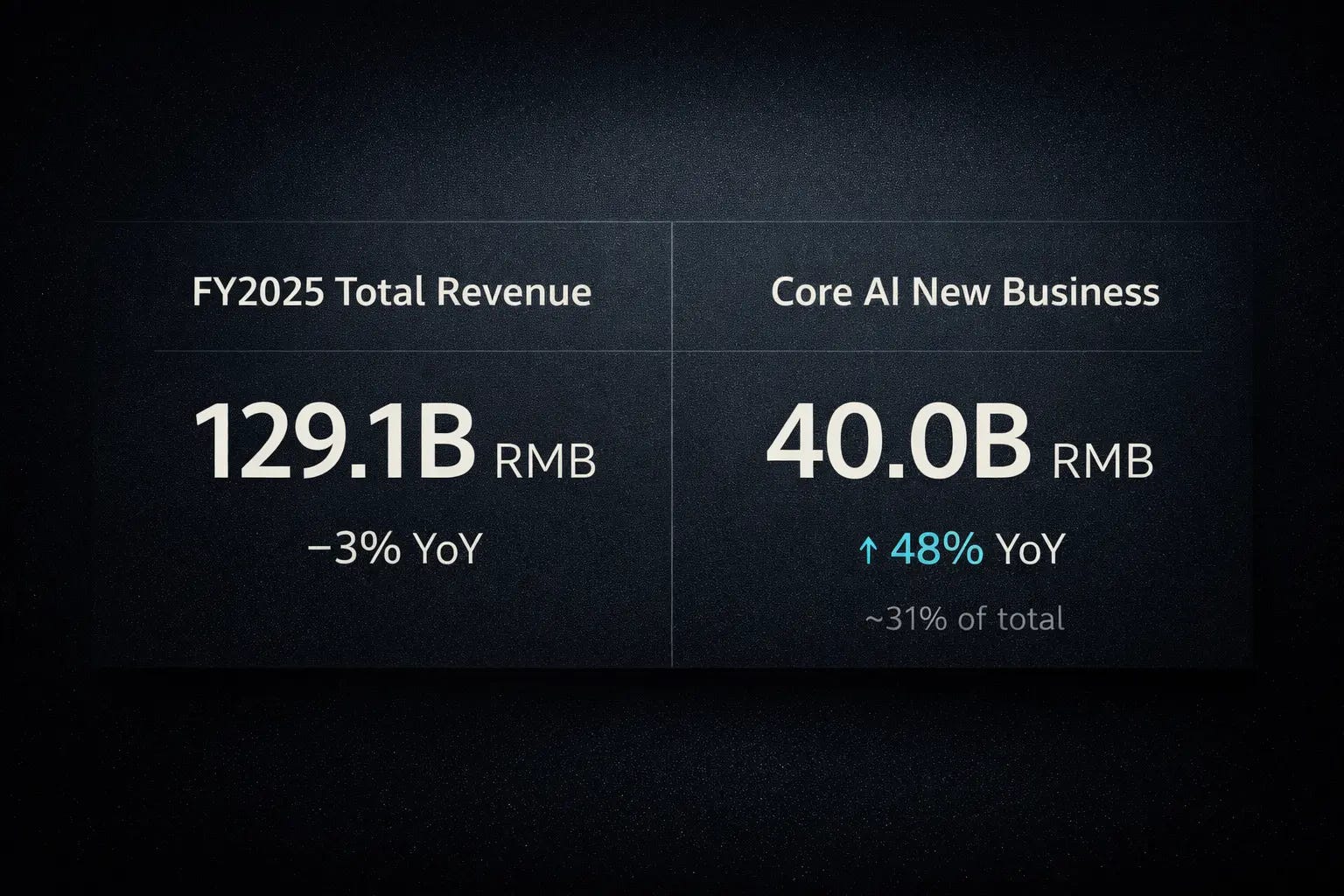
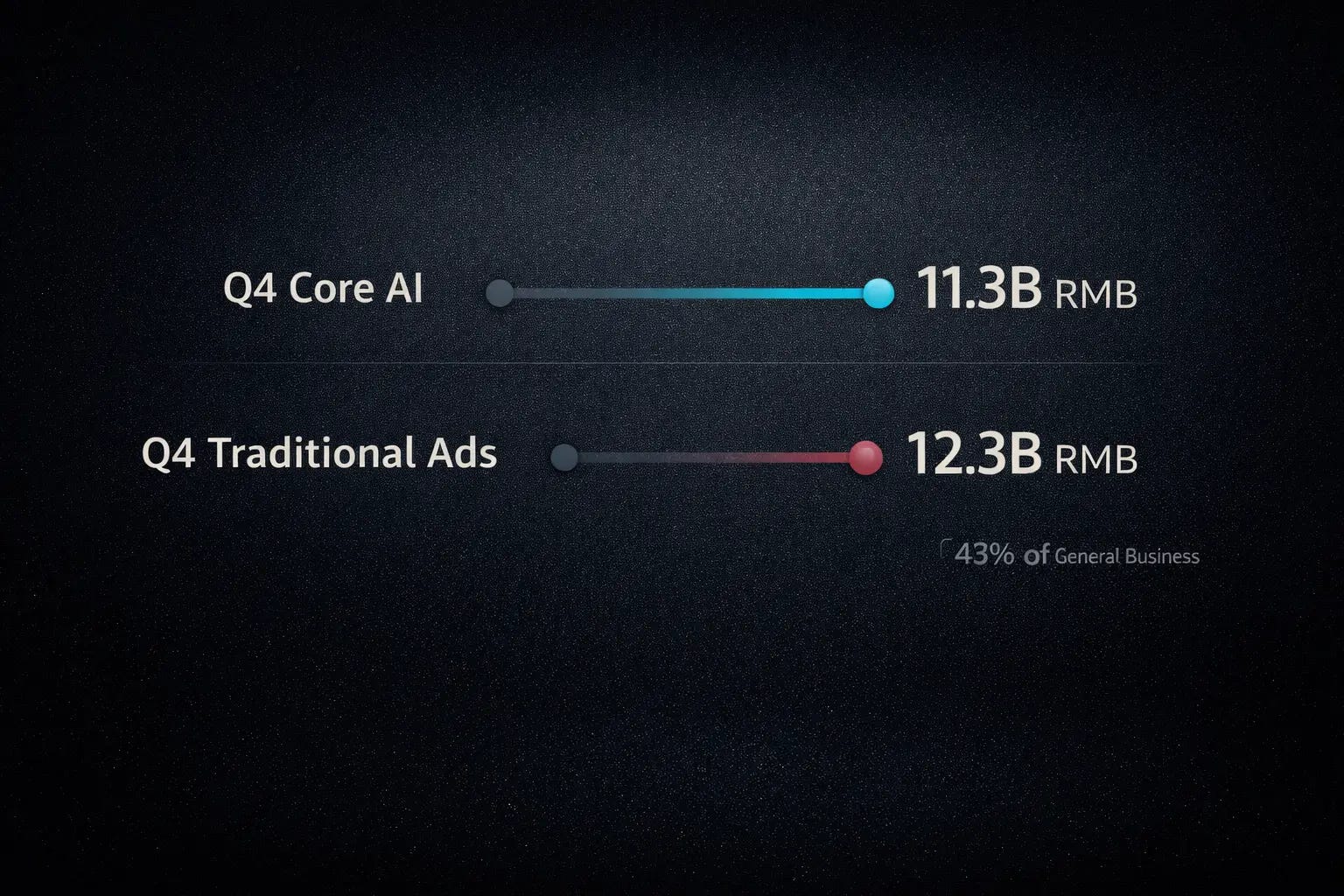
The AI segment tells another story. Baidu’s newly defined “Core AI New Business” covers four components introduced in this earnings report: AI cloud infrastructure, AI applications (such as Wenku and Netdisk), AI-native marketing services (digital humans and intelligent agents), and Apollo Go robotaxi operations. Together these generated RMB 40 billion ($5.8 billion) for the full year, up 48%, accounting for roughly 31% of total company revenue. In Q4, AI revenue exceeded RMB 11.3 billion and reached 43% of “general business” revenue, a metric that excludes the iQIYI streaming subsidiary, up from 26% a year ago under the same framework. Q4 AI revenue of RMB 11.3 billion nearly matched the RMB 12.3 billion from traditional advertising.
The gap between AI growth and overall decline reflects a transition that has become structural. Baidu did not disclose advertising revenue as a standalone line item under its new reporting framework, but analysts have back-calculated from prior disclosures that traditional ad revenue likely fell approximately 15% for the full year and roughly 31% in Q4. The search ad business is eroding faster than AI can fill in.
The segment restructuring echoes Microsoft’s decision to reorganize its reporting around Azure and cloud services. The critical difference is that Baidu’s founding business faces an existential challenge from the very technology it is pivoting toward. Generative AI diminishes the value of traditional search by offering direct answers without the link-based advertising model that sustained Baidu for two decades. Alibaba and Tencent can treat AI as an enhancer for e-commerce and social platforms. For Baidu, AI is simultaneously the future and the force pulling apart the past.
Each of these four segments illuminates a distinct layer of how China monetizes artificial intelligence: cloud infrastructure ($2.9 billion, up 34%), applications ($1.5 billion, up 5%), AI-native marketing ($1.4 billion, up 301%), and autonomous ride-hailing (approximately $29 million). Together they form the clearest financial map of China’s AI economy available today.