

On January 15, Alibaba began dismantling the business model that made Taobao profitable. The demo looked simple: one sentence in Qwen, a delivery order generated through Taobao’s instant commerce channel, payment completed inside the chat interface. The implication is structural. Alibaba is betting that controlling the agent layer outweighs owning the app layer, even if that means compressing the attention-based ad inventory that has historically produced Taobao’s highest margins.
Alibaba framed the upgrade as a broad connection into its consumer stack, spanning Taobao, Alipay, the instant commerce channel, Fliggy, and Amap, alongside “400+” new features meant to move AI from conversation to completion.

This builds on my late November piece on China’s consumer AI race, where I argued China’s consumer AI race had already moved into “execution hell”: the phase where distribution is no longer the bottleneck and reliability becomes the product. January 15 stands out because it represents Alibaba’s clearest attempt to turn that thesis into a transactional interface.
The critical question is whether Alibaba can collapse the app layer into an agent layer without breaking the economics that made Taobao powerful, and without triggering an internal contest over who controls distribution, ranking, and monetization.
What Alibaba actually shipped on January 15
Alibaba’s own description is unusually explicit about scope and intent.
First, the company says Qwen is now “fully connected” to Taobao, Alipay, ShanGou(the instant commerce channel), Fliggy, and Amap, and that it is opening consumer-facing tests for ordering food delivery, shopping, and booking travel through the assistant.
Second, it pulled payment into the agent flow. Alibaba describes a “system-level” connection between Qwen, the instant commerce channel, and Alipay’s native in-chat payment capability, branded as “AI Pay,” enabling checkout without app switching.
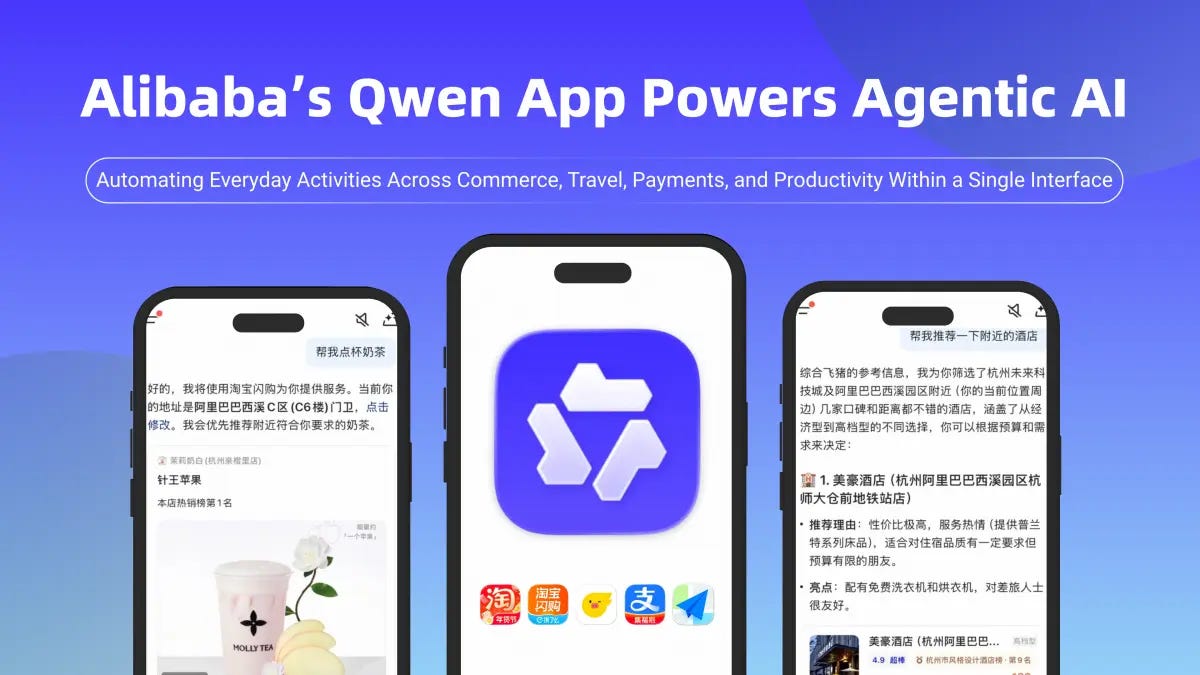
Third, it positioned shopping as an “intent to transaction” pipeline, not a recommendation widget. Qwen helps users decide what to buy and why, drawing on Taobao’s product database and review system, and using transaction and service data to reduce marketing noise and keep recommendations objective.
Finally, it put a public face on the internal coordination. Wu Jia, who leads Qwen’s consumer business, is quoted describing Qwen’s differentiation as the combination of the company’s strongest model and Alibaba’s richest ecosystem. In a separate January interview, he is identified as an Alibaba Group vice president, a useful signal to readers: this is not just an app manager pitching features but an executive advocating for a group-level interface strategy that necessarily cuts across business units.
The real bet: collapsing the app layer into a tool layer
In the mobile era, Taobao’s interface was the business. Search results pages, product listings, and endless browsing were not accidental. They were monetization surfaces that could be auctioned, optimized, and expanded.
An agent interface does the opposite. It compresses attention. It tries to reduce steps, reduce scrolling, and reduce time spent. The “ideal” assistant does not want you to browse. It wants you to finish.
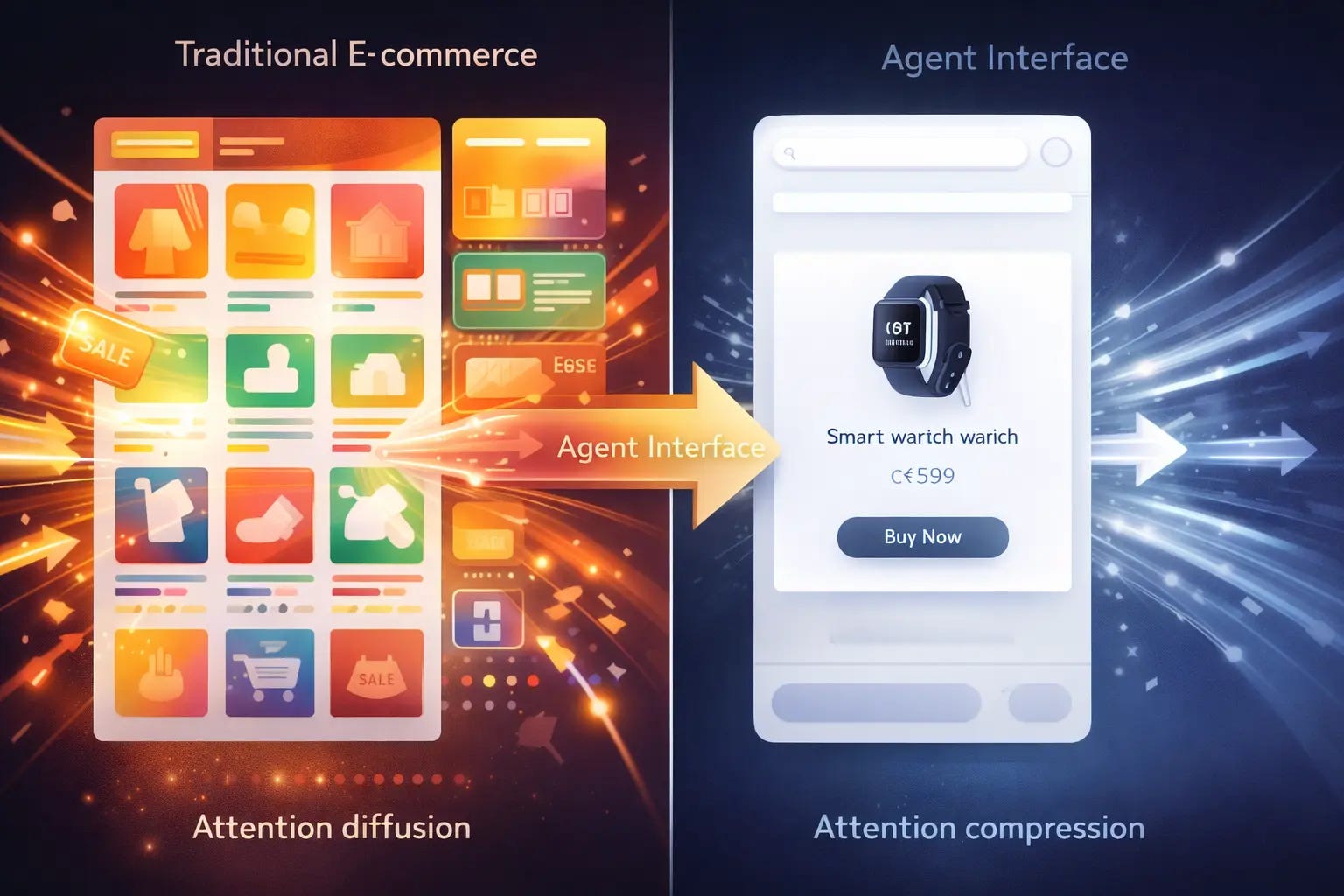
So when Alibaba says Qwen is becoming an AI assistant that can complete “real life complex tasks,” the language signals a structural choice that puts Qwen on a collision path with the legacy economics of e-commerce platforms.
If Qwen succeeds, Taobao becomes more like infrastructure than a destination: the system of record for supply, pricing, and fulfillment, while Qwen becomes the primary consumer interface. That shift creates upside for Alibaba’s ecosystem as a whole, but it can also cannibalize the very surfaces that have historically produced Taobao’s highest-margin revenue.
The upside: a transaction agent with native payment rails
Alibaba’s best-case scenario is compelling because it owns what most AI companies have to rent: payment rails, commerce supply, and high-frequency local services inside one corporate boundary.
Native closure from intent to payment: The in-chat checkout is the critical feature. Alibaba says Qwen can generate an order through the instant commerce channel and complete payment through embedded Alipay “AI Pay,” without a jump to another app. That removes the biggest drop-off points in agent-led commerce: authentication, payment friction, and loss of context during handoff.
A cleaner learning signal than “answers”: Commerce produces verifiable outcomes. Price, delivery time, refunds, disputes, repeat purchases, and basket composition are measurable. Alibaba is leaning into that by arguing Qwen can draw on transaction and service data to filter promotion-heavy noise and maintain objective recommendations. If Qwen can build trust here, it earns something rare in consumer AI: permission to act.
Cross-service composition is an ecosystem advantage: Alibaba also describes Qwen calling into Fliggy for flight and hotel booking and Amap for itinerary planning, plus connecting into public services through Alipay for tasks like visa or social insurance related services. For English-language readers, this explains why “super app” dynamics in China look different: payment apps often double as gateways to daily-life services that, in other markets, are fragmented across websites and agencies.
Alibaba’s advantage is structural: a vertically integrated execution stack that competitors cannot easily replicate in the near term.
Alibaba’s closed-loop advantage has global implications. OpenAI needs partnerships to execute in the physical economy: Instacart for groceries, Uber for rides, Klarna for payments. Each handoff is a trust boundary and a revenue split. Alibaba owns the entire stack.
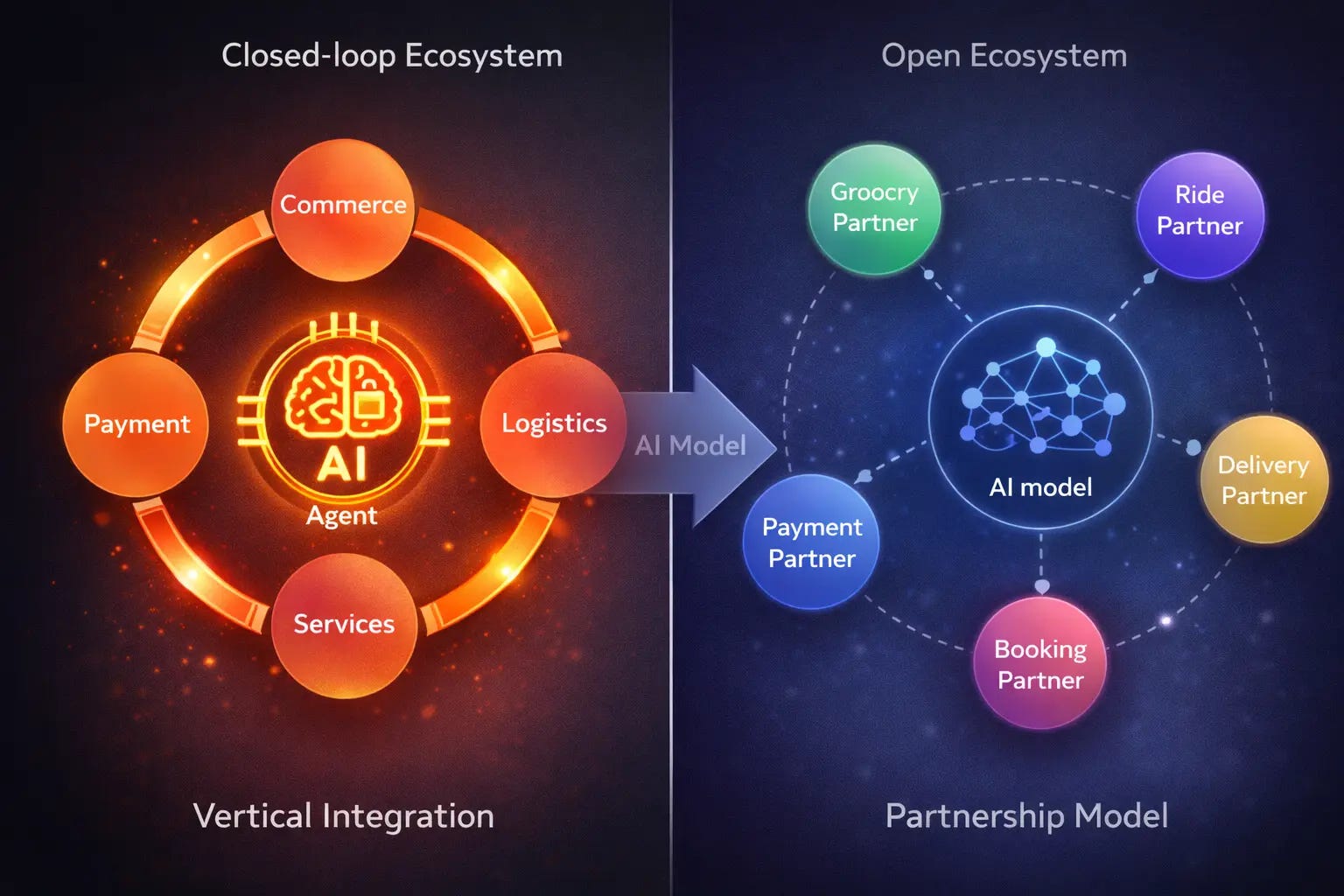
But closed loops can become traps. If Qwen primarily routes to Alibaba properties, it becomes excellent inside one ecosystem and weak everywhere else. Compare Google’s approach with Gemini: open connectors, broader reach, but no native payment rail and weaker closure. The question is whether Alibaba can build Qwen into a platform that third parties want to integrate with, while keeping enough economic capture to justify the investment.
