

On August 20, Alibaba reported a 75% drop in net income. US-listed shares fell 4.6% in pre-market trading, then closed the day at $130.53, up 1.26%. The next day they closed at $119.34. Then on Sunday, August 23, Alibaba announced a HK$80bn ($10.2bn) share placement in Hong Kong to fund AI investment, the largest primary follow-on offering ever by a Hong Kong-listed company. The shares priced at HK$112.70, an 8.4% discount to Friday’s close. In early Monday trading in Hong Kong, the stock fell as much as 10%. Day one shrugged. Day two sold. Day three put a price on the AI bill.
The 75% headline is a poor guide to Alibaba’s quarter. The decline combined operating pressure with weaker investment income: operating profit fell 57%, while lower disposal gains and smaller mark-to-market changes widened the gap in GAAP earnings. Adjusted EBITA fell 30%. The adjusted EBITA decline reflects Alibaba’s deliberate acceleration of AI investment, as management explained on the call.
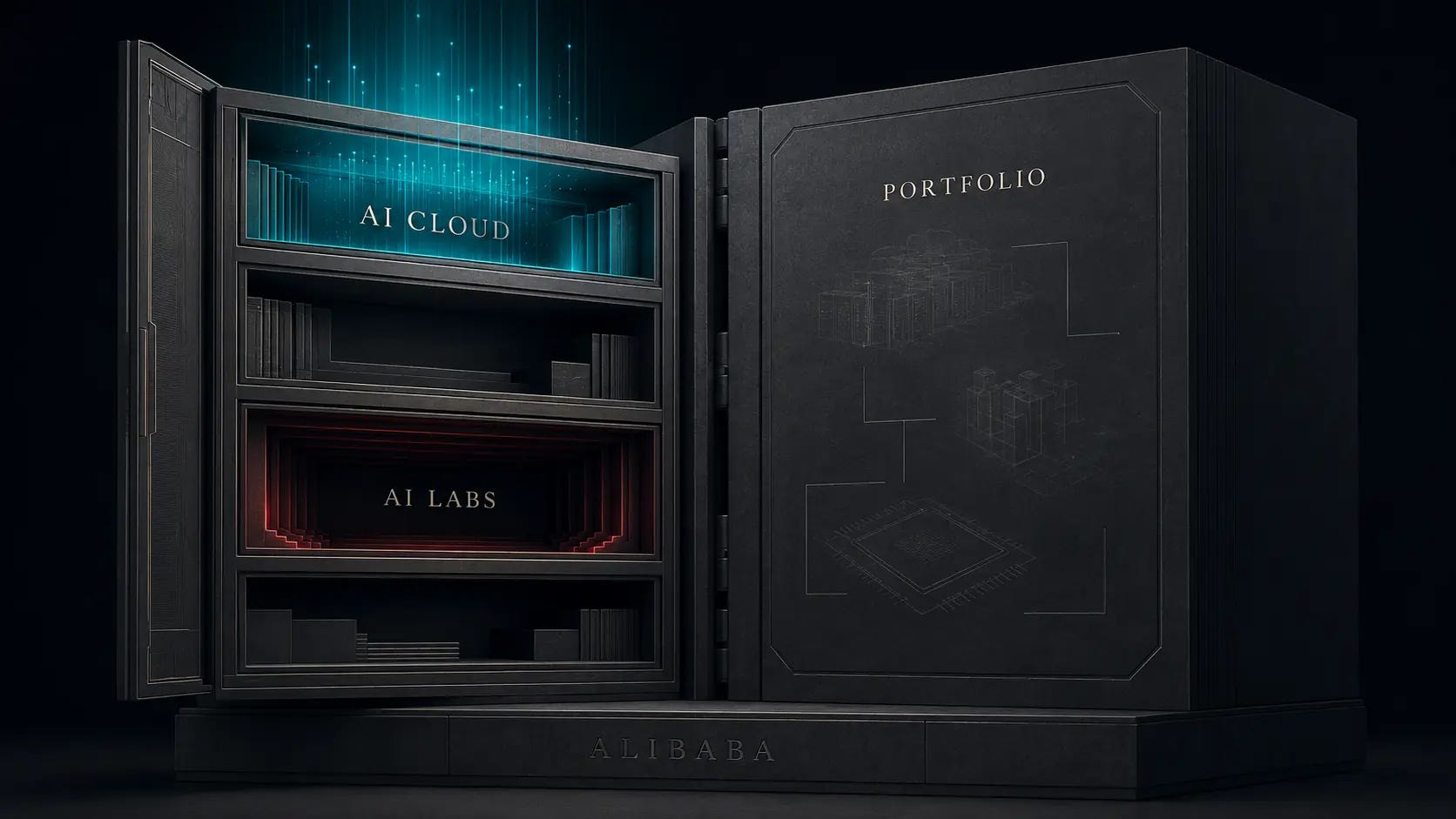
Three weeks ago, I argued that Alibaba’s AI empire had no checkout: equity gains, cloud orders and hardware costs sat in three separate ledgers, and no public filing reconciled them. This earnings report installs half of one. Starting this quarter, Alibaba reorganized its financial disclosures into four segments: Alibaba E-commerce Group, AI Cloud and Compute Services, AI Labs and Applications, and All Others. The restructuring pulled AI model spending out of the opaque “All Others” residual and gave it a visible line. For the first time, investors can see what the infrastructure side earns and what the application side burns.
The half that remains missing is the external portfolio. Alibaba’s AI investments, including stakes in Moonshot and MiniMax, two Chinese frontier AI model companies, and CXMT, China’s leading DRAM manufacturer, still generate paper gains that flow into non-operating income. Cloud orders from portfolio companies remain undisclosed. Hardware-cost relationships go unmapped. The internal AI P&L gained a register. The external one did not.
The Ledger Alibaba Chose to Open
The new segment structure splits Alibaba’s AI business across two reporting lines.
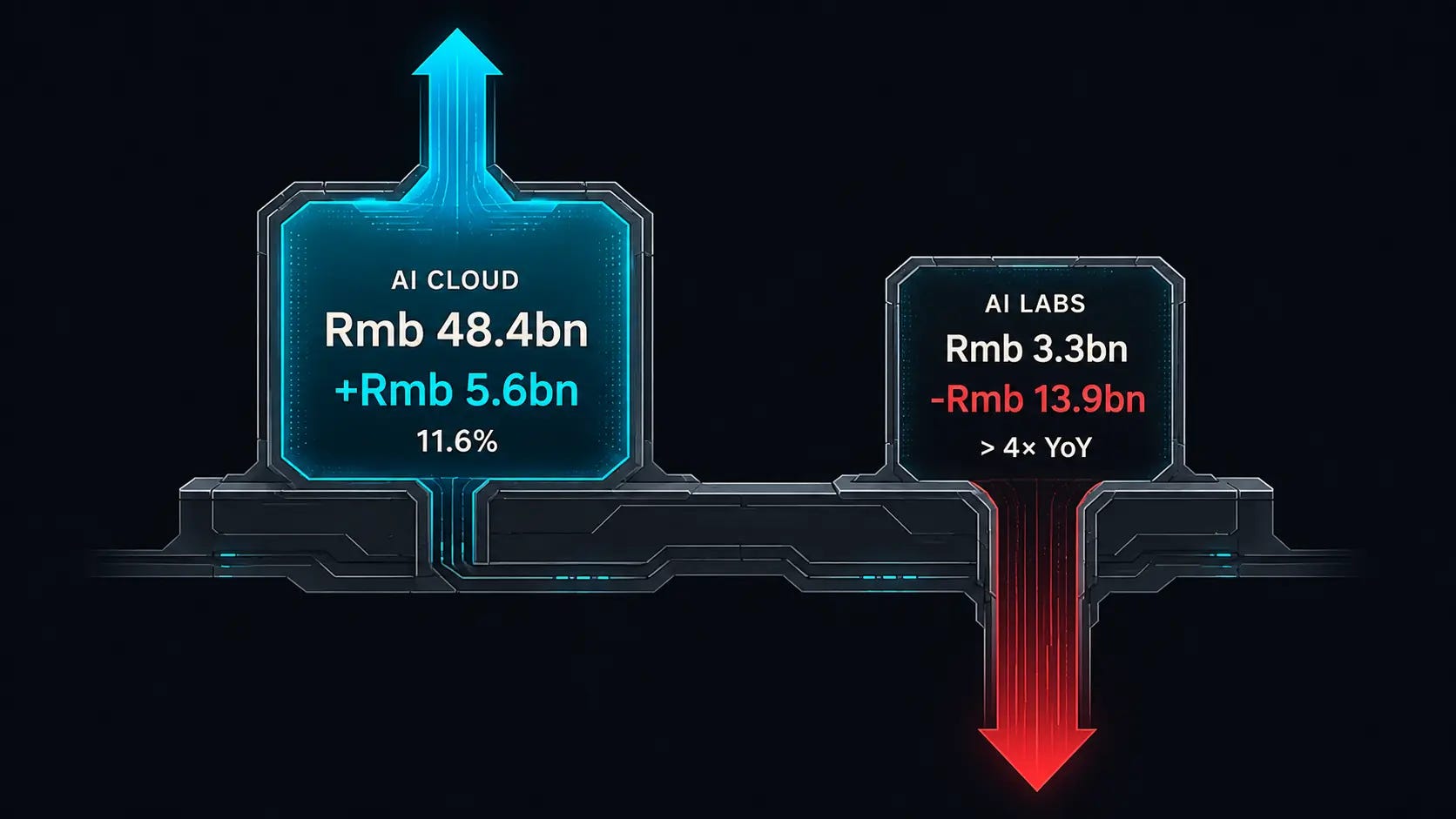
AI Cloud and Compute Services, which combines the Cloud Intelligence Group with chip design unit T-Head, posted revenue of Rmb 48.4bn, up 45% year over year. Growth hit a 22-quarter high. AI-related product revenue reached Rmb 12.4bn, the 12th consecutive quarter of triple-digit growth, now accounting for 35% of external cloud revenue. Adjusted EBITA rose 133% to Rmb 5.6bn. The margin climbed from roughly 7% a year ago to 11.6%.
AI Labs and Applications houses model development, the Qwen consumer app and QwenWork enterprise agents. It reported revenue of Rmb 3.3bn, up 16%, and an adjusted EBITA loss of Rmb 13.9bn. The recast year-earlier loss was Rmb 3.2bn, previously buried inside “All Others” alongside Amap (Alibaba’s mapping and navigation app), Alibaba Health, gaming and other units. The current deficit is more than 4 times as large.
The disclosure points toward one of the five markers I set in July. I asked whether Token Hub, the organizational group CEO Eddie Wu created to unify model services, would become a reporting segment with its own margin. The result is close but incomplete. AI Labs and Applications partially fills that role. But MaaS revenue, the model-as-a-service business Wu has positioned as the cloud’s highest-margin product, still sits inside the cloud line. The register is clearer. It is not yet clean.
The surrounding numbers explain why the segment restructuring appears to have been timed to this quarter. Revenue grew 9% to Rmb 269bn. The E-commerce Group generated Rmb 39.7bn in adjusted EBITA, stable year over year, providing the cash that funds the rest. Quick commerce revenue, which includes Taobao Instant Commerce and Freshippo, grew 45% to Rmb 53.3bn. Alibaba said Taobao Instant Commerce improved unit economics sequentially. Core e-commerce advertising, measured by customer management revenue, fell 7% on a reported basis and grew just 1% on a like-for-like basis after accounting reclassifications. The cash engine still runs. Its output is flat. Like-for-like CMR growth fell from 8% the prior quarter to 1%, a deceleration steep enough to test how long e-commerce profits can keep funding the AI bill.
On the same call, Wu outlined the investment math behind Alibaba’s AI spending: payback periods, asset lifetimes and the conditions under which growth can become cash generative. The model, and the gaps it leaves, sit behind the paywall.
Hello China Tech publishes three analyses a week on China’s AI, chips, robotics, and EVs, built from primary sources rather than second-hand coverage. If the gap between cloud AI profitability and model-layer losses inside a single company is the kind of reading you want more of, subscribe free and get each one as it publishes.