

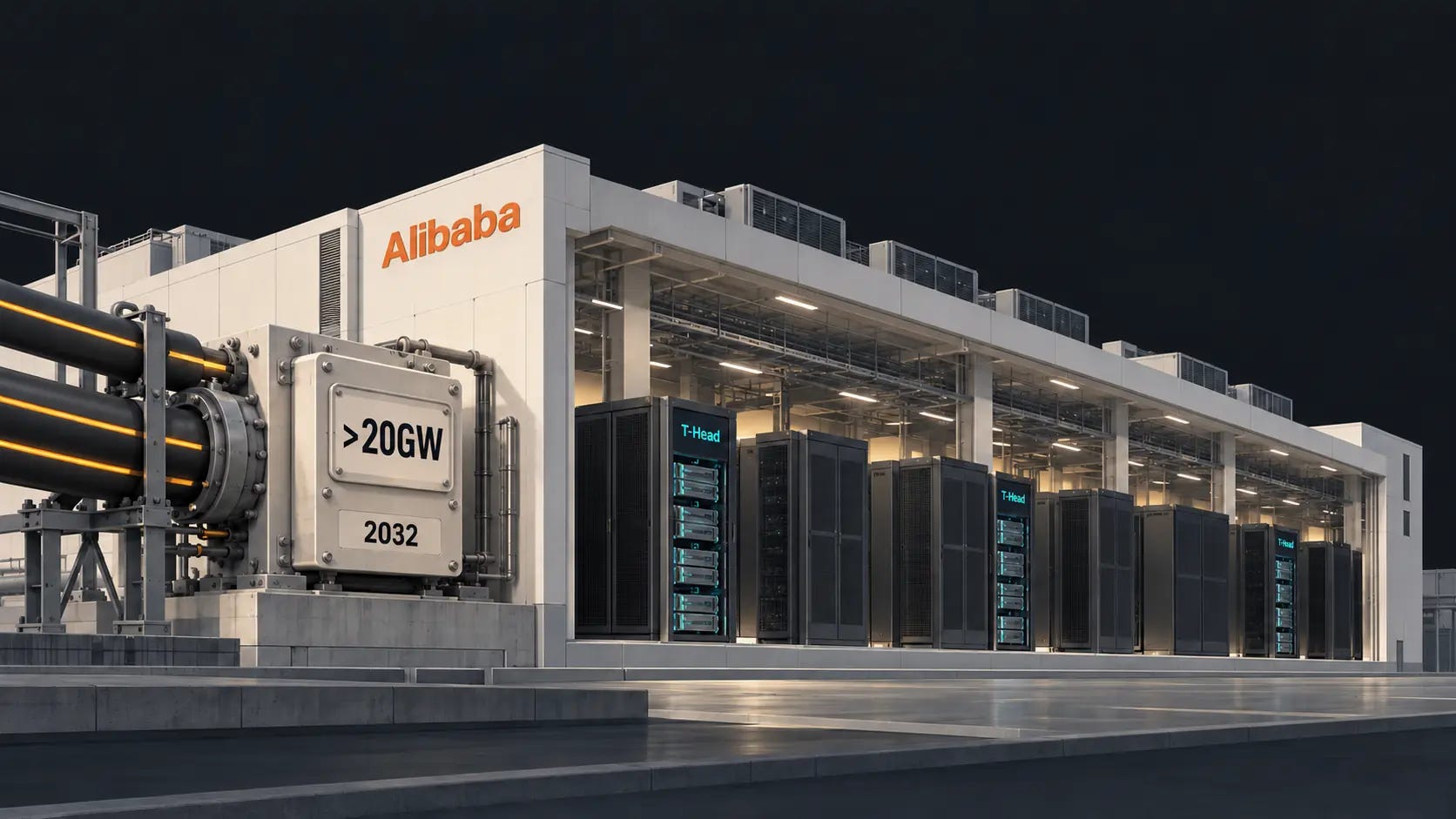
On September 22, Alibaba CEO Eddie Wu set a new target at Apsara, the company’s annual cloud conference in Hangzhou. By 2032, Alibaba Cloud aims to operate more than 20 gigawatts (GW) of data center capacity worldwide. A gigawatt measures electric power, not computing. He gave no spending figure. He said the industry’s demand over the medium and long term far exceeds what Alibaba can supply. A global shortage in the data center supply chain, he said, limits how fast Alibaba can add computing power. Alibaba would build “with all partners.”
Wall Street put forecasts on the target within a day. Wallstreetcn, a Chinese financial news site, summarized the reports. Goldman Sachs put Alibaba’s capital expenditure at Rmb 209bn, Rmb 243bn and Rmb 260bn for the fiscal years ending March 2027, 2028 and 2029. Citi linked the target to about $160bn in external cloud revenue in the fiscal year ending March 2033. UBS put the figure at about $170bn for 2032. All three kept buy ratings.
Those numbers rest on inputs Alibaba has not published. One of the largest is how much of each gigawatt T-Head, Alibaba’s in-house chip unit, can fill with its own chips instead of bought ones. Goldman came closest to saying so. It called T-Head key to the economics of the target. It expects T-Head’s share of Alibaba Cloud’s computing power to rise from about 10% today to about half over the medium term.
My read: the 20GW target is less a promise about power than a bet on T-Head. A power target is easier to announce than a plan to fill it and earn from it. That plan leans on chips whose supply Alibaba called limited as recently as May.
Reading a gigawatt target through the chips that have to fill it is one example of how Hello China Tech reads China’s tech sector: primary sources first, three analyses a week, across AI, chips, robotics, and EVs. Subscribe free to get the next one in your inbox.
An Old Ambition in a New Unit
The scale of the ambition is not new. In May, Alibaba told analysts it would need 10 times its 2022 data center infrastructure by 2033. Wallstreetcn’s summary puts 20GW at about 10 times the 2022 level. If that is right, the new target is close in scale to the May one, one year earlier and in a different unit. Alibaba has not published a conversion between the two measures.
The price has disappeared. In February 2025, Alibaba announced a three-year AI and cloud investment plan of Rmb 380bn. At Apsara in September 2025, Wu said spending would go beyond that figure. In May 2026, management said Alibaba would likely overshoot it. By the end of June, Alibaba had spent Rmb 190bn. In August, it raised HK$80bn in a Hong Kong share placement. It said about 60% would go to global computing infrastructure and about 40% to AI data centers and cloud upgrades. This September, the stage carried no yuan figure at all. Citi noted that Alibaba has not updated the Rmb 380bn guidance.
Goldman puts Alibaba’s current capacity at 5 to 6GW and the pace at 1 to 2GW a year. If Goldman’s starting point and Alibaba’s target measure capacity the same way, closing a gap of 14GW or more in about six years takes more than 2GW a year. For scale, Microsoft said it added more than 2GW in its 2025 fiscal year. The banks had to decide what each gigawatt costs to fill and what it earns.
Goldman expects T-Head chips to supply a much larger share of Alibaba Cloud’s computing. Alibaba has not reported that share. An analyst asked management for it in May. What management said, and why it matters for the 20GW plan, follows below.
